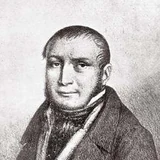
Louis de La Bourdonnais
For nineteen years no one could beat Louis-Charles Mahé de La Bourdonnais, and in the summer of 1834 he proved it in the most exhausting way the century could devise: eighty-five games against Alexander McDonnell, played across six matches in London with no clocks, no rest days and no title to win. He took the series decisively, and chess has treated the result as the unofficial championship of the world ever since. He died six years later, broke, and was buried in London a short walk from the man he had beaten.
◈The Régence
He came from a prominent family — his grandfather had been governor of the Île de France — and learned the game at the Café de la Régence in Paris under Alexandre Deschapelles, the strongest player in France. By 1821 he had passed his teacher, and Deschapelles would only play him at odds thereafter.
From that point onward he was regarded, everywhere the game was followed, as the best player alive. He made his living from chess, which in the 1830s meant stakes, lessons and journalism rather than prizes.
◈Eighty-five games
In 1834 he crossed to London and met Alexander McDonnell at the Westminster Chess Club. What was meant as a match became six of them, eighty-five games in all, played through the summer at a pace that would be considered inhumane now. La Bourdonnais won forty-five, lost twenty-seven and drew thirteen.
The games themselves were a revelation and stayed in the literature for a century — open, sharp, full of pawn storms and queen sacrifices, and far ahead of anything published before. They are the reason both men are remembered, and they are the backbone of this archive.
◈Le Palamède, and the end
In 1836 he founded Le Palamède, the first magazine in the world devoted to chess, and edited it himself. It was the beginning of chess journalism as a trade.
The money went. He lost his inheritance in a property speculation, and by the end of the decade he was living on what the game could pay him, in failing health. He returned to London to take a post with the Westminster Chess Club and died there on 13 December 1840. He was buried at Kensal Green, in the same ground as McDonnell.
◈Legacy
La Bourdonnais is the first player the world agreed to call the best, and the 1834 series is the first great match in the history of the game. The chess in it — direct, attacking, structurally far more sophisticated than its reputation suggests — was studied by Morphy, by Steinitz, and by everyone who came after. He also invented the chess magazine, and then died too poor to be buried at his own expense.