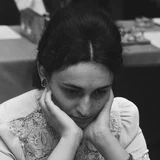
Maia Chiburdanidze became Women's World Champion in 1978, at seventeen, by beating Nona Gaprindashvili 8½–6½, and she held the title for thirteen years. She defended it four times, against Nana Alexandria, Irina Levitina, Elena Akhmilovskaya and Nana Ioseliani, before losing it to Xie Jun in 1991. In 1984 FIDE made her the second woman grandmaster, after Gaprindashvili, and in the 1980s she won tournaments against men at New Delhi and Banja Luka. She played board one in fifteen Women's Olympiads, for the Soviet Union and then for Georgia, and won nine team gold medals.
Kutaisi
Chiburdanidze was born in Kutaisi, in western Georgia, on 17 January 1961. Her older brother taught her chess when she was eight. At ten, in 1971, she won the Georgian schools championship.
In 1973, at twelve, she played for the Soviet Union in a match against Yugoslavia and won all four of her games against Vlasta Maček. The Russian Chess Federation recalls that she was called "the female Fischer". The same year the reigning Women's World Champion, Nona Gaprindashvili, gave a simultaneous exhibition against the country's most talented girls and lost only one game, to Chiburdanidze, who also beat her later that year at the USSR Women's Championship in Tbilisi.
In 1974, at thirteen, she won her first international tournament, the women's event at Brașov, and FIDE made her a Woman International Master. She won the USSR girls' championship in 1976 and the USSR Women's Championship at Lvov in 1977 with 13/17, and became a Woman Grandmaster the same year. From 1976 she was coached by the grandmaster and opening theorist Eduard Gufeld, who was still her trainer when she first visited the United States, in Los Angeles in 1987.
Champion at seventeen
Chiburdanidze finished second at the Tbilisi Interzonal in 1976 with 6½/10, half a point behind Elena Fatalibekova, and qualified for the Candidates matches. She beat Nana Alexandria 5½–4½ in Tbilisi and Elena Akhmilovskaya 6½–5½ in Tallinn in 1977, and in the final at Bad Kissingen in January 1978 she beat Alla Kushnir, who had challenged Gaprindashvili three times, 7½–6½.
A few months before the title match she played in a tournament at Vilnius whose field included Tigran Petrosian and Samuel Reshevsky. Garry Kasparov, writing about Reshevsky in My Great Predecessors, Part IV, notes that Reshevsky drew with "the former chess king and the future queen" there.
The match with Gaprindashvili was played at Pitsunda in 1978. The first three games were drawn, Chiburdanidze won the fourth and fifth, and she won the match 8½–6½ with four wins and two losses. At seventeen she was the sixth Women's World Champion and the youngest, a record that stood until Hou Yifan won the title in 2010.
“I am convinced that a time will come when there will be no distinctions made between men's and women's chess any longer.”
“The champion should be humble but with inner strength.”
“The manner in which Chiburdanidze responds to Gufeld's rather impetuous pawn storm by logical and cool central counteraction is most admirable and worthy of emulation.”
“Maya doesn't suffer from inflated self-importance. She makes it easy to forget that she is a national treasure of the Soviet Union.”
“His games with the former chess king and the future queen (Maya’s victorious match with Gaprindashvili was to begin a few months later!) ended in draws.”
Four defenses
In 1981 Nana Alexandria challenged her in Borjomi and Tbilisi. The match went the full sixteen games and ended 8–8, and the tie kept the title with the champion. In 1984 she beat Irina Levitina by three points in Volgograd, in 1986 she beat Elena Akhmilovskaya 8½–5½ in Sofia, and in 1988 she beat Nana Ioseliani 8½–7½ in Telavi.
In 1991 she met the Chinese challenger Xie Jun in Manila. Chiburdanidze won the fourth and fifth games, but she lost four, and Xie Jun won the match 8½–6½. Chiburdanidze had been champion for thirteen years.
Against men
In 1980 she played in a USSR Championship semifinal in Tallinn and beat Semen Dvoirys with a knight sacrifice, 12.Nd5. In My Great Predecessors, Part III Kasparov calls it "the source game" for that sacrifice in the Najdorf Sicilian and writes that the Baku master Rostislav Korsunsky had shown the idea to Gufeld.
FIDE awarded Chiburdanidze the grandmaster title in 1984; she was the second woman to receive it, after Gaprindashvili. That year she was the only woman in a twelve-player international tournament in New Delhi, and she won it. In 1985 she won at Banja Luka with 8½/13 without a loss, half a point ahead of Ivan Farago, in a field that included Nigel Short, Lev Psakhis and Dragoljub Velimirović.
In 1986 she drew an eight-game match with the Yugoslav grandmaster Petar Popović 4–4. In 1987 she shared third and fourth places at Bilbao and finished second at Brussels. Her rating reached 2560 on the January 1988 list, the highest of her career.
In the 1990s she played in the Women–Veterans tournaments, team events between leading women and former leading men. She was the top scorer at Vienna in 1993 with 9/12, and at Roquebrune in 1998 she had the women's best score, 7½/12, with wins over Lajos Portisch, Vlastimil Hort and the former World Champion Vasily Smyslov. She shared first place at Lippstadt in 1995 and won there outright in 1997.
Olympiads and later years
Chiburdanidze played in fifteen Women's Olympiads between 1978 and 2008, always on board one, and scored 125½ points from 167 games. With the Soviet Union she won gold in 1978, 1980, 1982, 1984 and 1986 and silver in 1988 and 1990, and in those seven Olympiads she lost one game out of 76. With Georgia she won gold in 1992, scoring 11½/13 in Manila, and again in 1994, 1996 and 2008. In Dresden in 2008 she scored 7½/9 with a performance rating of 2715.
She kept trying to regain the title. At the Shanghai Candidates Tournament in 1992 she tied with Nana Ioseliani for second place, and Ioseliani went to the final on tiebreak. At Tilburg in 1994 she shared first place with Susan Polgar, two points ahead of the field, and lost the final to Polgar 1½–5½ in St Petersburg in March 1995. In the knockout championships she reached the semifinals in 2001 and 2004, losing to Zhu Chen and Antoaneta Stefanova, who both went on to win the title. In 2008 she and five other Georgian players did not travel to the championship in Nalchik, Russia, after war broke out between Russia and Georgia.
Chiburdanidze graduated from the Tbilisi Medical Institute. ChessBase reports that she never practiced as a doctor. In 1984 she published Играю против мужчин (I Play Against Men), written with Gufeld and Arsen Eremian.
Legacy
Chiburdanidze held the women's title from 1978 to 1991, after Gaprindashvili had held it from 1962, so that two Georgian players were champion for nearly thirty years in succession. She received the women's chess Oscar each year from 1984 to 1987 and was inducted into the World Chess Hall of Fame in 2014. Georgia gave her the Order of Honor in 1994 and the Order of Vakhtang Gorgasali in 2001, and Tbilisi made her an honorary citizen in 2011. In 2020 she appeared with Gaprindashvili, Nana Alexandria and Nana Ioseliani in the documentary Glory to the Queen.
Books
Books Maia Chiburdanidze wrote, co-wrote, edited, or contributed to. Translations and reprints are grouped under the same work.
-
Играю против мужчин (I Play Against Men)
Coauthor — Eduard Gufeld and Arsen Eremian