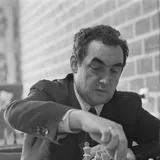
Mark Taimanov combined a grandmaster's career with a concert pianist's. He won the Soviet Championship, defeated six world champions, and recorded with his wife and piano partner Lyubov Bruk. His 6–0 loss to Bobby Fischer in 1971 brought severe Soviet sanctions, including a ban on concerts. In I Was a Victim of Bobby Fischer, he returned to the match with admiration for his opponent and a frank account of his own mistakes. Chess and music both remained part of his life into old age.
Born to two arts
Taimanov was born in Kharkov in 1926 to a Jewish father and a Russian mother, and grew up in Leningrad, where he studied piano as a child. He learned the violin for his role in the 1936 Soviet film Beethoven Concerto. At eleven he joined the chess section of the Leningrad Pioneers' Palace, where he became a pupil of Mikhail Botvinnik.
The biographical appendix to I Was a Victim of Bobby Fischer describes how the war divided his family. In 1941 he and his father were evacuated to Tashkent. His mother stayed in Leningrad with his two siblings, fearing that his infant sister would not survive the journey. They endured the siege until their evacuation in March 1942. After returning to Leningrad, he finished music school and entered the conservatory.
The duo at two pianos
At the Leningrad Conservatory he studied under the pedagogue Samari Savshinsky, and there he met Lyubov Bruk. They married when they were both nineteen and formed a piano duo that became one of the leading two-piano partnerships in the Soviet Union, touring and recording the four-hand and two-piano repertoire.
In his 2002 interview with Joel Lautier, Taimanov recalled that their concert career expanded abroad after a Soviet tour in 1950. Their recordings later appeared in Philips' Great Pianists of the 20th Century series. He explained that alternating between concerts and chess gave him a rest from each profession and helped him recover from setbacks in the other.
Music also supplied comparisons for his chess writing. In the Russian Karpov–Kasparov World Championship Match (1986), written with Yuri Averbakh, he compared judging their first match from its results alone to imagining an opera from its libretto without hearing the music or seeing the performance. The publisher's foreword describes the two authors spending game-day evenings in the press center, taking part in collective grandmaster analysis.
“Well, I still have my music.”
“As I used to say, when I gave concerts I was taking a rest from chess and when I played chess, I was resting from the piano. As a result, my whole life has been one long holiday!”
“I recall the match with Fischer not only without bitterness, but as the brightest significant event in my biography.”
“In the children’s school, it is not necessary to grow large grandmasters. It is important to teach children to love chess.”
“It is only with the years one comes to understand that the better position you have, the more accurately you must play, as the sense of mortal danger imbues the defender with terrific resourcefulness.”
“The 6–0 result was too much. The battle was more difficult than the final score would indicate.”
“Taimanov’s sporting appearances were rich in ups and downs, but he always created and fought to the end.”
“He was a very positive person.”
“That's how he was. A man who loved life.”
Among the champions
Taimanov became an International Master in 1950 and a Grandmaster in 1952. Bernard Cafferty's narrative in The Soviet Championships (1998), for which Taimanov selected and annotated the games, follows his rise in the national championship: joint last on his debut in 1948, he was equal third a year later. In the 1952 championship he led throughout the second half, but World Champion Mikhail Botvinnik caught him by winning his last three games, then won their six-game playoff in February 1953 by 3½–2½. Taimanov played in the 1953 Zurich Candidates tournament and appeared in a record 23 Soviet Championship finals, a total matched by Efim Geller.
In Leningrad in 1956 he came straight from the Hastings tournament with no rest days and began slowly, but he finished level with Yuri Averbakh and Boris Spassky, the first three-way tie in the championship's history. He won the match-tournament for the title with 3 points to Averbakh's 2½ and Spassky's ½. In his notes to his win over Isaak Boleslavsky from that championship, he blamed his “fresh impulsiveness” for putting off the win. At Erevan in 1962 he won five games in a row and finished half a point behind Viktor Korchnoi.
Artur Yusupov remembered his ease in positional play; Tal, in an assessment reproduced in Taimanov's memoir, emphasized his willingness to enter sharp positions with chances for both sides. Across his career he defeated six men who held or would hold the world title: Botvinnik, Smyslov, Tal, Petrosian, Spassky and Karpov. The Taimanov Variation of the Sicilian bears his name, as do lines in the Modern Benoni and Nimzo-Indian Defense.
Preparing for Fischer
The 1969 USSR Championship was also the Soviet zonal, and Taimanov only just reached the four qualifying places by beating Anatoly Lutikov with his Sicilian in the last round. In his notes he admitted that an impulsive check (“tension, nerves!”) had turned the game into tactical chaos, and added: “Had I not made this mistake, there would be one most striking and memorable game less in my collection!” A strong year in 1970 brought Taimanov back to the Candidates: he won at Wijk aan Zee, beat Wolfgang Uhlmann in their board-seven encounter in the USSR–World match, and qualified from the Palma de Mallorca Interzonal. Drawing Fischer as his quarterfinal opponent did not discourage him. In I Was a Victim of Bobby Fischer, he recalled welcoming the chance to test himself against the strongest player in the world.
Botvinnik helped him prepare and recommended Yuri Balashov as a second alongside Evgeny Vasiukov. Taimanov had wanted Tal, whose company he later felt would have helped him through the match. Botvinnik prescribed training games in which the two seconds could consult each other, move the pieces, use reference books, and take an extra hour. To curb Taimanov's habit of replying impulsively, he suggested a one-minute sandglass beside the clock and sitting on his hands until he had thought about his reply.
Vancouver, 1971
The 1971 Candidates quarterfinal in Vancouver was scheduled for ten games. Fischer won the first six, ending the match without a draw. Taimanov's memoir describes missed opportunities and the mounting strain of playing him. After losing the third game and then the resumed second game, he needed hospital treatment for high blood pressure and the match paused for three days. Fischer himself acknowledged that the struggle had been harder than the score suggested.
One small dispute during the match was settled between the players themselves. As Kasparov recounts in My Great Predecessors, Part IV, Fischer objected to Taimanov’s pacing during game three, although the arbiter said it was allowed. Taimanov agreed to sit if Fischer would stop shaking his leg; both kept the agreement.
Robert Byrne's report, reprinted in the book, records Taimanov's comment to Fischer after the match: “Well, I still have my music.” The sanctions came afterward. Soviet authorities stripped him of the title Honoured Master of Sport, removed him from the national team, barred foreign tournament travel for almost two years, and prevented him from writing or giving concerts. A Solzhenitsyn novel and money he was carrying from Max Euwe to Salo Flohr provided the customs pretext. The declassified documents reproduced in the memoir identify the novel as In the First Circle and the money as Flohr's fee for articles published abroad.
Taimanov believed that Larsen's subsequent 6–0 loss to Fischer weakened the accusations against him. He later wrote about the match in his 1993 memoir, published in English in 2021 as I Was a Victim of Bobby Fischer, translated by Douglas Griffin. Despite the defeat and the punishment, he remembered the match with admiration for its chess and without bitterness toward Fischer.
One long holiday
In April 1973 a Sports Committee document titled “GM Draws are outside the Law” criticized Spassky, Petrosian and Taimanov by name for lack of effort, but the authorities allowed him to travel again for that year's Interzonal. He resumed both careers, although rebuilding his concert work was difficult after his separation from Bruk. He continued writing about the Sicilian, annotated the games for The Soviet Championships, and won the World Senior Championship in 1993 and 1994. His description of alternating between music and chess — “one long holiday” — appears in the memoir's biographical appendix.
In the April 2016 interview included in the book, Taimanov discussed the chess school bearing his name in Saint Petersburg. He stressed the value of experienced children's coaches and teaching pupils to love the game. He married four times and became the father of twins at seventy-eight, fifty-seven years after his oldest child was born. He died in Saint Petersburg on 28 November 2016, aged ninety.
Legacy
Taimanov's opening ideas, games, and books remain part of chess study, while his recordings with Bruk preserve their piano partnership. His account of the Fischer match gives both the losing player's analysis and a record of the pressure Soviet players faced. He returned to concerts and international chess after the sanctions and later encouraged children to enjoy the game.
Books
Books Mark Taimanov wrote, co-wrote, edited, or contributed to. Translations and reprints are grouped under the same work.
-
Межзональный шахматный турнир в Стокгольме 1952 года: Сборник партий
Contributor — game annotations
-
Slawisch bis Reti-Eröffnung
Author
-
Damengambit bis Holländisch
Author
-
Modernes Benoni bis Wolga-Gambit
Author
-
Holländisch bis Bird-Eröffnung
Author
-
Sicilian: Paulsen
Author
-
Königsindisch bis Altindisch
Author
-
Damenindisch bis Katalanisch
Author
-
Englisch: Klassisch bis seltene Systeme
Author
-
Königsindisch: Sämisch-Systeme bis Vierbauernvariante
Author
-
Защита Нимцовича
Author
-
World Chess Championship: Karpov–Kasparov, Moscow 1985
Coauthor — Yuri Averbakh
-
The Sicilian Defence: Taimanov System
Author
-
Winning with the Sicilian
Author
-
Taimanov's Selected Games
Author
-
The Soviet Championships
Coauthor — Bernard Cafferty
-
Шахматная Академия: 24 лекции (Chess Academy: 24 Lectures)
Contributor — lectures on flank attacks and the hanging pawn centre
-
Taimanows Schachschule
Author
-
I Was a Victim of Bobby Fischer
Author