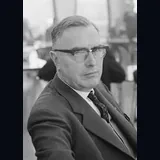
Max Euwe never let chess become his whole life, and that is what makes his story unusual. He was a doctor of mathematics, a schoolteacher, a husband and father who played chess on weekends and evenings, and for two years he was world champion. In the autumn of 1935 this courteous Dutch amateur did what no professional had managed in eight years: he took the title from Alexander Alekhine. He won it and lost it graciously, and spent the rest of a long life giving back to chess: seventy books, a generation of pupils, and in the end a FIDE presidency remembered as one of the most principled the game has had.
The mathematician from Watergraafsmeer
Machgielis Euwe — Max to everyone — was born in the Watergraafsmeer district of Amsterdam on 20 May 1901. He learned the moves as a small boy and played his first tournament at the age of ten, reportedly winning every game; but chess was never allowed to crowd out the rest of his mind. He read mathematics at the University of Amsterdam under the shadow of the great intuitionist L. E. J. Brouwer, and in 1926 took his doctorate under Roland Weitzenböck. He taught mathematics in Rotterdam and then at a girls' lyceum in Amsterdam, and he carried that teacher's clarity to the board for the rest of his life.
He remained, by choice, an amateur — a player who earned his bread elsewhere and came to the sixty-four squares unbought and unhurried. In 1928 at The Hague he won the World Amateur Championship with a commanding 12 out of 15, and across three decades he would take the Dutch national title a record twelve times. The professional world began to understand that the polite professor from Amsterdam was something more than a gifted dilettante.
The road to the title
Through the late 1920s and early 1930s Euwe tested his logical, well-prepared style against the strongest opponents alive. He had a mathematician's appetite for variations and would walk into the wildest complications when his calculation told him they were sound. Garry Kasparov's My Great Predecessors, Part II records his victory at Hastings 1930–31: 7 out of 9, half a point ahead of José Raúl Capablanca. Their ten-game match in July 1931 was a different matter: Capablanca won 6–4, with two wins and eight draws.
At the end of 1933 Euwe was planning to leave chess for a few years and concentrate on mathematics. In the same chapter he recalls a chance meeting with Hans Kmoch in a café. Kmoch convinced him that thorough preparation could give him a chance against Alexander Alekhine, and Euwe decided to challenge for the title. His preparation combined physical training, opening study and practical play: he swam, boxed, played tennis and took cold showers while building his opening repertoire.
“Strategy requires thought, tactics require observation.”
“Whoever sees no other aim in the game than that of giving checkmate to one's opponent, will never become a good chess-player.”
“Yes, Hein, that is so, but you shouldn’t forget that I understand chess better than the three of you put together ...”
“Botvinnik’s comments always gave food for thought and they sometimes forced me to change my decisions. Differences of opinion never interfered with our friendship.”
“Euwe was undoubtedly the best President of FIDE in all the history of this organisation!”
“He was the last honourable president of FIDE.”
“Euwe won the 1935 match on merit.”
“Thorough preparation, exceptional concentration, strength of will – this is what we learned from Euwe.”
The Pearl and the crown
The 1935 World Championship match ran from 3 October to 15 December, a marathon of thirty games carried across thirteen Dutch cities — it was the first title match in which the players used seconds to help analyse adjourned positions. Alekhine started like the champion he was, winning games one, three, four, seven and nine to open a daunting lead. Then the tide turned. Euwe steadied, struck back, and game by game hauled himself level and ahead.
Game twenty-six, played at Zandvoort, became famous as the Pearl of Zandvoort — a bold, creative win that is still cited as one of the finest games of the entire match. When the dust settled, Max Euwe had won 15½–14½ and become the fifth World Chess Champion, and the only Dutchman ever to hold the title. A nation that had never produced a champion suddenly had one, and chess clubs sprang up across the Netherlands in his wake.
Reign, rematch, and a logical art
Euwe held the title the way he did everything, with modesty and good humor. He was admired for the clarity of his play and for an opening knowledge so thorough that he changed theory in several lines. But his contemporaries also noticed that his even temper could cost him: Gennadi Sosonko thought Euwe's modesty was a handicap at the top level, and the champion sometimes lacked the ruthlessness to fight on in a position that had gone wrong.
The rematch came in 1937, and a transformed Alekhine — who had given up alcohol and tobacco to prepare — reclaimed the title decisively, 15½–9½. Euwe accepted the loss without bitterness and simply kept playing and, above all, kept teaching. He went on to write more than seventy chess books — more than any other World Champion — including The Road to Chess Mastery (with Walter Meiden), Judgment and Planning in Chess and Strategy and Tactics in Chess. His instructional work Practische Schaaklessen became a textbook even in the Soviet chess schools that produced his rivals. Two of his courses, a set of lessons for beginners and a course of lectures for rated club players, appeared in Russian in the early 1930s and reached third editions; a Moscow publisher collected both in 2003 as Uchebnik shakhmatnoy igry, calling them bibliographic rarities. The lecture course starts from his view that every player's development repeats the history of the game, so the lectures move in order from Greco and Philidor through Anderssen and Morphy to Steinitz.
His books grew out of teaching and collaboration. In the preface to De beginselen van alle schaakspel (1939), the revised edition of his De fundamenten van het schaakspel (1931), he explains that the book writes up the lectures he gave in the 1930–31 course at the Volksuniversiteit, the adult-education institutes of Amsterdam and The Hague. In it he argues that misjudging a feature of a position teaches a player something he can use again, while a miscalculation teaches little, because the same position may come up once in a thousand, the same feature once in ten. In the foreword to Strategy and Tactics in Chess, he traces that book to lectures he gave in Amsterdam in 1934.
In the signed preface to Judgment and Planning in Chess, he recalls meeting J. du Mont at Plymouth in August 1948: du Mont suggested a book to guide players after their opening knowledge ran out. M. Blaine and J. F. S. Rumble, who had conceived The Logical Approach to Chess while serving with the RAF in Ceylon, showed him their manuscript during the Hastings Congress of 1949–50, and he undertook to revise it. In his preface he admits that at first he hesitated, “for I felt some scruples because my share of the labour would not be in proportion to that of the other authors.” He agreed when he realized that he could “subscribe to every word of the text in its final form.” Euwe and Meiden's preface to The Road to Chess Mastery describes twenty-five master–amateur games chosen to explain the reasons behind moves. The amateurs grow stronger through the collection and win its final three games.
The honourable president
In 1970, at the age of sixty-nine, Euwe took on the presidency of FIDE, the world chess federation, and gave the game one last great service. Where chess politics ran on Cold-War expediency, he insisted on principle. He interpreted the rules flexibly to bring Bobby Fischer into the cycle that produced the epochal 1972 match against Spassky; he defended the right of defectors such as Viktor Korchnoi and Gennadi Sosonko to compete; and in 1977 he ruled that women could not be barred from open events.
A mathematician who had become a professor of the new science of computing, Euwe was also an early believer in computer chess, taking the machines seriously long before they could beat a master. He served until 1978. The assessments collected in Kasparov's My Great Predecessors, Part II differ: Averbakh praises his tact and fairness, and Kasparov records Korchnoi remembering him as one of FIDE's last honest presidents. Karpov supports his efforts to spread chess but criticises the inflation of grandmaster titles. Kasparov, in turn, faults his handling of the 1978 match in Baguio.
Legacy
Max Euwe died of a heart attack in Amsterdam on November 26, 1981, aged eighty. He had been appointed Officer of the Order of Orange-Nassau in 1936 and promoted to Commander in 1979. Amsterdam remembers him at the Max Euweplein, a square with a giant outdoor chessboard and his statue, beside the Max Euwe Centrum, which houses one of the world's great chess libraries. He is honored on two counts: as the amateur who reached the top of a professional's game on his own quiet terms, and as the rare administrator who put integrity above power. The schoolteacher from Watergraafsmeer gave chess a champion, a teacher and a conscience.
Books
Books Max Euwe wrote, co-wrote, edited, or contributed to. Translations and reprints are grouped under the same work.
-
Schaken
Coauthor — José Raúl Capablanca
-
A Guide to Chess Endings
Coauthor — David Hooper
-
Algebraïsche en geometrische invarianten
Author
-
Bedrijfsvoering met de computer, Deel 1
Coauthor — J. D. Albarda
-
From Steinitz to Fischer / Fischer en zijn voorgangers
Author
-
De bouwsteenen van onze bekwaamheid in het schaakspel
Author
-
De bouwstenen van de schaakkunst
Author
-
Meneer Caïssa / Caissas Weltreich
Coauthor — B. Spaak
-
Chess Master and Grandmaster / Chess Master vs. Chess Master
Coauthor — Walter Meiden
-
Chess Master vs. Chess Amateur / Meester tegen amateur
Coauthor — Walter Meiden
-
The Road to Chess Mastery / Amateur wordt meester
Coauthor — Walter Meiden
-
Computer en ethiek
Author
-
The Development of Chess Style / Veldheerschap op de vierenzestig
Author — revised with John Nunn
-
De fundamenten van het schaakspel
Author
-
H. G. M. Weenink
Coauthor — Meindert Niemeijer, Alexander Rueb and B. van Trotsenburg
-
Hoger onderwijs in de informatica
Author
-
Hogeschool van het eindspel
Author
-
Inleiding tot computer en automatisering
Author
-
Judgement and Planning in Chess / Oordeel en plan
Author
-
Kunnen computers denken?
Author
-
The Logical Approach to Chess / Schaak met verstand
Coauthor — M. Blaine and J. Rumble
-
Meet the Masters / Zóó schaken zij!
Author
-
Het middenspel, Deel 1: De relatieve waarde der stukken, centrumformaties, diverse pionformaties
Coauthor — Haije Kramer
-
Het middenspel, Deel 2: De strijd om open lijnen, zwakke pionnen, het initiatief
Coauthor — Haije Kramer
-
Het middenspel, Deel 3: Typen van koningsaanval, de verdediging, het laveren
Coauthor — Haije Kramer
-
Het middenspel, Deel 4: De afwikkeling, bekende tekortkomingen, de individuele stijl
Coauthor — Haije Kramer
-
Neue Schach-Teste
Coauthor — Willem Muhring
-
Positiespel en kombinatiespel / Positions- und Kombinationsspiel im Schach
Author — German translation by Kurt Richter
-
De praktijk van het schaakspel III
Author
-
Het schaakphenomeen José Raoul Capablanca y Graupera
Coauthor — Lodewijk Prins
-
Volledige handleiding voor het schaakspel / Schach von A–Z
Author — translated and adapted by Kurt Richter
-
Schaken in de strandstoel
Coauthor — Willem Muhring
-
Schaken in de wachtkamer
Author
-
Schaken op reis
Coauthor — Willem Muhring
-
Stelling, plan en combinatie
Author
-
Strategie en taktiek in het schaakspel / Strategy and Tactics in Chess
Author
-
Vervolgcursus Schaken: De match van de eeuw
Coauthor — Willem Muhring
-
Wetenschap en computer
Author
-
Wit speelt… en wint!
Author
-
Zo leert u goed combineren, Serie 1
Coauthor — Willem Muhring
-
Zo leert u goed combineren, Serie 2
Coauthor — Willem Muhring
-
Zo leert u goed schaken, Eerste serie
Coauthor — Willem Muhring
-
Zo leert u goed schaken, Tweede serie
Coauthor — Willem Muhring
-
Zo leert u goed schaken, Derde serie
Coauthor — Willem Muhring
-
Zo leert u goed schaken, Vierde serie
Coauthor — Willem Muhring
-
Theorie der schaakopeningen, Deel I: Damegambiet I
Author
-
Theorie der schaakopeningen, Deel II: Damegambiet II
Author
-
Theorie der schaakopeningen, Deel III: Damegambiet III
Author
-
Theorie der schaakopeningen, Deel IV: Indisch I
Author
-
Theorie der schaakopeningen, Deel V: Indisch II
Author
-
Theorie der schaakopeningen, Deel VI: Diverse antwoorden op d4
Author
-
Theorie der schaakopeningen, Deel VII: Réti-complex
Author
-
Theorie der schaakopeningen, Deel VIII: Half-open spelen I
Author
-
Theorie der schaakopeningen, Deel IX: Half-open spelen II
Author
-
Theorie der schaakopeningen, Deel X: Open spelen I
Author
-
Theorie der schaakopeningen, Deel XI: Open spelen II
Author
-
Theorie der schaakopeningen, Deel XII: Open spelen III
Author
-
Het Eindspel no.1: de koning alleen
Author
-
Het Eindspel no.2: stukken tegen pionnen I
Author
-
Het Eindspel no.3: stukken tegen pionnen II
Author
-
Het Eindspel no.4: stukken tegen stukken I
Author
-
Het Eindspel no.5: stukken tegen stukken II
Author
-
Het Eindspel no.6: stukken en pionnen tegen stukken of pionnen I
Author
-
Het Eindspel no.7: stukken en pionnen tegen stukken of pionnen II
Author
-
Het Eindspel no.8: pionneneindspelen
Author
-
Het Eindspel no.9: praktische eindspelen I (met torens)
Author
-
Het Eindspel no.10: praktische eindspelen II (met dames,paarden of loopers)
Author
-
Het Eindspel no.11: praktische eindspelen III (met torens en lichte stukken)
Author
-
Het Eindspel no.12: praktische eindspelen IV (met ongelijksoortig materiaal)
Author
-
Schaken zonder bord
Coauthor — Willem Muhring
-
Учебник шахматной игры: Уроки шахматной игры; Курс шахматных лекций
Named author on omnibus title and title verso; author of the later lessons and lecture course, reviser of earlier Den Hertog lessons
-
Oom Jan leert zijn neefje schaken
Formally credited coauthor; contribution caveat, possibly name lent for chess promotion