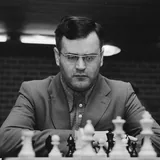
Belgrade in the 1960s was one of the great chess cities of the world, and for two decades Milan Matulović was one of the players who made it so: a sharp attacker ranked just behind Svetozar Gligorić and Borislav Ivkov in Yugoslavia, who beat nearly everyone ahead of him at one time or another. He won the national title twice, played for Yugoslavia in five Olympiads with a score of 76.9 percent that still ranks among the ten best in the history of the event, and in the summer of 1958, aged twenty-three, sat down against a fifteen-year-old American named Bobby Fischer and won. He was also the most controversial figure of Yugoslavia's golden age of chess, a grandmaster whose name became attached in chess folklore to a single French word.
A Belgrade boy in the golden age
Milan Matulović was born in Belgrade on 10 June 1935, in the Kingdom of Yugoslavia, and he came of age in a country about to become one of the two great chess powers of the world. The earliest score sheet the archive holds of his is from Kragujevac in 1949, when he was not yet fifteen; by February 1955 he was already contesting the final of the Yugoslav Championship against the men who would define the era — Gligorić, Ivkov, Aleksandar Matanović, Petar Trifunović. It was the hardest apprenticeship available anywhere outside the Soviet Union.
The titles came in order. International Master in 1961, the year he took first place at Netanya, his first international tournament win; Grandmaster in 1965, the year he first became champion of Yugoslavia. In between came wins at Vršac in 1964 and at Novi Sad and Belgrade in 1965. He would go on to win Reggio Emilia 1967/68, share first at Sarajevo 1971 with David Bronstein and Milko Bobotsov, and win Birmingham 1975, Helsinki 1981 and a long line of Yugoslav tournaments, and by July 1971 he stood 47th in the world, with a peak rating of 2530 reached in May 1974.
The American boy
In July 1958 a fifteen-year-old from Brooklyn arrived in Yugoslavia to acclimatise before the Portorož Interzonal, and was given a four-game training match in Belgrade against a twenty-three-year-old master with a reputation for sharpness. Bobby Fischer took the match 2½–1½ — but Matulović won one game and drew another, and the game he won is in this archive: a King's Indian Sämisch, played on 18 July 1958. Very few players who ever lived can say they beat Fischer in his first formal games on European soil.
The two kept crossing. At the strong Skopje tournament of 1967 Matulović shared second place with Efim Geller, half a point behind Fischer. At Vinkovci in 1968 he finished second, again behind Fischer. And in 1970, at Herceg Novi, he took his seat in the twelve-man double-round blitz event since remembered as the first unofficial world championship of speed chess — a field of Fischer, Tal, Korchnoi, Petrosian, Bronstein, Smyslov, Hort, Reshevsky, Uhlmann and Ivkov. Fischer won it by four and a half points with 19 out of 22. Matulović finished seventh; among the scalps he took there, held here in the archive, are Bronstein, Reshevsky and Uhlmann.
“Matulovic may have been a trickster, but he was also one of his country's finest players, not easily defeated.”
“In the ninth round, the Yugoslav player, Matulović, in sore straits against the Hungarian Bilek, played a move that would have lost out of hand.”
Champion of Yugoslavia
1965 was his year: the grandmaster title and the championship of Yugoslavia together. He took the national crown a second time in 1967, and that same autumn played the hardest tournament of his life at the Sousse Interzonal — the qualifying gate into the world championship cycle. It was a brutal field. Bent Larsen won it on 15½; Korchnoi, Geller and Gligorić tied on 14; Fischer withdrew while leading. Matulović finished ninth on 12½, clear of half the grandmasters present but short of the six Candidates places. From that fortnight the archive holds his wins over Korchnoi and Lajos Portisch — two of the five men who finished above him.
He never made it to the Candidates; he never advanced beyond an Interzonal. But in ordinary tournaments he was formidable. He won the Athens Zonal in 1969, and later that year at Belgrade he shared first place on 10 points with Gligorić, Ivkov and Lev Polugaevsky, ahead of Geller on 9½ and the former world champion Mikhail Botvinnik on 8½. For much of the 1960s and 1970s his results made him the third strongest player in Yugoslavia.
The colours of Yugoslavia
His finest work was done in a team shirt. Across five Chess Olympiads — Tel Aviv 1964, Havana 1966, Lugano 1968, Siegen 1970 and Skopje 1972 — Matulović played 78 games and lost four. His record of 46 wins, 28 draws and 4 losses is a score of 76.9 percent, the tenth best Olympiad performance in the history of the competition. He came home with seven team and board medals: team silver and a board gold at Tel Aviv, board silver at Havana, team silver at Lugano, team bronze and board-three silver at Siegen, and team bronze at Skopje. Only Ivkov, Matanović, Gligorić and Trifunović have won more for Yugoslavia and Serbia.
He was a fixture in the European Team Championship as well, taking silver at Oberhausen 1961, Hamburg 1965 and Bath 1973. And in 1970, when the Soviet Union played the Rest of the World in Belgrade, Matulović sat on the eighth board opposite Botvinnik himself — losing one game and drawing the other three against the patriarch of Soviet chess.
The style was uncomplicated in the best sense: sharp, forward, attacking. Hand him the initiative and the white pieces and he went straight down the middle. The game he is most often shown for is his demolition of Georgi Tringov at Siegen in 1970 — an Austrian Attack against the Pirc, met head-on and finished by force. His Sousse win over Korchnoi was a Sicilian Dragon answered with the Yugoslav Attack, the line his countrymen had made their own.
The record and the reputation
No account of Matulović is complete without the incident that renamed him. In the ninth round at Sousse in 1967 he was, as Harry Golombek reported in The Times of 2 December that year, “in sore straits against the Hungarian Bilek” when he “played a move that would have lost out of hand. After he had played the move he said ‘Ich spreche j'adoube’.” R.G. Wade's tournament book, published the following year, records that “on move 38 the Yugoslav champion Matulović is alleged to have taken back a move, then to have assured his opponent that he had said ‘j'adoube’ and made another move.” István Bilek complained to the arbiter; the move was allowed to stand. The nickname “J'adoubović” followed him for the rest of his life, and the takeback was reported to have happened on more than one occasion, including in a game against Fischer.
There was more. He was known for playing on in hopeless positions long past the point where grandmaster etiquette called for resignation — allegedly in the hope of reaching adjournment, so that the next day's reports would read that Matulović's game had been adjourned rather than lost. More seriously, after the 1970 Interzonal at Palma de Mallorca he was accused of throwing his game against Mark Taimanov in return for a $400 bribe, letting Taimanov through to the Candidates matches, where Fischer beat him 6–0. It has also been suggested that he was simply uninterested in the game, having already been eliminated from contention himself. Away from chess entirely, he was convicted of vehicular manslaughter and served nine months in prison for a car accident in which a woman was killed.
These things belong to the record and are set down here as the record sets them down. So does the other half of the picture, and Frank Brady — Fischer's biographer, and no admirer of Matulović's methods — stated it exactly: he may have been a trickster, but he was also one of his country's finest players, and not easily defeated. Both sentences are true, and neither cancels the other.
Legacy
Matulović kept playing the occasional tournament until 2006, still sitting down against masters fifty years younger, and died on October 9, 2013, aged 78, after a long illness. Seven years later, on September 23, 2020, the Serbian post office issued a stamp series titled Chess Giants of Serbia; Matulović was on it, alongside Gligorić, Petar Trifunović, Boris Kostić and Milunka Lazarević. It was an official recognition that, whatever else was in his record, his chess had earned him a place among the country's best. Frank Brady, writing about the young Fischer's first opponent on European soil, said the same thing more bluntly: a trickster, yes, but also one of his country's best players, and not easy to beat. What he left is several hundred games of hard, direct, attacking chess against very strong opposition.
Books
No authored or contributed books are documented in the available sources.