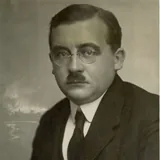
Milan Vidmar was a Slovenian electrical engineer and university professor who, without ever becoming a chess professional, was one of the strongest players in the world from about 1910 to 1930. He shared second place at San Sebastián in 1911 behind José Raúl Capablanca, won at Berlin in 1918, shared first place with Alexander Alekhine at Hastings 1925/26 and finished fourth at New York 1927. He beat Akiba Rubinstein, Alekhine, Max Euwe and Aron Nimzowitsch. FIDE made him a grandmaster when it introduced the title in 1950, and in 1948 he was chief arbiter of the World Championship match tournament won by Mikhail Botvinnik.
Ljubljana and Vienna
Vidmar was born in Ljubljana on 22 June 1885. His father introduced him to chess in the winter of 1899–1900, and in 1902 he went to Vienna to study engineering. He took his doctorate at the Technical University in Vienna in 1910, after sitting special examinations in electrical engineering, which Vienna had begun to teach only in 1904. His dissertation, which was never published, was on the theory of centrifugal pumps, as he noted in the preface to his book Theorie der Kreiselpumpe (1922).
He played in Viennese club events as a student, and in 1904, at nineteen, he shared first place in the Hauptturnier, the main tournament below the masters' event, at the German Chess Federation congress in Coburg.
Among the leaders, 1907–1914
Vidmar finished sixth at Carlsbad 1907 and third at Prague 1908, and in 1909 he won at Gothenburg. The Swedes had invited three masters there to play their own champion, and Vidmar's third game against Paul Saladin Leonhardt decided first prize. In Das Ende des Goldzeitalters (1942), a book mostly about America and economics, he recalled leaving the board while Leonhardt was still thinking and standing alone on a balcony above the city, sure of the first great win of his life. He was twenty-four. At San Sebastián in 1911 he shared second place with Akiba Rubinstein, half a point behind José Raúl Capablanca. He won at Budapest in 1912, and at Mannheim in 1914 he was second behind Alekhine when the First World War stopped the tournament.
In 1912 and 1913 he worked at the Ganz Works in Budapest as an assistant to Ottó Bláthy, one of the inventors of the transformer. Transformers became his own specialty as an engineer. In the preface to the first edition of his textbook Die Transformatoren he called Bláthy a teacher of rare greatness and wrote that his two years in Budapest ran between the lines of everything he had written.
“He has not learned yet to sacrifice his opponents' pieces instead of his own.”
“Even the greatest masters have their shocks. Only the naive observer who puts his faith blindly in late, misleading commentaries, thinks that great masters see all.”
“Dr Vidmar, one of the best players in the world who is also a man of science and a man of great ingenuity.”
“Vidmar also wrote on chess and was all the more interesting for excelling as one of the greatest stylists in the Slovene language.”
Berlin 1918
In April 1918 Vidmar played a four-player double round-robin in Berlin with Rubinstein, Carl Schlechter and Jacques Mieses. Needing an answer to Rubinstein's 1.d4, he took the advice of his friend István Abonyi and played the Budapest Defense. He beat Rubinstein in 24 moves and won the tournament, and the game made the opening known among leading players. He also won a tournament in Vienna that year.
The 1920s
Vidmar was third at London 1922 behind Capablanca and Alekhine, shared first place with Alekhine at Hastings 1925/26, and was third at Semmering 1926, where he beat Alekhine. At Hastings the two scored 8½ of 9, which, Vladimir Vuković wrote in his article on Vidmar in the book of the 1975 Vidmar Memorial, Portoroz/Ljubljana Grandmaster Chess Tournament 1975, prompted the comment that the tournament had two players and eight “participants”. He finished fourth at New York 1927 and fourth again at London 1927. Crossing to New York in February 1927 on the liner Westphalia, he spent hours, he wrote, in the ship's bar working on a new defence to the Queen's Gambit with Rudolf Spielmann, one of the two other masters on board; chess writers came to call it the Westphalia Variation. At Carlsbad 1929 he shared fifth place with Albert Becker and Euwe, and he beat Euwe, who resigned facing a queen sacrifice and mate.
Vidmar's own notes to his win over Richard Réti at Semmering 1926 are reprinted in the same book, which Vlastimil Hort wrote. As Vidmar sealed his move, Réti, sure that his attack would succeed, almost consoled him: “His words had the ring of a merciful victor. But I realised I was winning.” Réti spent the break in good spirits, and his mood changed only when the envelope was opened. Vidmar won three moves later.
His results after 1927 were weaker. Vuković wrote that in his autobiography Vidmar put this down to a loss of self-confidence after a “life crisis” in 1930, and judged that his amateur status had become too great a handicap. He played board one for Yugoslavia at the Prague Olympiad of 1931, scoring 8½ of 16, and at the Warsaw Olympiad of 1935, scoring 8½ of 14. In 1939 he won the championship of Yugoslavia.
Professor, rector and arbiter
Vidmar became a full professor at the technical faculty of the new University of Ljubljana in 1919 and taught there until 1957. In the preface to the first edition of Die Transformatoren he wrote that he also stayed on as director of a machine works and foundry company in Ljubljana because he wanted to remain an engineer, and after the First World War he began building transformers in his home town. He was rector of the university in 1928/29, was president of the Slovenian Academy of Sciences and Arts during the Second World War, and in 1948 founded the institute for electrical engineering that now bears his name.
In Das Ende des Goldzeitalters he told how a colleague in Germany wrote to him in 1921 about unexplained failures at a large transformer factory. The problem stayed with him for fifteen months. Travelling home from the London tournament of 1922, he saw the answer on the night train as it reached Zidani Most, and having no paper he worked out the calculation with his finger on the misted windows of the sleeping car, one after another, while the conductor shook his head. He wrote that wins over hard scientific problems had always given him a purer happiness than wins at the chessboard, which could come at the cost of someone else's defeat.
He was the first president of the Yugoslav Chess Federation, founded in 1921. In 1948 he was chief arbiter of the World Championship match tournament in The Hague and Moscow, and in 1950 he was chief arbiter of the Dubrovnik Olympiad, where his son Milan Vidmar Jr. played for Yugoslavia. That year FIDE named him one of its first grandmasters. He won at Basel in 1952 and played his last tournament at Opatija in 1953, at sixty-eight. His last work for chess, Vuković wrote, was organizing the Bled tournament of 1961, where he also acted as judge.
He wrote about chess as well as engineering. His engineering books include the textbook Die Transformatoren, which reached a third, rewritten edition in 1956, and Theorie der Kreiselpumpe (1922). His chess books include Pol stoletja ob šahovnici (Half a Century at the Chessboard, 1951) and the memoir Goldene Schachzeiten (1961), and he wrote the tournament book of Carlsbad 1911.
Legacy
Vidmar died of heart disease in Ljubljana on 9 October 1962 and is buried at Žale cemetery. The Slovenian Chess Federation holds an international tournament in his memory, the Vidmar Memorial, and the Elektroinštitut Milan Vidmar in Ljubljana carries his name. Slovenia's first grandmaster, he is often called the greatest amateur in the history of chess: he earned his living as an engineer and professor throughout a career spent among the leading players of his time.
Books
Books Milan Vidmar wrote, co-wrote, edited, or contributed to. Translations and reprints are grouped under the same work.
-
Moderne Transformatorenfragen
Author
-
Der wirtschaftliche Aufbau der elektrischen Maschine
Author
-
Die Transformatoren
Author
-
Theorie der Kreiselpumpe
Author
-
Der Transformator im Betrieb
Author
-
Vorlesungen über die wissenschaftlichen Grundlagen der Elektrotechnik
Author
-
Wirkungsweise elektrischer Maschinen
Author
-
Der kupferarme Transformator
Author
-
Transformatorenkurzschlüsse
Author
-
Veletransformatorski problemi
Author
-
Transformation und Energieübertragung
Author
-
Problemi prenašanja električne energije
Author
-
Aluminij v električnih prenosnih progah
Author
-
Veleprenosne proge v svetlobi telegrafske enačbe
Author
-
Die Gestalt der elektrischen Freileitung / Oblikovanje električnih nadzemnih prog
Author
-
Predavanja o znanstvenih osnovah delovne elektrotehnike
Author
-
Neuartige Aluminiumleiter in Starkstromfreileitungen
Author
-
Delovanje električnih strojev
Author
-
Problemi razpetine v električnem daljnovodu
Author
-
Električno ožilje Jugoslavije
Author
-
Zanimivosti elektrotehnike in njenega gospodarstva
Author
-
Elektrifikacija
Author
-
Razgovori o skrivnostih elektrotehnike
Author
-
Das zweite internationale Schachturnier in Karlsbad 1911
Author
-
Šah
Author
-
Razgovori o šahu z začetnikom
Author
-
Pol stoletja ob šahovnici
Author
-
Goldene Schachzeiten
Author
-
Moj pogled na svet
Author
-
Oslovski most
Author
-
Med Evropo in Ameriko / Das Ende des Goldzeitalters
Author
-
Spomini, I
Author
-
Spomini, II
Author
-
Portoroz/Ljubljana Grandmaster Chess Tournament 1975
Historical Réti–Vidmar game, explicitly Notes by Vidmar, pp.6–8