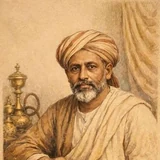
Moheschunder Bannerjee
He was about fifty years old, living in a village outside Calcutta, when a member of the Calcutta Chess Club went out to see whether the stories were true and lost to him. Moheschunder Bannerjee had never played a European master and barely knew the European rules. Within three years his games were being printed in London, and the openings he played — fianchetto systems that European theory had no name for and no answer to — were being called the Indian defences. Every King's Indian, Grünfeld and Nimzo-Indian played today descends from a way of setting up the pieces that he had learned as a boy in Bengal, because the game he grew up with did not allow anything else.
◈A village in the mofussil
In the autumn of 1848 a member of the Calcutta Chess Club heard that there was a Brahmin in a village out in the mofussil — the country districts beyond the city — who had never been beaten at chess. He went to find him, played him, and lost. He brought him back to Calcutta.
There John Cochrane played him. Cochrane was a Scottish barrister who twenty-five years earlier had beaten Deschapelles and La Bourdonnais in Paris, and he won this first encounter; but he had spent years in India looking for an opponent who could test him, and he knew at once that he had found one. Moheschunder was engaged as a paid attaché of the Chess Club. He was around fifty years old. He improved very quickly.
◈The rules he had learned
The chess he had grown up with was not the European game. In the Bengali form, a pawn could not advance two squares from its starting rank, there was no castling, and a king that had not yet been checked could make a knight's move once in the game. The consequences run deep: without the two-square pawn move you cannot fight for the centre by occupying it quickly, so you develop the pieces first and attack the centre from a distance instead.
That is why he fianchettoed. Bishop to g7 behind a pawn on g6 with a pawn on d6, or bishop to b7 behind b6 with a pawn on e6 — these came to him not as theory but as the only sensible way to begin a game. European chess in 1848 held it as near-axiomatic that the centre had to be occupied by pawns. Moheschunder had never been told that, and he was beating people who had.
◈Teaching Europe the Indian defences
The archive shows what those arguments looked like. Fourteen of his wins here come against the King's Indian Four Pawns Attack — Cochrane building the largest pawn centre the position allows, e4, d4, c4 and f4, and Moheschunder undermining it from the wings. Twelve more are in what would now be called the Pirc, and there are wins in the King's Indian Attack and the queenside fianchetto besides.
One of the Four Pawns games, from 1853, is a model of the whole idea. Cochrane occupies the centre; Moheschunder gives material back to prise it open, and finishes with a rook thrown onto the queenside — 21.Rxf6 axb3 22.a3 Rxa3 23.bxa3 Qxc3+ 24.Kb1 Nc4 — every black piece pointed at a king with nowhere to go.
It was Cochrane who supplied the name: he called this class of opening the Indian defence, after the man playing it against him, and the earliest recorded use of the term dates from 1884. Moheschunder is also credited with the first recorded outing of the Grünfeld-style defence, more than sixty years before Ernst Grünfeld played it at Vienna in 1922 — though the sources disagree on exactly when, some placing that game in May 1851 and others in May 1855.
◈Twelve years across a board from Cochrane
From 1848 to 1860 the two of them played constantly. Cochrane, the stronger over the whole run, sent the games home, and from 1851 the Chess Player's Chronicle in London printed them — which is the only reason a single one of them survives. Almost everything known about Moheschunder's life comes from what Cochrane wrote about him for the London magazines.
What Cochrane wrote, in 1850, was that his opponent “possesses as great a natural talent for chess as any player he ever met with, without one single exception.” From a man who had sat across the board from La Bourdonnais and Staunton, that is not a polite compliment.
This archive holds 127 of his wins, from 1849 to a game played on 15 January 1860. The earliest is a Giuoco Piano in which he takes the European opening on its own terms and wins in twenty-three moves. The last is another Italian, twenty-six moves, the rooks arriving on the e-file at the end.
◈What is not known
Almost everything else. His birth year is an inference — he was said to be about fifty in the autumn of 1848 — and no year of death is recorded anywhere. His name reaches us in half a dozen spellings, because English speakers wrote down what they heard: Moheschunder Bannerjee, Mahesh Chandra Banerjee, Moheschunder Bonnerjee, Mahescandra. The Mega2024 database that supplies this archive files him under Bonnerjee, Mohishunder, which is why the games here are titled that way.
No portrait of him from his own lifetime is known to exist. The image on this page is a modern artist's impression, not a likeness taken from life. What actually survives of him is what he did on the board, printed in a magazine six thousand miles from where he sat.
“He possesses as great a natural talent for chess as any player he ever met with, without one single exception.”
“The Indian Defences by P-KKt3 coupled with P-Q3, or P-QKt3 coupled with P-K3, were largely taught to European players by the example of Moheschunder and other Indians.”
◈From the archive
◈Legacy
He has no dates, no portrait and no settled spelling of his own name, and he changed the openings. For four centuries European chess had treated the centre as something you occupied; Moheschunder Bannerjee, who had never read a word of that theory, spent twelve years demonstrating across a Calcutta board that you could surround it instead. Cochrane published the games, Europe read them, and the idea took another seventy years to be fully absorbed — by Nimzowitsch, by Réti, by the hypermoderns who turned it into doctrine. The King's Indian, the Grünfeld, the Nimzo-Indian, the Queen's Indian and the Modern all carry the name of his country, and the fianchetto is now among the most-played structures in serious chess. It came from a fifty-year-old villager in Bengal whose year of death nobody wrote down.