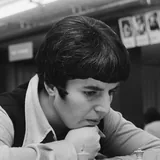
Nona Gaprindashvili was Women's World Champion for sixteen years, from 1962 to 1978. She took the title at twenty-one by beating Elisaveta Bykova 9–2, defended it four times, three times against Alla Kushnir and once against Nana Alexandria, and lost it in 1978 to Maia Chiburdanidze. She also played in men's tournaments: she won the Hastings Challengers in 1963/64, and in 1977 she shared first place at Lone Pine and became the first woman to earn a grandmaster norm. The next year FIDE made her the first woman grandmaster. She played in twelve Women's Olympiads, won the USSR Women's Championship five times and, from 1995 on, won the women's World Senior Championship eight times.
Zugdidi
Gaprindashvili was born in Zugdidi, in western Georgia, on 3 May 1941, the only girl among six children. In her 1977 memoir I Prefer Risk she listed five brothers: Emzar, Tamaz, Jemal and Murad were older, and the youngest, Nugzar, was born after her. She wrote that Emzar, who had the game from their father, got the rest of the family playing, and that she knew the moves at four from watching her brothers. Her account of her first official event also differs from the common story that she played in her brother's place. In 1953, when she was twelve, the Zugdidi team for the Georgian schools championship in Batumi needed one girl, and her brothers said she could play; Tamaz, who had also been picked, gave his place to another player. She scored 3½/7. The Tbilisi trainer Vakhtang Karseladze, whom she later called the father of the Georgian women's school of chess, had watched all her games, and on the last day he asked her to tell her parents to send her to him in Tbilisi.
Her parents let her move to Tbilisi, where she lived with her aunt and began training with Karseladze at the Pioneers' Palace in 1954. In 1956 she won the Georgian women's championship with 15½/16; her fifteenth birthday fell during the event, and Karseladze remarked that she had marked it with fifteen wins. Later that year, at fifteen, she won a semi-final of the USSR Women's Championship in Tbilisi by a point and a half. The crowds were so large that she left the Rustaveli Theatre each day with two policemen to get through.
Her first USSR Women's Championship finals went less well: she shared seventh place at Dnepropetrovsk in 1956 and eleventh place at Vilnius in 1957. In I Prefer Risk she traced the Vilnius result to her third-round game. Her opponent, whom she names only as N., took her queen without seeing an intermediate check, and Gaprindashvili told her she could take the move back. Unsettled, she got into time trouble and the game was adjourned in N.'s favour; the chief arbiter advised N. to offer a draw, but N. told him she had not taken a move back. Gaprindashvili lost that game and the next three. She called it the only such lapse she could reproach herself for, and wrote that sport is fair only when its rules are applied to the letter. From early 1957 her trainer was the Tbilisi master Mikhail Shishov, who steered her toward positional play, and at Kharkov in 1958 she was third, half a point behind Larisa Volpert and Kira Zvorykina.
Women's World Champion
In 1961 she won the Women's Candidates Tournament at Vrnjačka Banja without losing a game, two points ahead of the field. The title match against the champion, Elisaveta Bykova, was played in Moscow in 1962, and Gaprindashvili won it 9–2 without a loss. In a 2018 interview she recalled that the footballers of Dinamo Tbilisi came to watch the last game, which was adjourned, and that Bykova resigned it by telephone.
Before the match she had prepared at Mozzhenka, near Zvenigorod, with Shishov and two consultants, Bukhuti Gurgenidze and David Bronstein. In I Prefer Risk she recalled that after they went through about 150 of Bykova's games, Bronstein expected Bykova to steer the play into endgames, so he set her endgame positions, even drawing them on napkins at meals. He also gave her a portrait of Bykova and told her, as a joke, to hang it on the wall and get angry; she wrote that she could not be angry with an opponent without a reason.
She came home to Tbilisi a celebrity. In Chess Queens Jennifer Shahade describes her win as the start of a "women's chess revolution" in Georgia, which became one of the leading countries in women's chess.
“Without a doubt it was my shared first place in Lone Pine, USA, after which I was — as the first woman in history — awarded the grandmaster title.”
“I am very thankful that chess was my sport of choice, as the arbiters there do not have much influence on the game itself.”
“Anybody who was foolish enough to think that Nona would be outclassed in a masculine tournament was soon disillusioned.”
Four defenses
Gaprindashvili defended the title against Alla Kushnir three times: in Riga in 1965, 8½–4½; in Tbilisi and Moscow in 1969, again 8½–4½; and in Riga in 1972, when Kushnir came closest and Gaprindashvili held on 8½–7½ after draws in the last two games. In I Prefer Risk she put the 1972 slump down to illness. She led 6–3 but won none of the last seven games, and she called the eleventh, which she lost after winning a pawn and building a strong attack, her worst game in any title match. Before the last three games she steadied herself by reasoning that if she could not draw one of them, she was not the champion. In 1975 she beat her fellow Georgian Nana Alexandria 8½–3½ in Pitsunda and Tbilisi.
Her championship games also entered opening theory. In My Great Predecessors Part IV, Garry Kasparov cites the fourth game of her 1969 match with Kushnir as an earlier example of recapturing on f3 with the g-pawn in the Alekhine Defence, a plan that later became fashionable. He discusses it in his notes to the nineteenth game of the 1972 Spassky–Fischer match.
In 1978 the challenger was the seventeen-year-old Maia Chiburdanidze, also from Georgia. Chiburdanidze won the match 8½–6½, and Gaprindashvili's sixteen years as champion came to an end.
Lone Pine
Gaprindashvili played against men throughout her career. In 1959, Tengiz Giorgadze records in his Chronicle of Georgian Chess, she became the first woman to play in the Georgian men's championship. She won the Hastings Challengers in 1963/64, tying with Ove Kinnmark on 6½/9 and taking first place on tiebreak. In the 1964/65 Premier, the first woman in that section since Vera Menchik in 1936, she scored 5/9 for fifth place behind Paul Keres and beat all four British players. Giorgadze writes that Keres pressed hard to beat her, but she played on until only the kings were left and accepted the draw he offered. She shared third place at Dortmund in 1974, where she beat Rudolf Servaty in 17 moves with a combination that gave up both rooks, finished half a point behind the winner, David Bronstein, at Sandomierz in 1976, and tied for second at Dortmund in 1978. In I Prefer Risk she wrote that men were ashamed to lose to a woman, so that even players at the bottom of the table played her as if first prize depended on the game.
At Lone Pine in March 1977, a nine-round Swiss of forty-eight players with an average rating of 2410, she scored 6½/9, beat four grandmasters and tied for first with Yuri Balashov, Oscar Panno and Dragutin Sahović. It was the first grandmaster norm earned by a woman. At Sandomierz and Dortmund she had finished half a point short of a norm, but at the 1978 FIDE Congress she was awarded the grandmaster title, although the usual requirement was three norms over 24 games. She has called Lone Pine and the title that followed her greatest achievement in chess.
Olympiads and later years
Gaprindashvili played in twelve Women's Olympiads, eleven for the Soviet Union between 1963 and 1990 and one for Georgia in 1992, and scored 107 points from 128 games. Her teams won eleven gold medals and one silver, and at Dubai in 1986 she won all ten of her games. She won the USSR Women's Championship in 1964, 1973/74, 1981, 1983 and 1985, and reached her highest rating, 2495, in July 1987.
In 2005, at sixty-four, she won the BDO tournament in Haarlem with 6½/9 and a performance rating of 2510. She won the women's World Senior Championship in 1995, 2009, 2014, 2015, 2016, 2018, 2019 and 2022, and she is the only Women's World Champion who has also won the women's senior title.
Beyond the board
Gaprindashvili studied English at the Tbilisi Institute of Foreign Languages and by 1977 was an assistant in its department of language and literature teaching methods. By then she had twice been elected a deputy of the Supreme Soviet of the Georgian SSR, where she sat on the commission for health, social security and sport. She was president of the Georgian National Olympic Committee from 1989 to 1996. She took part in the protests against President Eduard Shevardnadze in 2002 and was a prominent member of the opposition People's Assembly at the time of the 2011 protests.
In 2021 she sued Netflix because The Queen's Gambit described her as a Russian player who had never faced men. By 1968 she had played at least 59 men, ten of them grandmasters. Netflix settled with her in 2022.
Legacy
Many Georgian women took up chess after Gaprindashvili won the title in 1962, and she later trained younger players, among them Ana Matnadze and Tea Lanchava. In 2020 she appeared with Nana Alexandria, Maia Chiburdanidze and Nana Ioseliani in the documentary Glory to the Queen. The Chess Palace in Tbilisi is dedicated to her, Zugdidi has put up a statue in her honor, and the Olympiad trophy for the best combined open and women's result carries her name. In 1982 she received the first chess Oscar for women, given by the International Association of Chess Press. She was inducted into the World Chess Hall of Fame in 2013 and received Georgia's Presidential Order of Excellence in 2015.
Books
Books Nona Gaprindashvili wrote, co-wrote, edited, or contributed to. Translations and reprints are grouped under the same work.
-
არსი ჩემი ცხოვრებისა (The Essence of My Life)
Author — literary record by Viktor Vasiliev
-
Предпочитаю риск (I Prefer Risk)
Author — literary record by Viktor Vasiliev
-
ქართული ჭადრაკის მატიანე, წიგნი II (Chronicle of Georgian Chess, Book II)
Editor — games and game fragments
-
რჩეული პარტიები (Selected Games)
Author