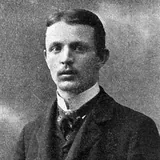
Oldřich Duras was one of the leading tournament players in the years before the First World War. Between 1905 and 1912 he shared first place at Vienna and Prague in 1908 and at Breslau in 1912, where he and Akiba Rubinstein shared the German championship, and he won the Czech championship three times. He beat Rubinstein, Carl Schlechter, Siegbert Tarrasch, Mikhail Chigorin and the young Alexander Alekhine, and he gave his name to an attacking line of the Ruy Lopez. After 1914 he never returned to tournament play. He turned to composing endgame studies and problems instead, and in 1950 FIDE named him a grandmaster, the first Czech player to hold the title.
Pchery and Prague
Duras was born Důras on 30 October 1882 in Pchery, in Bohemia. Everyone in his family played chess: his first teachers and opponents were his father Adolf, his mother Františka and his uncle Vojtěch Vlk. As a boy he admired the combinative play of Mikhail Chigorin, and in 1899 he joined the Czech Chess Association in Prague. His sister Božena Durasová married the sculptor Jan Štursa.
The Barmen generation
In 1905 Duras shared first place with Akiba Rubinstein in the Hauptturnier A at Barmen, which earned him the master title. The same year he won the first Czech championship, and he won it again in 1909 and 1911. In 1906 he finished second at the German Chess Federation congress in Nuremberg, behind Frank Marshall, and in 1907 he was second at the Trebitsch Memorial in Vienna.
“I shall always look back with real appreciation to the many happy and interesting hours I spent in the company of Professor Rice while engaged in the earnest attempt to ferret out the real inwardness of this truly remarkable opening.”
“… when he is playing me, I always know what he is thinking about. But when I play Lasker or Capablanca, I have absolutely no idea what they are thinking about.”
Vienna, Prague and Breslau
In 1908 two tournaments marked the sixtieth year of Franz Joseph's reign. At Vienna Duras scored 14 points and shared first place with Géza Maróczy and Carl Schlechter, and at Prague he shared first with Schlechter on 13½. At the Chigorin Memorial in St. Petersburg in 1909 he shared third place with Rudolf Spielmann, behind Emanuel Lasker and Rubinstein. Chessmetrics later ranked him fourth in the world in August 1909.
At Hamburg in 1910 he beat Schlechter and the seventeen-year-old Alekhine and finished second, half a point behind Schlechter. At Breslau in 1912 he beat Rubinstein in a long rook ending, then won his last-round game against Amos Burn to share first place with Rubinstein. The two players shared the German championship.
Style and openings
Duras was an attacking player who was also strong in the endgame. Against the Ruy Lopez he played 5.d3 d6 6.c4, a line associated with his name, and the Duras Gambit is named after him. He had plus scores against Richard Teichmann (+6 −2 =6), Dawid Janowski (+3 −1), Schlechter (+2 −1 =11) and Aron Nimzowitsch (+3 −2 =3), and level scores against Tarrasch and Maróczy. He lost his one game against Lasker, drew and lost against José Raúl Capablanca, and had minus scores against Rubinstein, Ossip Bernstein and Milan Vidmar.
Years later, Alekhine discussed his Mannheim 1914 game against Duras at a chess gathering in Moscow. In Garry Kasparov on My Great Predecessors, Part I, Kasparov recounts that someone asked Alekhine to rate Duras. Alekhine called him “a very strong player,” but said he always knew what Duras was thinking during their games. He contrasted this with playing Lasker and Capablanca, whose moves often surprised him.
After 1914
In 1913 Duras played in Russia and the United States, where he lost a short match to Marshall. He remained in New York into 1914, analyzing the Rice Gambit, a line of the King's Gambit, with Isaac L. Rice, the gambit's namesake and president of the Rice Chess Club of New York. In July 1913 Duras found a new move for White in one of its variations. Rice showed it in London to Edward Lasker, who found a reply that European analysts thought had disposed of it. Duras answered in The Rice Gambit: Supplement to the Fifth Edition (1914), which he edited and dated New York, February 1914, and where the line is printed as "The Duras Variation": "By the analysis presented herewith, I think I have shown conclusively that Lasker's continuation does not accomplish what was claimed for it." The German Chess Federation congress at Mannheim in 1914 was stopped when the First World War began. Duras joined the Austro-Hungarian army that year and later worked for the Czechoslovak Ministry of Defense. He married after the war and did not return to tournament play.
He stayed in chess as a writer and referee and became a composer, with about 40 endgame studies and about 50 problems, mostly three-movers. His studies won five prizes, one of them a special prize, and an honorable mention.
Legacy
Duras died in Prague on 5 January 1957, at seventy-four. FIDE had made him a grandmaster in 1950, when it first awarded the title, on the strength of his results before the First World War. In a poll for the best Czechoslovak player of the century he finished fourth, behind Richard Réti, Vlastimil Hort and Salo Flohr. The Brno chess club ŠK Duras, founded in 1923, bears his name, as does Durasova Street in Slaný, near his birthplace.
Books
Books Oldřich Duras wrote, co-wrote, edited, or contributed to. Translations and reprints are grouped under the same work.
-
Šachy: Rukověť praktické hry
Contributor — reviewed Karel Zmatlík’s textbook
-
The Rice Gambit: Supplement to the Fifth Edition
Editor