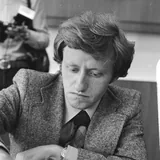
Oleg Romanishin came out of the Lviv school of Viktor Kart with Mikhail Tal as his mentor, and he has played aggressive, original chess ever since. He won the European Junior Championship in 1973, shared second place in the 1975 USSR Championship after beating the winner, Tigran Petrosian, and won tournaments from Hastings to Reggio Emilia. He beat Tal, Petrosian, Vasily Smyslov and Boris Spassky, and twice beat the young Garry Kasparov. In opening theory his name is attached to 4.g3 in the Nimzo-Indian. In 2026, past seventy, he was still playing in the European Championship.
Lviv
Romanishin was born in Lviv on 10 January 1952. With a group of other promising juniors he was first coached by Viktor Kart, an instructor at the Lviv Sports Academy, and then, as he improved, he was assigned a senior master as a mentor: Mikhail Tal. His style has been described as aggressive, and that coaching may be part of the reason.
He won the European Junior Championship at Groningen in 1972/73 and became an International Master in 1973. In 1974 he played for the Soviet team that won the World Student Team Championship at Teesside, with the best score on board four, 8/9.
The 1975 USSR Championship
At Yerevan in 1975 Romanishin shared second place in the USSR Championship with Boris Gulko, Tal and Rafael Vaganian, half a point behind Tigran Petrosian, whom he beat in their individual game. FIDE confirmed his grandmaster title in 1976. He finished third in the 1981 USSR Championship, behind Kasparov and Lev Psakhis.
“When I play with caution I do not always fare well.”
“It is not easy to have a fighting character / And to defend one's style.”
Tournament victories
Romanishin's tournament wins include Odesa 1974, Novi Sad 1975, Yerevan 1976, Hastings 1976/77, Tallinn 1977, Leningrad 1977 (shared with Tal), Gausdal 1979, Polanica-Zdrój 1980, Lviv 1981 (shared with Tal), Jūrmala 1983, Moscow 1985, Reggio Emilia 1985/86 (shared with Ulf Andersson and Ljubomir Ljubojević) and Debrecen 1990. At the Hungarian Open in Győr in 1990 he finished two points ahead of the field.
He was second at Tilburg in 1979, behind Anatoly Karpov, and at Dortmund in 1982, behind Vlastimil Hort, and shared third place at Sochi in 1982. He played in the Interzonals at Riga in 1979, where he shared fifth–sixth with Florin Gheorghiu on 10½/17, and at Taxco in 1985, but never qualified as a FIDE Candidate. In 1993 he qualified from the PCA tournament at Groningen, and in 1994 he lost his Candidates quarter-final to Viswanathan Anand, 5–2. Kasparov records the Riga placing in My Great Predecessors, Part II and the Anand match score in My Great Predecessors, Part V.
Playing for the team
Romanishin played for the Soviet Union at the 1978 Olympiad and for Ukraine at Olympiads through the 1990s, winning two silver and two bronze medals in all. At the European Team Championships he won six gold medals and one silver. He also played for the Soviet Union against the Rest of the World in London in 1984.
Openings
Romanishin is known for rare and offbeat opening systems, some of them long discarded, which he prepared deeply and used to avoid well-known theory. He revived 4.g3 against the Nimzo-Indian, a line known in the 1930s, in the 1970s, and it now carries his name. With the Australian correspondence player John Kellner he also pioneered lines of the French Defense with an early ...Be7.
In Garry Kasparov on My Great Predecessors, Part I, Kasparov also notes Romanishin's successful use of the Berlin Defence from the mid-1970s, before Kramnik took it up (Game 47, note to 5...Nd6). Part III credits him and Robert Hübner with introducing an unusual English Opening setup: after 1.c4 Nf6 2.Nc3 e6 3.Nf3 b6 4.e4 Bb7, White plays 5.Bd3, intending Bc2 and d4 (p. 262, Game 71).
In My Great Predecessors, Part II, Kasparov credits Romanishin's game against Alexander Beliavsky at Groningen in 1993 with reviving an older Nimzo-Indian line played by Alekhine: Black recaptures on d5 with the queen, then can retreat it to f5 after White develops the king's knight.
A long career
Less active in later years, he still won events such as Solin-Split 2004 and Hotel Petra in Rome in 2005. He has kept playing into his seventies: he scored 5/9 at the Rilton Cup in Stockholm in 2024, and in April 2026 he played in the European Individual Championship.
Legacy
Romanishin never played a FIDE Candidates match, but for half a century he has been one of the most original grandmasters of the Soviet and Ukrainian school: a European junior champion, a pupil of Tal who beat Tal, Petrosian, Smyslov, Spassky and the young Kasparov, a regular member of winning Soviet and Ukrainian teams, and a player whose name is attached to an opening line still played today.
Books
Books Oleg Romanishin wrote, co-wrote, edited, or contributed to. Translations and reprints are grouped under the same work.
-
Secrets of Opening Surprises, Volume 3
Contributor — “Catch-as-catch-Kan?”
-
Victor Kupreichik: The Maestro from Minsk
Contributor — written tribute
-
From Ukraine with Love for Chess
Contributor — recollections of training with Mikhail Tal