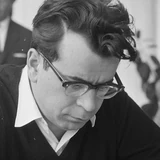
Pal Benko survived the war in Hungary, won his country's championship at twenty and spent sixteen months in an internment camp for trying to escape to the West. On his second attempt, in Reykjavík in 1957, he succeeded, and a year later he was a grandmaster and a World Championship Candidate playing for the United States. He won the U.S. Open eight times and beat four World Champions: Bobby Fischer, Mikhail Tal, Tigran Petrosian and Vasily Smyslov. In 1970 he gave up his place in the Interzonal so that Fischer could play, and Fischer went on to take the world title. Two openings bear his name, the Benko Gambit and 1.g3, and he was also a composer of problems and endgame studies of international standard, with a Chess Life column that ran for more than forty years.
Budapest in wartime
Benko was born on 15 July 1928 in Amiens, where his Hungarian parents were on holiday, and grew up in Budapest. His father, an engineer and an artist, taught him chess. The war kept him out of tournaments until he was seventeen. He served in the Hungarian army, was captured by Soviet forces and was put to forced labour.
At the end of 1944 the Soviet army occupied Hungary. His father and brother were taken to Russia as labourers and his mother died as the war ended, leaving him to look after his younger sister. Chess helped him find food and shelter. Once he could play tournaments he improved quickly, won the Hungarian championship in 1948, at twenty, and became an International Master in 1950.
Two escapes
In March 1952, during a tournament in East Berlin, Benko tried to reach the American authorities in West Berlin. He was caught and sent to an internment camp, where he went hungry and saw other prisoners die. He was held for sixteen months and released after Stalin's death.
In July 1957 he played for Hungary at the World Student Team Championship in Reykjavík. When it was over he went to the American embassy and asked for political asylum. He reached the United States in 1958 with no English and very little money. That summer he tied for third and fourth place at the Portorož Interzonal, which earned him the grandmaster title and a place in the 1959 Candidates Tournament. He finished last there, but he beat the former World Champion Vasily Smyslov.
“A player who is not well equipped with basic endgame knowledge is liable to lose the fruit of even a well-played game.”
“Months before the game I had showed this line to Benko and he suggested this innocent-looking move.”
Curaçao 1962
Benko qualified for the Candidates again from the Stockholm Interzonal of 1962, after a play-off. Leonid Stein won the three-player contest, with Benko second ahead of Svetozar Gligorić. But only five players from one country could enter the Candidates, and the Soviet places were already filled; Benko went through instead. At Curaçao he opened eleven of his fourteen games with White with 1.g3, the move now known as Benko's Opening, and with it he beat both Fischer and Tal. He finished sixth of eight.
His most consequential game came in the penultimate round. Paul Keres had won all three of his previous games against Benko and was fighting Petrosian for first place; Benko beat him, and Petrosian won the tournament by half a point. Benko later wrote that Petrosian and Geller had offered to help him analyse the adjourned position, and that he had refused.
America's professional
He won or shared first place in the U.S. Open eight times, in 1961, 1964, 1965, 1966, 1967, 1969, 1974 and 1975, won the Canadian Open in 1964 and finished second in the U.S. Championship of 1974. His lifetime score against Fischer was three wins, eight losses and seven draws.
Fischer credited Benko with an idea he used to beat Max Euwe at the Leipzig Olympiad in 1960. Months before the game, Fischer had shown him a line of the Caro-Kann; Benko suggested the rook move 15.Rb1. Kasparov records Fischer's acknowledgement in his annotation of the game.
His third-place finish in the 1969 U.S. Championship qualified him for the Palma de Mallorca Interzonal of 1970, and he gave up his place so that Fischer could play instead. Fischer won the Interzonal by three and a half points, won all three of his Candidates matches and became World Champion by beating Boris Spassky in 1972.
The gambit, the problems and the columns
The Benko Gambit, 1.d4 Nf6 2.c4 c5 3.d5 b5, gives up a pawn for long-term pressure on the a- and b-files, and Black is often content to trade queens and play the ending a pawn down. Benko played it from the mid-1960s and made it popular; ChessBase reported his estimate that he had played it in far more than fifty games and lost only three.
He was a world-class composer of problems and endgame studies, and FIDE made him an International Master of Chess Composition. In Chess Life he wrote In the Arena from 1972 to 1981 and Endgame Lab from 1981 to 2013, along with the puzzle feature Benko's Bafflers. In later life he helped train the Polgár sisters and Péter Lékó.
In 2003 he revised Reuben Fine's Basic Chess Endings, a book that had guided his own development as a player. Burt Hochberg, the editor, recalled that Benko worked on the revision in Budapest and returned to New York six months later with a manuscript on a computer disc. He also handed over his own heavily marked hardcover edition for reference.
Legacy
Benko died in Budapest on 25 August 2019, at ninety-one. He was inducted into the U.S. Chess Hall of Fame in 1993. He had been a prisoner, a refugee and a two-time Candidate, and he kept writing about the endgame in Chess Life until he was eighty-five. The gambit he popularised is still played under his name, and the Interzonal place he gave up in 1970 was the one Fischer used on his way to the world title.
Books
Books Pal Benko wrote, co-wrote, edited, or contributed to. Translations and reprints are grouped under the same work.
-
The Benko Gambit
Author
-
Winning with Chess Psychology
Coauthor — Burt Hochberg
-
Basic Chess Endings
Contributor — revised and expanded Reuben Fine’s original text
-
Pal Benko: My Life, Games and Compositions
Coauthor — Jeremy Silman; opening survey by John L. Watson
-
Pal Benko's Endgame Laboratory
Author