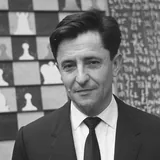
Petar Trifunović was a doctor of law who became one of the leading players of Yugoslavia's postwar chess generation. He won the national championship five times between 1945 and 1961, played in seven Chess Olympiads from 1935 to 1962 and won the board-three gold medal when Yugoslavia took the team title at Dubrovnik, his birthplace, in 1950. Known in the 1930s as an attacking player, he later built his game on careful positional play and defense, and in the 1940s and 1950s he was counted among the twenty best players in the world. FIDE made him a grandmaster in 1953.
Šibenik and Zagreb
Trifunović was born in Dubrovnik on 31 August 1910 and grew up in Šibenik. He learned chess late, at sixteen, while still at secondary school there. He studied law in Zagreb and took his doctorate in law in 1933. He earned the master title at a tournament in Banja Luka in 1931.
Typhoonovic, 1935–1938
In the 1930s he was an attacking player, known as "Typhoonovic." He was third in the first Yugoslav Championship in 1935 and second in 1936, and he shared second place in 1937 and in 1938. At the Warsaw Olympiad of 1935 he scored 12½ of 16 on board four, and at Stockholm in 1937 he scored 11 of 16 on board two, winning a board bronze medal each time.
In 1938 he settled in Belgrade, where he lived for more than forty years, and from 1938 to 1940 he edited the magazine Šahovski pregled.
“Such a superiority frightens even me, an old tournament fox.”
National champion
After the Second World War Trifunović won the Yugoslav Championship in 1945, 1946 and 1947, the last shared with Svetozar Gligorić, and again in 1952 and 1961. He finished among the top three of the national championship sixteen times. Abroad he won at Zlín in 1945, shared second place behind Miguel Najdorf at Prague in 1946 and finished tenth at the Saltsjöbaden Interzonal of 1948. In 1949 he drew a twelve-game match with Najdorf at Opatija, winning one game, losing one and drawing ten.
At the 1950 Olympiad in Dubrovnik, the city of his birth, he scored 10 of 13 on board three and won the individual gold medal as Yugoslavia took the team gold. FIDE awarded him the international master title in 1950 and the grandmaster title in 1953, making him the third Serbian grandmaster after Boris Kostić and Gligorić.
The international circuit
He won at Lima in 1950 and shared second place behind Gligorić at Cheltenham in 1951. At Belgrade 1954 he was third behind David Bronstein and Aleksandar Matanović, ahead of Gligorić and Tigran Petrosian. He shared first place at Netanya in 1961, won outright at Prague in 1961 and at Beverwijk in 1962, and in 1965 he finished second to Mikhail Botvinnik at Noordwijk, ahead of Salo Flohr, Bent Larsen and Jan Hein Donner.
His later style was cautious and positional, and he drew many games; at Leipzig in 1965 he drew all fifteen. He could still play sharply when he chose: at Havana in 1963 he beat Mikhail Tal with Black in the Falkbeer Countergambit. He played for Yugoslavia in Olympiads until Varna 1962, adding team bronze medals at Helsinki 1952 and Amsterdam 1954 and team silver medals at Munich 1958 and Varna 1962.
In My Great Predecessors, Part V (2006), Kasparov quotes a letter Trifunović sent to Belgrade during Korchnoi's extraordinary start at Wijk aan Zee in January 1968. The Moscow weekly 64 reported the letter. After Korchnoi began with eight wins and reached 10½/11, the veteran wrote: “Such a superiority frightens even me, an old tournament fox.” He went on to wonder whether everyone except Korchnoi had forgotten how to play chess.
Teacher and organizer
Trifunović was a chess teacher and trainer, a team captain and president of the Chess Federation of Serbia. With Sava Vuković he wrote Šahovski bukvar (1959), and he wrote Za šahovsku krunu on the 1972 Spassky–Fischer match. He died in Belgrade on 8 December 1980.
Legacy
Trifunović belonged to the generation that made Yugoslavia the second-strongest chess nation in the world after the Soviet Union. He won eight team and board medals at Olympiads, the fourth-highest total among Serbian and Yugoslav players. A chess club and a memorial tournament carry his name, the Trifunović Variation of the Four Pawns Attack in the Alekhine Defense (5...Bf5) is named after him, in 1995 the Politika chess club published a book of his selected games, and in 2020 Serbia put him on a postage stamp.
Books
Books Petar Trifunović wrote, co-wrote, edited, or contributed to. Translations and reprints are grouped under the same work.
-
Grünfeldova indijska odbrana
Coauthor — Petar Trifunović, Erwin Gruber, Branko Božić
-
Yugoslav Chess Triumphs / Jugoslovensko šahovsko stvaralaštvo / Jugoslawisches Schach II
Coauthor — Petar Trifunović, Svetozar Gligorić, Rudolf Marić, Dragoljub Janošević
-
Ambasador šaha: Bora Kostić
Coauthor — Guido Bučan, Petar Trifunović, Branko Božić
-
Bobi Fišer: Ante portas
Coauthor — Dimitrije Bjelica, Petar Trifunović
-
Jugoslavija na šahovskim olimpijadama
Contributor — text, with O. Nedeljković; edited by Miloš Petronić
-
Šahovski bukvar
Coauthor — Petar Trifunović, Sava Vuković
-
Izabrane partije velemajstora Petra Trifunovića
Contributor — own selected games and annotations