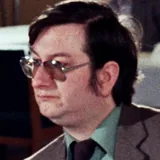
Raymond Keene won the British Championship in 1971, became the first English player to earn a grandmaster norm, at the Nice Olympiad of 1974, and in 1976 became the second Englishman, after Tony Miles, to receive the grandmaster title. He played for England in eight consecutive Olympiads from 1966 to 1980. At eighteen he beat the former World Champion Mikhail Botvinnik at Hastings. A follower of Nimzowitsch and Réti, he favored hypermodern openings such as the Modern Defense. After he retired from competitive play in 1986 he became one of the best-known figures in British chess as an organizer, columnist and author of well over a hundred books.
Dulwich and Cambridge
Keene was born in London on 29 January 1948. He had known the moves for five years when he began to take the game seriously at about eleven, and in Becoming a Grandmaster (1977) he named Nimzowitsch's My System as the most notable of the books that shaped his style. In 1964 he won the London and British Under-18 Championships, shared with Brian Denman. He played for England at the World Junior Championships of 1965 in Barcelona, where he finished second to Duncan Suttles in the B group, and 1967 in Jerusalem, where he took the silver medal behind Julio Kaplan. He was educated at Dulwich College and Trinity College, Cambridge, where he read German literature, graduating in 1971, and wrote his first chess book.
The Hastings Premier of 1966/67 was his first all-play-all international tournament. At eighteen he beat Mikhail Botvinnik, who won the tournament with 6½/9 and lost no other game; Keene finished eighth with 3½. He played the game in a dinner jacket and a black elasticated bow tie, “determined to perish in style,” and photographs later showed that the elastic had snapped after Botvinnik's 26th move. In Becoming a Grandmaster he called it his “rotten win” and wrote that the applause it drew was misguided. Botvinnik dismissed him as a “calculator of variations,” and Keene gave up the Modern Benoni and the Dragon Sicilian for solid opening systems. Three months after Hastings he began work on Flank Openings (1968).
British Champion
Keene won the British Championship at Blackpool in 1971, unbeaten with 8/11, and shared second place in 1968, 1970 and 1972. At Blackpool he scored 4/5 with Black, using the analysis of the Pirc and Modern Defenses he had prepared with George Botterill. He had made his first International Master norm at the Siegen Olympiad of 1970, on first board in the C final after Jonathan Penrose fainted at the board and withdrew from the team. The British title brought an invitation to the first German International Championship in Berlin later in 1971, where he scored 8/15 and made the second norm, gaining the title “exclusively on German soil.” He was awarded the International Master title in 1972, the first English player to receive it since Penrose in 1961.
In 1968 he won Jim Slater's Young Masters tournament at Southend, which Slater sponsored to find the best young British player. Slater offered a year's financial support if Keene left Cambridge at once to become a professional player. Keene wrote that Slater's continual query, “What use is German Literature?”, “struck me as unworthy of an answer,” and he persuaded Slater to wait until he had his degree. Slater then paid towards a second, Les Blackstock, for Berlin 1971, Palma 1971 and Reykjavik 1972, but the support lasted “precisely four months rather than the hoped-for year,” and Keene called his results in 1972 “uniformly dismal.”
“One might suppose from this game that Capablanca had carefully read My System and then used all the theories contained therein against their inventor!”
“Historically the game was important, as one of the very few wins this century by an Englishman against an Ex-World Champion, but as chess it was nonsense and deserved to be hissed rather than clapped.”
“Chess is rich and fascinating, but it is not everything, and it may just be possible that those players who are not cultural morons may eventually inherit the earth.”
“I suspect my main weaknesses are of a psychological rather than technical nature, and I suppose I play better under the whiplash of the team captain!”
“By a combination of ability and shrewdness, Keene has attracted considerable sponsorship and has proved himself capable of efficient and rapid organisation of chess events.”
The grandmaster title
Keene played for England in eight consecutive Olympiads, from Havana 1966, when he was eighteen and played bottom board, to La Valletta 1980. At Lugano in 1968 he scored 13/17 without a loss on fourth board, and he was unbeaten again at Siegen in 1970. He played top board at Skopje in 1972. At Nice in 1974 he earned the first grandmaster norm by an English player, and at Haifa in 1976 he scored 7/10, again without a loss, to earn his second. By then he had missed the norm by a single point in six international tournaments, among them Hastings 1973/74, where he scored 9/15. Tony Miles had completed his own norms a few months earlier and became the first British grandmaster; Keene was the second.
His tournament victories include the Hastings Challengers of 1965/66 (shared with Yuri Balashov), Johannesburg and Woolacombe in 1973, the masters' group of the Capablanca Memorial in 1974, Alicante 1977, Sydney 1979, Dortmund and Barcelona in 1980, the Lloyds Bank Masters of 1981, Adelaide 1983 and La Valletta 1985. At the European Team Championship at Skara in 1980 he won the individual gold medal on his board. His highest rating was 2510, in January 1977.
A hypermodern player
Keene's play was original and positional. Strongly influenced by Aron Nimzowitsch and Richard Réti, he preferred hypermodern openings: the Modern Defense, the Nimzo-Indian and the King's Indian. His Aron Nimzowitsch: A Reappraisal (1974) was later revised and translated into Russian; he wrote that his rating rose by 55 points, from 2450 to 2505, almost immediately after he finished it. In 1974 he and Bill Hartston covered Viktor Korchnoi's Candidates final against Anatoly Karpov in Moscow as accredited foreign journalists, and in their book Karpov–Korchnoi 1974 they thanked Korchnoi for analyzing his games with them. In 1978 he helped Korchnoi in the World Championship match against Karpov.
That work included negotiations away from the board. In My Great Predecessors Part V, Kasparov describes a written agreement Keene signed with the Soviet delegation's Viktor Baturinsky at Baguio. Korchnoi dropped his demand for a glass screen and his use of mirrored glasses, while Karpov agreed that Professor Zukhar would sit in the Soviet delegation's sector from the eighteenth game onward.
In My Great Predecessors Part III, Kasparov recalled that after the sixteenth game of his second match with Karpov in 1985, Keene called the powerful knight an “octopus.”
Organizer and writer
Keene retired from competitive play in 1986, at thirty-eight. He brought the 1983 Candidates semi-final matches Kasparov–Korchnoi and Smyslov–Ribli to London, organized the 1984 match between the USSR and the Rest of the World there at two weeks' notice, and was involved in organizing the World Championship matches of 1986, 1993 and 2000 in London. In 1992 he was one of the organizers of the checkers world championship between Marion Tinsley and the program Chinook, which Man versus Machine (1997), written with David Goodman, calls the first world championship in any event between a man and a machine. He wrote a chess column for The Spectator from 1977 and was chess correspondent of The Times from 1985, succeeding Harry Golombek, until 2019.
He has written well over a hundred books on chess and mind games, among them Warriors of the Mind (1989, with Nathan Divinsky). He was appointed OBE for services to chess in 1985.
Legacy
Keene and Miles led the growth of English chess in the years that followed, when Michael Stean, John Nunn, Jon Speelman and Jonathan Mestel also became grandmasters. Keene's own playing career ended in 1986, but he stayed in chess as an organizer and author, and wrote the chess column of The Times for thirty-four years.
Books
Books Raymond Keene wrote, co-wrote, edited, or contributed to. Translations and reprints are grouped under the same work.
-
The King’s Indian Defence
Coauthor — Leonard Barden, William Hartston, Raymond Keene
-
How to Play the Opening
Coauthor — Raymond Keene, David Levy
-
Howard Staunton: The English World Chess Champion
Coauthor — Raymond Keene, R. N. Coles
-
Learn from the Grandmasters
Editor and contributor
-
An Opening Repertoire for the Attacking Player
Coauthor — Raymond Keene, David Levy
-
How to Play the King’s Indian Saemisch Variation
Author
-
Leonid Stein: Master of Attack
Author
-
Becoming a Grandmaster
Author
-
The Chess Combination from Philidor to Karpov
Author
-
Karpov–Korchnoi: World Chess Championship 1978
Author
-
Modern Chess Theory 1978
Editor
-
Flank Openings
Author
-
Modern Chess Theory 1979
Editor
-
Fischer’s Chess Games
Contributor — introduction
-
Modern Chess Theory 1980–1981
Editor
-
Karpov–Korchnoi: World Chess Championship 1981
Author
-
Modern Chess Theory 1981–1982
Editor
-
Batsford Chess Openings
Coauthor — Garry Kasparov, Raymond Keene
-
Dynamic Chess Openings
Author
-
How to Play the Nimzo-Indian Defence
Coauthor — Raymond Keene, Shaun Taulbut
-
Ray Keene’s Good Move Guide
Coauthor — Raymond Keene, Andrew Whiteley
-
An Opening Repertoire for White / Two Opening Repertoires for White, Volume 1
Author
-
Battle of the Titans
Author
-
French Defence: Tarrasch Variation
Coauthor — Raymond Keene, Shaun Taulbut
-
The Moscow Challenge
Author
-
Manoeuvres in Moscow: Karpov–Kasparov II
Coauthor — Raymond Keene, David Goodman
-
The Evolution of Chess Opening Theory
Author
-
The Brussels OHRA Tournament 1986
Coauthor — collective tournament book
-
The Centenary Match: Karpov–Kasparov III
Coauthor — Raymond Keene, David Goodman
-
The English Defence
Coauthor — Raymond Keene, James Plaskett, Jon Tisdall
-
How to Play the Caro-Kann Defence
Coauthor — Raymond Keene, Shaun Taulbut
-
Pocket Book of Chess / Simon and Schuster Pocket Book of Chess
Author
-
Showdown in Seville: Kasparov–Karpov IV
Coauthor — Raymond Keene, David Goodman, David Spanier
-
Warriors of the Mind
Coauthor — Raymond Keene, Nathan Divinsky
-
Chess: An Illustrated History
Author
-
How to Beat Garry Kasparov
Author
-
Duels of the Mind
Author
-
How to Beat Your Chess Computer
Coauthor — Raymond Keene, David Levy
-
The Times Winning Moves
Author
-
Winning with the Nimzo-Indian
Author
-
Discover Your Chess Strength
Author
-
Nigel Short: World Chess Challenger
Author
-
The Complete Book of Gambits
Author
-
The Complete King’s Indian
Coauthor — Raymond Keene, Byron Jacobs
-
Gary Kasparov’s Best Games
Author
-
Contenders for the Crown
Author
-
Winning with the Hypermodern / How to Win with Hypermodern Chess Strategy
Coauthor — Raymond Keene, Eric Schiller
-
Two Opening Repertoires for White, Volume 2
Coauthor — Raymond Keene, Byron Jacobs
-
Winning Chess
Author
-
World Chess Championship: Kasparov–Anand
Author
-
A Complete Defence for Black
Coauthor — Raymond Keene, Byron Jacobs
-
The Times Winning Moves 2
Author
-
Samurai Chess: Mastering Strategic Thinking Through the Martial Art of the Mind
Coauthor — Raymond Keene, Michael J. Gelb
-
Aron Nimzowitsch: A Reappraisal
Author
-
The Brain Games World Chess Championship 2000
Coauthor — Raymond Keene, Don Morris
-
Brighton: International Chess Tournaments
Coauthor — Raymond Keene, Julian Simpole, Charles Holcombe
-
World Chess Championship: Kramnik v Leko
Author
-
Petrosian vs the Elite
Coauthor — Raymond Keene, Julian Simpole
-
Who Was the Strongest? Warriors of the Mind II
Coauthor — Raymond Keene, Nathan Divinsky, Jeff Sonas; appendix by Harry Joe
-
Vishy’s Victory: The Undisputed 2007 World Chess Championship in Mexico City
Coauthor — Raymond Keene, Julian Simpole, Steve Giddins
-
Chess Terminators
Author
-
Chess in the Year of the King
Author
-
Fifty Shades of Ray
Author
-
Grandmaster Strategy
Author
-
Grandmaster Tactics
Author
-
Kasparov’s Sicilian Strategies
Author
-
Nimzowitsch/Larsen Attack
Author
-
Openings in Modern Theory and Practice
Author
-
Staunton’s City
Coauthor — Raymond Keene, Barry Martin, Clive Davey
-
The Chess Player’s Bedside Book
Editor — with Raymond Edwards
-
The Modern Defence
Coauthor — Raymond Keene, George S. Botterill
-
The Spectator Book of Chess
Author
-
The Sunday Times Book of Chess
Author
-
Tony Miles: England’s Chess Gladiator
Author
-
Touchstone of Genius
Author
-
Understanding the Caro-Kann Defense
Coauthor — Raymond Keene, Andrew Soltis, Edmar Mednis, Jack Peters, Julio Kaplan
-
World Chess Championship: Botvinnik to Kasparov
Coauthor — Robert Wade, Andrew Whiteley, Raymond Keene
-
Karpov–Korchnoi 1974
Coauthor — Raymond Keene; William Hartston
-
Man Versus Machine: Kasparov Versus Deep Blue
Coauthor — Raymond Keene; David Goodman
-
Enciclopedia del ajedrez
Contributing article author
-
Killer Chess Tactics
Coauthor; revised World Champion Combinations material in the second half