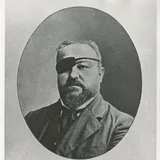
Eight times he finished fifth, and chess gave him a king's name for it — Richard the Fifth, half affection and half reproach. He was a one-eyed philologist who read Old French and Anglo-Saxon and spoke half a dozen modern languages, who could beat nearly anyone alive when he chose to, and who far more often took the draw, took the fifth prize, and went home. Then in 1911, at forty-two, he sat down at Karlsbad against twenty-five of the strongest players in the world and, for the only time in his life, played a great tournament at his full strength.
The one-eyed philologist
He was born in December 1868 at Lehnitzsch, a village outside Altenburg in the small duchy of Saxe-Altenburg. Very young — Alekhine's obituary says only that it happened early, and Capablanca reported that it was the result of an explosion — he lost the sight of his right eye. He could not tolerate an artificial one; the inflammation it caused was worse than the loss. For the rest of his life he sat at the board behind a patch, and everything he ever did in chess he did with a single eye and a body that gave him chronic trouble.
Chess was not the plan. He studied philology at Jena and at Berlin, and Emanuel Lasker later described him as an educated man who knew Old French and Anglo-Saxon and half a dozen modern languages, with whom one could discuss music and philosophy. He first drew attention as a player by winning a tournament of the Berliner Schachgesellschaft in 1890/91.
Sixteen years in London
In 1892, aged twenty-three, he moved to England to teach languages, and he stayed sixteen years. London was then the busiest chess city in Europe, and Simpson's Divan and the City of London Chess Club supplied a professional with enough small money to live on. He drifted into being a chess player by degrees, and never quite drifted back out.
His first international appearance came at the DSB Kongress in Leipzig in 1894, where he finished third behind Tarrasch and Paul Lipke and beat J. H. Blackburne along the way. He played the great Hastings tournament of 1895. He won a London City Club invitation tournament in 1900 ahead of Blackburne and Isidor Gunsberg, took the Simpson's Divan five-master event in 1901, and was second in the City of London tournament of 1904.
The eye shadowed all of it. At London in 1899 the trouble in his surviving eye forced him to withdraw after only four rounds. Reviewing a Teichmann victory in 1907, Emanuel Lasker put the matter exactly: in a short event he was a redoubtable opponent for anyone, but over a long contest the loss of the right eye always proved too severe a handicap. In 1908 he gave up London and went back to Berlin.
“Chess is 99% tactics.”
“So, finally, I decided that even the great Schlechter could not do wonders against natural moves, and I sent my minor pieces forward.”
“In a drawn-out contest, however, the loss of his right eye always proves too severe a handicap.”
“Like Lasker, Teichmann has Bohemian tendencies. He is an accomplished linguist; cannot extend himself to his best effort unless his whiskey and soda are at close call; and is clever at all games of cards and billiards. Work is no virtue with him, despite his massive bulk.”
“Despite his wrestler's build, he did not have the real temperament of a fighter and often settled for a draw.”
“The chronicle of human achievement does not include any more heroic deed than Teichmann's first prize in one of the strongest tournaments in chess history (Carlsbad, 1911).”
Richard the Fifth
The nickname came from the record: eight fifth places in international tournaments over two decades. It was not an accident of form. Fifth was, at most tournaments of the era, the last place that paid a prize, and Teichmann was a professional with no patron and no salary. A short draw against a dangerous man secured the money; a fight might lose it. He drew when the position was still alive, and his readiness to settle for a draw brought accusations of laziness.
The habit shows up starkly in the record. Against Carl Schlechter he played twenty-seven recorded games and drew twenty-one of them, winning four and losing two. Capablanca, writing in 1916, was blunter than most: “Like Lasker, Teichmann has Bohemian tendencies. He is an accomplished linguist; cannot extend himself to his best effort unless his whiskey and soda are at close call; and is clever at all games of cards and billiards. Work is no virtue with him, despite his massive bulk.” Rudolf Spielmann told a story that says the same thing more cheerfully: about fifteen moves into a match game against Friedrich Sämisch, with Sämisch pleased with his position, Teichmann stood up, pushed the pieces together, said “Genug des Stumpfsinns, Remis!” — enough of this tedium, a draw — and left for the circus to watch the wrestling, which had just begun.
The masters, though, knew what he was. Capablanca called him one of the finest players in the world and in 1914 counted him among the top five alive. His lifetime scores against the strongest of his contemporaries are the scores of a peer, not a straggler: level with Frank Marshall over thirty-one games, close against Akiba Rubinstein over twenty-two. He was an opening theorist of real depth and an endgame player of unusual patience; the games he chose to play out are clean, unhurried and free of theoretical vanity.
Edward Lasker remembered another side of him in Chess Secrets I Learned from the Masters (pp. 17–19). At Berlin's Café Kaiserhof, Teichmann sometimes passed up a paying game to analyze an opening idea with another master or even a student. He taught Lasker to judge moves by the activity of the pieces, rather than accept them because an opening manual recommended them. Lasker also recalled him quietly humming English folk songs during play, then raising his voice when he announced checkmate.
Garry Kasparov traces one of his contributions to opening theory in My Great Predecessors, Part I (game 55). Teichmann brought the Rio de Janeiro variation of the Ruy Lopez back from a South American tour in 1907. Named for the Brazilian player Vianna, its ...c5 idea appeared in Lasker's defense against Tarrasch in their 1908 world championship match.
Karlsbad, 1911
The year began badly, with a tenth place at San Sebastián in the spring. Then his mother died and left him a modest inheritance, and for the first time in his career he arrived at a great tournament without needing the prize money.
Karlsbad ran from 20 August to 24 September 1911: twenty-six masters, twenty-five rounds, 325 games, five weeks of chess. Lasker, Tarrasch and Capablanca stayed away, but nearly everyone else came — Rubinstein, Schlechter, Marshall, Nimzowitsch, Vidmar, Tartakower, Spielmann, Duras, Kostić, and an eighteen-year-old Alexander Alekhine. It was the kind of marathon that had always broken Teichmann's eye and his patience.
He scored 18 out of 25 and finished a clear point ahead of Rubinstein and Schlechter, who tied on 17. He beat both of them — the two men closest behind him — with the same variation of the Ruy Lopez. He was forty-two, and it was the only first prize of his life in a major international tournament. By January 1912 the retrospective rating lists place him fifth in the world. Capablanca reported that his friends marked the achievement by promoting him: they began calling him Richard the Fourth.
Lasker described Teichmann's return to Berlin in Chess Secrets I Learned from the Masters (pp. 136–139). He demonstrated the Schlechter win to an admiring audience, joking about bishops as cardinals and knights as cavalry. He also explained how long he had spent studying the bishop sacrifice before he was satisfied that it worked.
What the war took
August 1914 caught him in Switzerland, and he did not get home. He spent the war years there, editing the chess column of the Züricher Post, cut off from the German tournament circuit that had been his entire income.
The chess historian Michael Negele has documented what those years did to him. He fell into real destitution — poor enough to pick cigarette ends off the ground — and attempted to drown himself in Lake Geneva. Swiss chess circles came to his rescue with a sinecure in Zurich, and he survived. But he returned to Berlin around 1921 in his fifties with his health gone and something else gone with it, and he never again played a long tournament well.
Berlin, and the end
He was not finished as a player. In 1921, at fifty-two, he drew a six-game match with Alekhine in Berlin — two wins each and two draws — against a man six years from the world championship. He beat Sämisch in a short match in Berlin in 1922, played Teplitz-Schönau that same year and Karlsbad again in 1923. At that last Karlsbad, Tartakower recorded, the tournament director Tietz refused to ratify a draw Teichmann had agreed with Réti, on the grounds that Teichmann stood better and ought to play on. Teichmann played on, simplified without enthusiasm, and lost.
He composed problems and endgame studies, and took a prize in a three-mover tourney in Skakbladet in 1905. He left behind one sentence that outlived every game he played: “Chess is 99% tactics.” He never printed it. The Swiss master Erwin Voellmy recorded in 1930 that Teichmann had said it to him privately in Zurich — and added that Teichmann was exaggerating slightly.
Around February 1925 his health collapsed altogether. He entered the Virchow Hospital in Berlin and never came out of it, dying there on 12 June 1925 of chronic kidney and heart disease, aged fifty-six. He was buried two days later in the cemetery of the Golgatha church.
Legacy
The joke outlived him: a century later, Teichmann is still introduced as Richard the Fifth, the master who kept finishing fifth. That's unfair to a player Capablanca ranked among the five best alive, and odd for the man who won Karlsbad 1911 outright, beating Rubinstein and Schlechter with the same line of the Ruy Lopez in the same tournament. What he left is a small, solid body of work, with clean positional chess, patient endgames and no theoretical showing off, and one borrowed sentence, chess is 99% tactics, repeated by club players everywhere who have no idea it came from a one-eyed philologist from Saxe-Altenburg who was usually happy with a draw.
Books
Books Richard Teichmann wrote, co-wrote, edited, or contributed to. Translations and reprints are grouped under the same work.
-
Handbuch des Schachspiels, eighth edition
Contributor — opening theory
-
The Hastings Chess Tournament, 1895
Contributor — game annotations