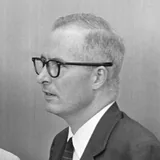
Robert Byrne grew up in New York with his brother Donald, and both learned from the teacher John W. Collins, who also taught Bobby Fischer. He made his name at the 1952 Helsinki Olympiad by beating David Bronstein, then spent most of the 1950s teaching philosophy at Indiana University. He came back to serious chess in the early 1960s, became a grandmaster in 1964 and turned professional in his forties. He won the U.S. Championship of 1972, finished third at the Leningrad Interzonal of 1973 and played Boris Spassky in the 1974 Candidates matches. He played in nine Olympiads for the United States and won seven medals, and from 1972 to 2006 he wrote the chess column of The New York Times. His last column was about the game against Bronstein.
The Collins kids
Byrne was born in Brooklyn on 20 April 1928, the son of Elizabeth Eleanor (Cattalier) and Robert Byrne, and graduated from Brooklyn Technical High School. He and his younger brother Donald were pupils of the New York chess teacher John W. Collins, as Fischer was, and the three of them were among the subjects of Collins's 1975 memoir My Seven Chess Prodigies. The brothers belonged to a generation of young American masters that also included Larry Evans, Arthur Bisguier and George Kramer.
His first master tournament was Ventnor City in 1945, at seventeen, where he scored 4 from 9; the winner was Weaver Adams. College then limited his chess. He played for the United States in the 1950 radio match against Yugoslavia, and in the 1951 Wertheim Memorial in New York, won by Samuel Reshevsky, he shared sixth and seventh places with 6 from 11.
Helsinki and the lecture hall
At the 1952 Olympiad in Helsinki Byrne played third board, won the board bronze medal and earned the International Master title. In the match between the United States and the Soviet Union he beat David Bronstein, who had drawn a world championship match with Mikhail Botvinnik the year before. The New York Times later wrote that this win first made Byrne famous.
He graduated from Yale the same year, took a master's degree at Indiana University and stayed there to lecture in philosophy through most of the 1950s, which left little time for chess. He still represented the United States in the team matches against the Soviet Union in New York in 1954, where he lost to Alexander Kotov 1½–2½, and in Moscow in 1955, where he lost to Paul Keres ½–3½.
“The hardest facet of chess to grasp, not only for the beginner but also for the master, is combinations. Unlike strategy, which is describable in terms of abstract principles, combinations do not generally appear in repeatable patterns.”
“The culminating combination is of such depth that, even at the very moment at which I resigned, both grandmasters who were commenting on the play for the spectators in a separate room believed that I had a won game!”
“It looks at times as though in this opening both sides get stuck in a sticky pudding after about fifteen moves.”
“He was a deep thinker, inventing his own variations and lines in different openings. He derived pleasure from original moves he prepared and injected into his games.”
“He looked calm during the games, but behind those eyeglasses was a fierce competitor.”
“Byrne, to his credit, recognized it. So one of his great losses is part of chess history.”
The return
Byrne played his first U.S. Championship in 1958–59, at thirty, and finished tied for ninth. A year later he was second with 8 from 11, behind Fischer and ahead of Reshevsky and Pal Benko. In 1960 he won the U.S. Open in St. Louis and scored 12 from 15 without a loss on third board at the Leipzig Olympiad, taking the board silver medal. On a South American trip in 1961 he shared second to fifth places at Mar del Plata behind Miguel Najdorf, and won at Santa Fe with 6½ from 7.
In the U.S. Championship of 1963–64 Fischer won all eleven games, including his third-round game against Byrne. Byrne later wrote that both grandmasters commenting for spectators believed he had a won game at the moment he resigned, so deeply concealed was Fischer's culminating combination. In 1964 Byrne finished third at Buenos Aires behind Keres and Tigran Petrosian, which made him a grandmaster. In the 1965–66 championship he shared second place and beat Fischer in their individual game, the only time he did so. In 1966 he shared first place in the U.S. Open at Seattle with Benko.
In 1971 Byrne worked as Fischer's trainer for the Candidates match against Petrosian in Buenos Aires. In My Great Predecessors, Part IV, Kasparov quotes Alexei Suetin's account of Byrne's frustration: he had spent all night analysing the adjourned sixth game, but Fischer returned his notebook and wanted to continue his own analysis.
Champion and Candidate
By the end of the 1960s Byrne was playing semi-professionally, and he became a full-time player in his forties, an age at which most top players are past their best. In the 1972 U.S. Championship he tied for first with Reshevsky and Lubomir Kavalek, and he won the three-player play-off in Chicago in 1973. That summer he scored 12½ from 17 at the Leningrad Interzonal and finished third, behind Anatoly Karpov and Viktor Korchnoi and ahead of Bent Larsen, Mikhail Tal and Svetozar Gligorić. He was the fourth American, after Reshevsky, Fischer and Benko, to qualify for the Candidates.
In My Great Predecessors, Part V, Kasparov records that Byrne began Leningrad with 6½ points from eight games before losing to Korchnoi in round nine. He describes it as the "tournament of his life."
In his quarter-final match at San Juan in January 1974 he lost to the former World Champion Boris Spassky by 1½–4½. As a Candidate he was seeded into the Biel Interzonal of 1976, where he shared fifth and sixth places with 11½ from 19 and missed the play-off for a Candidates place by half a point. He was the highest-rated American on the January 1977 FIDE rating list.
At the Olympiads he played for the United States nine times between 1952 and 1978, with 51 wins, 12 losses and 53 draws, and won seven team and individual medals. At Nice in 1974 he scored 12 from 16 on second board without a loss, and he played first board for the team that won the gold medal at Haifa in 1976.
Byrne played in the fifth and sixth series of the BBC's The Master Game (1980 and 1981), in which the players' recorded thoughts were heard as the moves were shown. He drew five of his six games and lost one, to Viktor Korchnoi. Against Michael Stean, with his pieces tied down, he said, “I feel as though I've been embraced by an octopus”, and he still saved the game. Jeremy James and William Hartston record in The Master Game, Book Two (1981) that he blamed a poor 1980, which included a muddle over the time control at Reykjavík, on impatience, “wanting to win games all at once instead of patiently establishing small advantages and then building upon them” (pp. 90, 113).
The Times column
In 1972 Byrne and Kavalek went to Reykjavík to report on the Spassky–Fischer match; Byrne covered it for Chess Life and Review and prepared the book Both Sides of the Chessboard with the Estonian grandmaster Iivo Nei. On 10 October 1972 The New York Times appointed him its chess columnist, succeeding Al Horowitz, and he wrote his first column from the Skopje Olympiad. He traveled to the major events with a typewriter and sent his columns by plugging his telephone into it.
He wrote the column for thirty-four years. Before the internet made live games easy to follow, it gave readers analysis and news from the top level that was often not available elsewhere. His last column, on 12 November 2006, was about his 1952 win over Bronstein. He also wrote for Chess Life, collected his columns in the book New York Times Book of Great Chess Victories & Defeats (1990), chaired the U.S. Chess Federation's committee on masters' affairs and served as one of its vice presidents.
The Times described him as a patient player who favored flank attacks and a solid pawn structure and was especially strong in the endgame. Kavalek, who played against him and next to him in four Olympiads, called him a positional player and a stubborn defender who in the 1970s gave up closed openings and became a dangerous 1.e4 player.
Legacy
Byrne died at his home in Ossining, New York, on 12 April 2013, eight days before his 85th birthday, after a long illness with Parkinson's disease. He was survived by his wife Maria, whom he married in 1971, his son Thomas and two grandchildren. He had been inducted into the U.S. Chess Hall of Fame in 1994.
Books
Books Robert Byrne wrote, co-wrote, edited, or contributed to. Translations and reprints are grouped under the same work.
-
Beginning Chess
Author
-
Both Sides of the Chessboard: An Analysis of the Fischer–Spassky Chess Match
Coauthor — Iivo Nei
-
The New York Times Book of Great Chess Victories and Defeats
Author
-
The Master Game, Book Two
Contributor — own game annotations