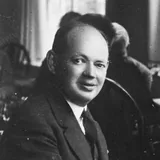
Rudolf Spielmann continued to play the King's Gambit and the Vienna Game when many leading masters had turned to quieter openings. At Carlsbad in 1923 he finished without a draw: five wins and twelve losses. His book, The Art of Sacrifice in Chess, explained both the appeal of attacking play and the practical judgment it required. A Viennese Jew, he fled Nazi persecution and eventually reached Sweden. He was found dead in his Stockholm apartment in August 1942, aged fifty-nine.
A son of Vienna's coffeehouses
Rudolf Spielmann was born in Vienna on 5 May 1883, into a large and literate Jewish family — his father Moritz was a journalist, and the household ran to brothers and sisters in a city then at the height of its café-chess golden age. The smoke-filled Viennese coffeehouses were the finest finishing school a young master could have, and Spielmann came up through them in the company of Réti, Tartakower and the rest of a brilliant Austro-Hungarian generation.
In his essays On Chess and Chessplayers, published in Russian in 1930, Spielmann recalled the Hauptturnier at Coburg in 1904 as his baptism of fire, and described the German federation's main tournaments of those years as the higher school for future masters of every country. He wrote that he, like Nimzowitsch, could have made a career teaching mathematics, and he called himself an amateur in the true sense, one whose love of chess had led him to devote his whole life to it. Over four decades he entered some hundred and twenty international tournaments, and by the years before the First World War he was already a feared attacker whose name appeared on the prize lists of the strongest events in Europe. Carl Schlechter, the leading Viennese master, was his friend; Spielmann adopted Schlechter's rule of keeping five minutes in reserve for the last move before the time control and found that it served him well.
The last knight of the King's Gambit
Spielmann favored the King's Gambit, the Vienna Game and the Center Game, continuing to use open gambits after most leading masters had abandoned them. He valued the beauty of a sacrifice, but also distinguished an attack's theoretical soundness from its chances in actual play. In Part II of The Art of Sacrifice in Chess, he explained that an opponent's weaknesses and time trouble could justify a practical risk even when later analysis found a defense: “We must distinguish between practical and theoretical soundness.”
His devotion had its perfect stage at Abbazia in 1912, a thematic tournament in which every game had to open with the King's Gambit — and Spielmann won it. The same romantic temperament produced his most extreme result at Carlsbad 1923: across seventeen rounds he scored five wins and twelve losses and not one draw, an all-or-nothing record no calculating professional would ever post. In Masters of the Chess Board, Réti described him as “the last bard of the Gambit Game,” particularly devoted to reviving the King's Gambit.
“Instinctively we place the moral value above the scientific.”
“The faculty, upon occasion, of converting energy into matter and matter into energy, constitutes one of the most wonderful characteristics of chess, and reveals, perhaps the innermost secret of its fascination.”
“Faith in the position is required, and faith in oneself.”
“The theory of chess is the work of the whole chess community.”
“Spielmann is the last bard of the Gambit Game, and what he wanted to revive especially was the King’s Gambit.”
“Spielmann is, in fact, the hardest-working of all the masters, continually searching out the flaws in his game and striving to eliminate them.”
“This seminal work was the first attempt to categorize and explain the different kinds of chess sacrifices.”
“No matter how much we have tried to convince Spielmann of the impossibility of surviving on nothing more than developing and attacking moves ... still he tries, almost as a matter of principle, to avoid the necessity of defense!”
Among the world's best
For all the losses that came with his daring, Spielmann was more than an entertainer: through the 1920s he was among the ten best players in the world. His best result was Semmering 1926, one of the strongest tournaments of the decade. The favorite was the rising Alexander Alekhine, but Spielmann finished first with 13 of 17, half a point ahead of the future World Champion.
Even the strongest players couldn't relax against him. Against José Raúl Capablanca, who once went years without losing a single game, Spielmann had a lifetime score of two wins, two losses and eight draws, beating the Cuban at Bad Kissingen in 1928 and again at Carlsbad in 1929. Over his career he won some thirty-three tournaments, from Abbazia and Stockholm to Pistyan and Semmering, almost always by playing boldly.
Carlsbad 1929 brought him close to first place. In his book of the tournament, translated into English by Jim Marfia, the winner Aron Nimzowitsch wrote that in the twentieth round "an exhausted Spielmann gathered up his last reserves of strength" and beat Capablanca, drawing level with Nimzowitsch. In the last round he let a probable win against Mattison slip and shared second and third prizes with Capablanca, half a point behind. Nimzowitsch also noted that the gambit player had suddenly taken up 1.d4. After New York 1927 Spielmann had studied rook endings from his large library, and in 1928–29 he worked through Nimzowitsch's books on positional play: "Here, by his own admission, he has come under my influence."
The art of sacrifice
Spielmann published The Art of Sacrifice in Chess in 1935. He distinguished the real sacrifice, whose outcome cannot be calculated with certainty, from the sham sacrifice, where a forcing sequence leads to a foreseeable result. The original book illustrated its argument with thirty-seven of his own games. In the introduction he explained that he chose them because he knew the reasons behind his decisions, rather than because he considered them the best possible examples. The young Tigran Petrosian bought the book as a boy and counted it among those that shaped him.
In chapter 6 he recalled being surprised by the strength of his own anti-castling sacrifice against Jacques Mieses at Regensburg in 1910. He remembered the lesson when a similar opportunity arose against Gereben at Sopron in 1934, nearly twenty-five years later. Discussing the later game, he acknowledged that analysis might refute his knight sacrifice, while judging it much harder to meet over the board with a time limit of eighteen moves an hour. He treated the clock and the defender's task as part of the decision.
His account of a King's Gambit win against Eljaschoff at Munich in 1903 was equally candid. Earlier games had reached the same position and continued with 19.Be3; one of them had shown a defense against that move. Spielmann found 19.Bf4 instead. “Luckily, perhaps for me, I did not know either game,” he wrote in chapter 7. He could approach the position without being influenced by those examples.
He also recognized the difficulty of creating attacking positions. In Meet the Masters (1940, p. 3), Max Euwe reported Spielmann's admiration for Alekhine: he could understand Alekhine's combinations, but could not explain how Alekhine obtained such lively positions from the opening. In his own book's epilogue, Spielmann invited criticism of his classification of sacrifices and called it a subjective first attempt. He regarded chess theory as the accumulated work of the whole community.
His 1930 essays show how he saw himself. He contrasted his temperament with Bogoljubov's: Bogoljubov kept his head in trouble but overrated his chances in good positions, while Spielmann never overrated his own play and lost heart easily when things went wrong. His one rule for the reader was to fight coolly. Troubled that the share of draws rose with the strength of the players (by his count 71 percent in the Lasker–Capablanca match and 74 percent in Capablanca–Alekhine), he proposed scoring each game out of seven points, weighted toward Black, so that a draw would give Black four points to White's three and prearranged draws would lose their appeal.
A fugitive without rest
History had no mercy on the gentle attacker. As a Viennese Jew, Spielmann watched the shadow of Nazism fall across his homeland and fled — first to the Netherlands, then to Prague, and at last, in 1939, to Sweden. He had hoped to reach England or America, but doors closed in front of him, and the world that had applauded his brilliancies in a hundred tournament halls now could not find him a place of safety.
His family was torn apart: his brother Leopold died in the Theresienstadt ghetto and his sister Irma in a concentration camp. Alone in Stockholm, increasingly poor and withdrawn, Spielmann shut himself away in his apartment, and in August 1942 he was found dead at the age of fifty-nine.
Legacy
Spielmann died in Stockholm on August 20, 1942, aged 59, officially of heart failure, but by then he was a broken refugee living in poverty and near-isolation, his best chess long behind him. He had fled Vienna ahead of the Anschluss and moved through the Netherlands and Prague before reaching Sweden in 1939; his brother Leopold died in Theresienstadt and his sister Irma in a concentration camp. His memoir, Memories of a Chess Master, was repeatedly delayed and never appeared, and his gravestone was inscribed, by report, “a fugitive without rest, struck hard by fate.” His work outlived him. The Art of Sacrifice in Chess is still in print and still studied, the Spielmann–Indian keeps his name in the openings, and he is remembered as the great romantic who believed that beauty and risk were worth more than a safe half-point.
Books
Books Rudolf Spielmann wrote, co-wrote, edited, or contributed to. Translations and reprints are grouped under the same work.
-
Handbuch des Schachspiels, eighth edition
Contributor — opening theory
-
Ein Rundflug durch die Schachwelt
Author
-
Richtig opfern! / The Art of Sacrifice in Chess
Author
-
Carl Schlechter, Volume I
Author
-
Carl Schlechter, Volume II
Author