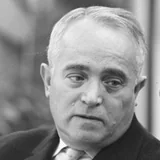
Salo Flohr was one of the leading players of the 1930s: a four-time Hastings winner, joint winner at Moscow in 1935 and FIDE’s designated world-title challenger in 1937. An agreement to face Alekhine followed, but the destruction of Czechoslovakia ended those plans. A refugee for the second time, Flohr settled in the Soviet Union and became a respected journalist, analyst and arbiter, remembered for his endgame technique and his contribution to opening theory.
Orphaned by the first war
Flohr was born in 1908 in Horodenka, a town in the Galician corner of Austria-Hungary that is now part of Ukraine, into a Jewish family. The First World War destroyed that family: his parents were killed in the violence that swept the region, and Salo and his brother fled west, refugees as children, settling in Czechoslovakia.
He had nothing to inherit but his own mind, and chess became the making of him. In the cafés of Prague he taught himself into a master, playing for stakes and reputation, and by his early twenties he had emerged as the finest player Czechoslovakia had ever produced — slim, immaculately dressed, famously cool at the board. He was a self-made man in the most literal sense, and the country adopted him as its own.
The golden decade
The 1930s belonged, for a while, to Flohr. He took first place at four consecutive Hastings Christmas congresses, from 1931/32 through 1934/35; the last was shared with Max Euwe and George Thomas. Euwe recalls that shared success in Garry Kasparov’s My Great Predecessors, Part II (2003), before Game 9. Flohr also excelled at match play, defeating Gösta Stoltz and Mir Sultan Khan and drawing hard-fought contests with Euwe in 1932 and the rising Soviet star Mikhail Botvinnik in 1933. At Moscow 1935 he shared first place with Botvinnik.
In reports reprinted in Mikhail Botvinnik’s Russian match book, Match Flohr–Botvinnik (1934), pp. 106–108, Flohr described about 2,000 spectators a day at Moscow’s House of Unions, watching on two four-metre demonstration boards. Speaking to Vechernyaya Moskva, he explained that match play demanded more caution than a tournament: he could not afford to risk a loss against Botvinnik.
His positional play and endgame technique brought him a reputation for precision. Botvinnik’s 1934 match book, pp. 21–22, describes a change in his style: his games of 1931 favoured attacks and combinations, while in 1932–33 he turned towards positional play, exchanges and endings. This was Botvinnik’s assessment after studying about 110 of Flohr’s games before their match. "It's much easier for me," he once said, "to calculate a forced ten-move combination than to find one best move in a strategically simple position." By the Chessmetrics reckoning he stood at world No. 2 in 1935. He was, briefly, everything a champion-in-waiting should be.
“It's much easier for me to calculate a forced ten-move combination than to find one best move in a strategically simple position.”
“They know that Boris has not been the champion, and on this occasion they want to allow him to have his turn.”
“This boy will go far!”
“Many of the endings which Flohr played in the thirties figured in my notebook of key endgame positions.”
Nottingham, and the scalps of champions
At Moscow on 2 June 1936, Flohr beat Lasker for the first time. Annotating the game in the Russian volume The Third International Chess Tournament, Moscow 1936 (1937), pp. 235–237, he explained that his disappointing tournament position had made him play for a win despite his opponent’s stature. He regarded the result as his first victory over a player who had held the world title and hoped it would be followed by others.
The peak of that decade came at Nottingham in 1936, one of the strongest tournaments ever assembled — Capablanca, Alekhine, Euwe, Lasker, Botvinnik and the young Americans all in a single hall. Flohr more than held his own, and in the space of a few days he beat two of the men whose names defined the game: the great Capablanca, and the aged Emanuel Lasker, a former World Champion, still formidable in his late sixties.
To stand in that company and take the scalps of both a reigning legend and the patriarch of the modern game was to announce, plainly, that Flohr was of championship class. The chess world agreed. The only question that remained was when, and against whom, he would play for the title itself.
The challenger the world denied
At the Stockholm FIDE Congress in August 1937, Flohr was chosen as the official world-title challenger. Euwe was still champion; Alekhine regained the crown later that year. Kasparov describes the vote in My Great Predecessors, Part II, before Game 20, and the subsequent negotiations in Part I (2003), “Undefeated”: an agreement signed in Prague in May 1938 envisaged play in several Czechoslovak towns in autumn 1939, with the prize fund guaranteed by the Tomáš Baťa footwear factory. The Munich Agreement of September 1938 disrupted those plans. A Jewish grandmaster from Prague had far more than chess to fear.
At the great AVRO tournament of 1938, the only time the world's top eight played in one event, Flohr, distracted and exhausted by events in Czechoslovakia, finished last, and his title hopes ended there. He fled again, as he had as a child, this time east to the Soviet Union in 1939, and became a Soviet citizen in 1942. He had been within reach of a world title match, and events took it away before a single move was played.
Flohr nevertheless accompanied Botvinnik to a private meeting with Alekhine after AVRO, as a witness to negotiations for a possible Moscow title match. In the account Kasparov quotes in Part I, after Game 147, Botvinnik thought Flohr was upset to see another man negotiating for the opportunity he had lost, but recalled that “he didn’t let it show”.
The writer and the master of endings
The war and the years that followed turned Flohr from contender into elder statesman. The sharper, more violent Soviet generation overtook him at the board — he qualified for the 1950 Candidates Tournament but finished near the bottom — yet he found a second vocation that made him beloved across the chess world. He became one of the finest chess journalists of his time, writing warm, witty, humane columns for Ogonek and the Soviet press, and he served the game as an International Arbiter from 1963.
His work as a second could be exhausting. In My Great Predecessors, Part II, Game 66, Kasparov retells a story Mark Taimanov told him about the twenty-third game of the 1951 Botvinnik–Bronstein match. Flohr spent the night analysing a winning continuation beginning 42.Bb1, then explained it to Botvinnik’s wife and continued showing variations in the car. Only at the entrance to the playing hall did Botvinnik reveal that he had sealed 42.Bd6 instead. In Taimanov’s account, Flohr burst into tears.
His humour also survived the change of generation. Kasparov’s My Great Predecessors, Part III (2004), p. 206, recalls his joke after Spassky scored 7/9 at Moscow in February 1961: the older players knew Boris had never been champion, Flohr suggested, and wanted to let him have his turn. He was teasing the tournament’s older generation.
His fingerprints stayed on the board long after he left the front rank. He was instrumental in raising the Caro-Kann Defence from an obscurity to a respected weapon, and his name attached itself to variations across half a dozen openings — the Flohr–Zaitsev system of the Closed Ruy Lopez was still being wheeled out by Anatoly Karpov in World Championship play in the 1980s. Botvinnik paid him the deepest professional compliment of all: many of the endgames Flohr played in the thirties, the future World Champion admitted, lived on in his own notebook of essential positions. Flohr died in Moscow in 1983.
Legacy
Salo Flohr gave chess a decade of flawless technique, a model of how to win endgames, and several opening ideas, including the revival of the Caro-Kann and the Flohr–Zaitsev Ruy Lopez, that lasted for generations after him. But he is remembered most for the title match he was never allowed to play: orphaned by one war, he came within a step of the championship, and the next war ended his chance. He dealt with that loss the way he had dealt with the first one, by starting over, and became the warmest chess writer of his time and a keeper of the game's endgame knowledge. He is still the great challenger who never got his match.
Books
Books Salomon Flohr wrote, co-wrote, edited, or contributed to. Translations and reprints are grouped under the same work.
-
12th Chess Tournament of Nations, Moscow 1956
Author
-
Sowjetschach I: Schach in der UdSSR 1917–1935
Coauthor — Alexander Kotov, Salo Flohr
-
Max Euwe
Author
-
Salo Flohr: Master of Tactics, Master of Technique
Contributor — game annotations and articles; edited by Jimmy Adams