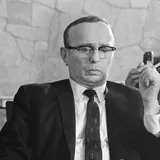
Before he was ten he was famous around the world: a tiny boy in a sailor suit who toured Europe and America taking on grown masters twenty at a time, and beating them. What's remarkable about Samuel Reshevsky is less that he was a prodigy than that he never went away. Seven decades later he was an Orthodox accountant who wouldn't touch a chessboard on the Sabbath, still at the board, still beating world champions in desperate time trouble. He never won the world title, because the timing and the politics never went his way, but he played eleven of the first twelve men who did, and he beat seven of them. No other American player has been so hard to beat for so long.
The boy who toured the world
He was born Szmul Rzeszewski in Ozorków, near Łódź, in 1911, then part of Russian-ruled Poland, and he learned the moves at four. By eight he was touring, giving simultaneous exhibitions across Europe against adults and winning nearly all of them; at a 1920 exhibition in Paris the eight-year-old beat every opponent in the room. People came to see something that didn't seem possible as much as to see chess.
In November 1920 his parents brought him to the United States to display his gift, and the boy played thousands of exhibition games up and down the country. In 1922, very likely the youngest competitor ever in so strong an event, he played the New York Masters tournament and defeated the old warhorse David Janowski. But a childhood spent on the exhibition circuit meant no schooling, and a Manhattan court took up the question of his guardianship. The philanthropist Julius Rosenwald, co-owner of Sears, Roebuck, stepped in to guarantee the boy's education. Reshevsky went on to graduate from the University of Chicago in 1933 — with a degree in accounting, as he recalled in the account quoted in Zenón Franco Ocampos's Learn from Sammy Reshevsky.
The accountant who would not play on the Sabbath
Reshevsky never made chess his living. He worked as an accountant his whole adult life, supporting a family — he married Norma Mindick and they raised three children — and fitting the greatest tournaments of the age around a day job. It made him, in a sense, the eternal amateur among professionals, and he believed that lack of full-time study, as much as anything, kept the world title out of his hands.
He was a devout Orthodox Jew, and he wouldn't play on the Sabbath or on the major Jewish holidays. Organizers learned to schedule around him; his games were postponed, doubled up or rearranged so that Friday sundown to Saturday sundown stayed free. He reached the top of world chess while keeping that rule, decade after decade.
“We often hear the terms “positional” and “tactical” used as opposites. But this is as wrong as to consider a painting’s composition unrelated to its subject.”
“Positional play is my forte, but when the situation demands it, I veer away from conservative continuations.”
“But what his team claimed they could do in the analysis room Geller could not do over the board.”
“I have come to the conclusion lately that it often pays to continue in equal positions, especially in the endgame where many players are more likely to go astray.”
“Reshevsky was probably the best chess player in the world.”
“What proved to be the last game of this ill-starred match is a good example of how Reshevsky, by virtue of pluck, stamina, and alertness, salvages a draw from a lost position.”
America's grandmaster
From the mid-1930s he was simply the best player his country had. He won the U.S. Championship eight times between 1936 and 1972 and competed in a record twenty-one of them, with the most top-three finishes, the most games played, and the most games won of anyone — and he had already taken the U.S. Open in 1931 at Tulsa and shared it with Reuben Fine in 1934.
His international breakthrough came in a single burst. In 1935 he ran away with Great Yarmouth on 10/11 and then took first at Margate, where he beat the former World Champion José Raúl Capablanca with the Exchange Variation of the Queen's Gambit Declined, a game still taught as a model of that structure. He shared third behind the elite at Nottingham 1936, tied for first at Kemeri in 1937, and in 1938 finished joint fourth at the famous AVRO tournament in the Netherlands, a field of arguably the eight strongest players alive.
Close to the title
Twice the crown came within reach. At the 1948 World Championship match-tournament in The Hague and Moscow — held to find a champion after Alekhine's death — he finished joint third with Paul Keres, behind only Mikhail Botvinnik and Vasily Smyslov. In 1950 FIDE named him a Grandmaster on its very first list. Then came his best chance of all: the Zurich Candidates of 1953, where he tied for second with Bronstein and Keres, two points behind Smyslov. Years later, in his book Secret Notes, David Bronstein wrote that the Soviet players had been instructed to stop Reshevsky from winning — a collusion other grandmasters later confirmed.
He kept knocking. He qualified again for the Candidates and lost a 1968 quarterfinal match to Viktor Korchnoi. Along the way he beat reigning and former world champions at will: leading the United States against the Soviet Union in 1955, he defeated the reigning champion Botvinnik over their short match. In all he faced eleven of the first twelve World Champions — from Emanuel Lasker to Anatoly Karpov, a span no one else managed — and defeated seven of them: Lasker, Capablanca, Alekhine, Euwe, Botvinnik, Smyslov and Fischer.
One of those late challenges brought him up against Efim Geller at the 1967 Sousse Interzonal. In The Art of Positional Play, Reshevsky recalled reaching a difficult pawn-up endgame. At the second adjournment, he wrote, Geller's team of analysts announced that their man could draw. He wrote: “But what his team claimed they could do in the analysis room Geller could not do over the board.”
Fischer, time-trouble, and the unending game
The fiercest rivalry of his later years was with the young Bobby Fischer, more than thirty years his junior. In 1961 they began a sixteen-game match across New York and Los Angeles; after eleven games it stood dead level — two wins each, seven draws — when it collapsed in a scheduling dispute with the organizer Jacqueline Piatigorsky, and Reshevsky was awarded the winner's share. He had outscored Fischer only once over a whole event, at Buenos Aires 1960, which he won jointly with Korchnoi while the young American faltered; he had reportedly arrived willing to finish next to last, provided Fischer came last. Fischer, for his part, reckoned that for a stretch of the 1950s Reshevsky had been the strongest player in the world.
He remained part of the strongest fields long after Fischer had become U.S. champion. At the Second Piatigorsky Cup in Santa Monica in 1966, he scored nine points from eighteen games, level with world champion Tigran Petrosian. In the tournament book's preface, director Isaac Kashdan noted that Reshevsky had started well and faded late; he also recorded that Reshevsky supplied annotations to six of his games for Second Piatigorsky Cup.
His style was practical, tenacious and deeply positional, lit by sudden tactics when the moment came. Famously he poured enormous time into the opening and then had to play whole endgames in seconds — a habit that produced both miraculous escapes and the occasional blunder, and that he admitted may have cost him the title. His books included Reshevsky on Chess, How Chess Games Are Won, and The Art of Positional Play.
The last of those books explains why his positional reputation never excluded tactical play. In its introduction he compared separating a position's strategic plan from its execution to separating a painting's composition from its subject. A sacrifice to expose the enemy king had tactical details but a positional goal. The examples included his own mistakes: against the young Henrique Mecking at Sousse in 1967, he admitted playing too quickly and underestimating his opponent's ingenuity. His notes to a win over Milan Matulovic at the same tournament explained another habit: he thought equal endings were worth continuing because opponents were more likely to make mistakes there.
After his win against R. Garcia in Buenos Aires in 1971, he reported that Garcia thought the Benoni Defense had been refuted. Reshevsky disagreed: Black could have played better, and his own inaccuracies had prolonged the game. He included the encounter in The Art of Positional Play as a lesson in blockading a passed pawn, without claiming that one success had settled an opening's merits.
And he never really stopped. He won the Reykjavík Open in 1984 at the age of seventy-two.
In June 1991, Reshevsky played a rapid match against the seventy-year-old Smyslov at the USSR Central Chess Club. Kasparov recalls in My Great Predecessors, Part II that the match ended 2–2 with no drawn games. After visiting the club’s museum, Reshevsky wrote in its guestbook that the visit made him feel his life had not been in vain.
He died in April 1992, having competed almost to the end.
Legacy
Samuel Reshevsky died of a heart attack at his home in Suffern, New York, in April 1992, at the age of eighty, after a career that ran from beating masters as a child after the First World War to beating Smyslov in his last full year. He is remembered as the second-greatest American champion, behind only the rival who finally overtook him; as a prodigy who kept playing at a high level all his life; and as the observant accountant who came close to the world title without ever giving up the Sabbath. Few players have been so hard to beat for so long.
Books
Books Samuel Reshevsky wrote, co-wrote, edited, or contributed to. Translations and reprints are grouped under the same work.
-
Learn Chess Fast!
Coauthor — Samuel Reshevsky, Fred Reinfeld
-
Reshevsky on Chess
Author
-
How Chess Games Are Won
Author
-
First Piatigorsky Cup International Grandmaster Chess Tournament
Contributor — game annotations; tournament book edited by Isaac Kashdan
-
Second Piatigorsky Cup International Grandmaster Chess Tournament
Contributor — own game annotations; tournament book edited by Isaac Kashdan
-
Reshevsky on the Fischer–Spassky Games
Author
-
Great Chess Upsets
Author
-
Reshevsky’s Best Games / Best Games, Volume 2: Challenging the Soviets
Author
-
The Art of Positional Play
Author