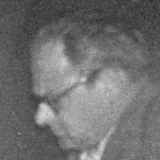
He was the man in the second chair. Semyon Furman came out of Pinsk and a Leningrad factory floor, learned chess late, went to the war, and only at twenty-seven walked into his first Soviet Championship final — where he finished third. With the white pieces they called him the world champion; with the black he was mortal, and the grandmaster title took until he was forty-five. But his real work was done off the stage: for Bronstein, for Botvinnik, for Korchnoi, and above all for a teenager from the Urals whom he helped to become the champion of the world.
Pinsk to a Leningrad factory floor
Furman was born in Pinsk on 1 December 1920 into a Belarusian Jewish family; his parents spoke Yiddish. In 1931 the family moved to Leningrad, and it was there, under the master Ilya Rabinovich — a positional player and the author of a classic Soviet endgame treatise — that the boy learned what chess actually was. He took no higher education. He went to work as a fitter in a factory and did his chess in whatever hours the shift left him.
By the standards of the prodigies he would one day teach, he was nowhere. In the All-Union candidates-to-masters tournament at Rostov-on-Don in 1939 he made 6½/13; in the same event at Kalinin the following year, 5/11; in the 1940 Leningrad Championship, 6½ out of 16. Then the war came. Furman served at the front and was decorated with the Medal for Combat Service, while behind him Leningrad closed under siege and organised chess was disrupted. He was twenty-four when it ended; in 1945 he shared first place in the All-Union first-category tournament at Gorky.
Third at the first attempt
Master of Sport in 1946. In 1947 he came through the Sverdlovsk semi-final, and in November 1948, aged twenty-seven, he sat down in Moscow for his first USSR Championship final. He finished third, behind only David Bronstein and Alexander Kotov, in a field that included Keres, Flohr, Levenfish and Bondarevsky — and he beat Keres, Taimanov, Averbakh, Kholmov and Levenfish along the way. Chessmetrics, reconstructing the era's strength long afterwards, puts him at world No. 11 that spring.
That should have been the start of an international career. It was not. Travel abroad was rationed to the very top of the Soviet list, and Furman was never on it. He took the International Master title in 1954 and played his first foreign tournament the same year, at Bucharest, aged thirty-three. He won the Leningrad championship in 1953 and shared it in 1954 and 1957; he played board ten for the USSR at the 1961 European Team Championship in Oberhausen and came home with a team gold; he shared fourth place with Paul Keres at the 1965 Soviet Championship in Tallinn. He kept reaching that final, on and off, for nearly thirty years. The Grandmaster title arrived only in 1966, when he was forty-five, after he won the international tournament at Harrachov.
His win over Keres in that first final ended with a knight underpromotion: 44.f8=N+ avoided the mating attack that making a queen would have allowed. Furman sealed 47.Qxd5, already with a winning position. In the notes later collected in Semyon Furman, he remembered Keres resuming play to test the young man's technique. He passed the test, and Keres resigned after 56.Qxh6.
“The sealed move. Here the game was adjourned, and Black could quietly resign. Keres, evidently, decided to test the ‘technique of youth’.”
“I was too confident that the position was won and my sealed move is a decisive mistake which lets the win slip.”
“Furman’s death killed something in me”
“When Furman started to work with Anatoly Karpov, I was not surprised by the young grandmaster's success, showing a brilliant understanding of grandmaster strategy.”
“Syoma had an excellent memory, but he never contented himself with it, trying to delve into everything himself, with his own analytical work.”
The world champion with White
He opened 1.d4, 1.c4 or 1.Nf3 and almost nothing else, and with those moves he was, by the standing verdict of the Soviet circuit, the world champion — the world champion when playing White was a phrase that followed him for years. The record bears it out. Nearly all his wins over the elite came with the white pieces, in games where the opponent was given no target, no counterplay and no air, and was slowly strangled by a strategy that was exact without ever being sharp. With Black he was less convincing, and his reputation rested on what he could do with White.
His real authority was in the openings. The Breyer System of the Ruy Lopez was known in the Soviet Union as the Furman–Borisenko System, and he left significant work behind in the Nimzo-Indian, the Queen's Indian, the King's Indian, the Grünfeld and the Queen's Gambit Accepted. The method was simply labour. He filled thick notebooks with variations and hand-drawn diagrams, carried his analysis out of the opening and deep into the endgame, and worked from a pocket set because the Leningrad flat had no room for anything larger. Mark Taimanov, who analysed with him until midnight and found him back at it the next morning, said the striking thing was that Syoma had an excellent memory and refused to lean on it.
One of his ideas reached the most visible board in chess. In My Great Predecessors, Kasparov credits Furman with 14.Bb5 in the Queen's Gambit line Fischer used against Spassky in the sixth game of their 1972 world championship match. Furman had played the line against Geller in Moscow in 1970; its use by Fischer showed how far an analyst's work could travel.
The trainer's trainer
Bronstein beat Furman in the 1948 championship. Later, impressed by the logic of his play, he invited him to help prepare for the 1951 world title match against Botvinnik. Konstantinopolsky was Bronstein's official second; Furman and Boleslavsky supplied additional help. Furman travelled as Bronstein's second to the Gothenburg Interzonal of 1955 and the Amsterdam Candidates of 1956. Botvinnik himself played long series of training games against Furman before the title matches of 1960 and 1961 — kept private at the time, published only many years later — and by Karpov's account used him again as an assistant against Petrosian in 1963. Viktor Korchnoi took him for the 1968 Candidates quarter-final against Reshevsky. Efim Geller worked with him too.
At Varna in 1962 the work ran through the night. Botvinnik had adjourned a difficult rook ending against Fischer, and Furman joined him, Geller and Keres upstairs while Tal, Boleslavsky and Spassky analysed below. Geller found the key drawing idea; the groups exchanged their conclusions, and Botvinnik recalled that Furman did not leave him until half past five in the morning. The champion saved the game the next day.
In 1971 those loyalties crossed. Korchnoi asked Furman to second him against Geller. Furman and Geller were clubmates at the Army sports club and Furman had trained him; he refused on principle and withdrew his services. Korchnoi won the match anyway. Three years later, in the Candidates final that decided who would challenge Bobby Fischer, the man who knew Korchnoi's chess from the inside was sitting in Anatoly Karpov's room.
Karpov
They had met in 1963, at a training session run by Botvinnik, when Karpov was twelve. The working relationship began five years later at the 1968 Soviet Team Championship in Riga, where the seventeen-year-old was playing the junior board for the Army club and Furman was there in a training role; the two got on, and Karpov made 10/11. From 1969 Furman was his trainer, and Karpov rearranged his life around it — leaving Moscow for Leningrad and transferring from Moscow State University to Leningrad State University to be near him. That year Karpov won the World Junior Championship at Stockholm, the first Soviet victory at that level since Spassky in 1955. A few months later, at a Soviet Championship he had not qualified to play in, it was Karpov who sat in the second chair for Furman.
Furman taught him how positions actually work while leaving his natural instincts intact. Karpov recalled an early demonstration after Furman's game with Leonid Stein in the 1969 Soviet final. Furman introduced his young pupil to Stein as they analysed: the trainer offered broad evaluations, while Stein produced rapid concrete variations. Karpov watched two different ways of understanding the same position.
During the 1974 Candidates final, according to Yuri Razuvaev's recollection in My Great Predecessors, Geller wanted Karpov to play more aggressively. Furman listened, quietly smoking, and answered that Geller should find another pupil if he wanted to teach that style: he liked Karpov's play as it was. The trainer was protecting the player's strengths.
Once Karpov had the standing to arrange it, he brought his trainer along with him: Madrid 1973, Portorož and Ljubljana 1975, Bad Lauterberg 1977. Karpov won all three; Furman took or shared third in all three, at fifty-two, fifty-four and fifty-six — the best sustained run of his playing life, produced in his sixth decade. At Portorož and Ljubljana in 1975 he shared third with Vlastimil Hort and Zoltán Ribli on 9½ of 15, beating Hort and losing only to Ribli, and annotated eight of his games for Hort's tournament book, Portoroz/Ljubljana Grandmaster Chess Tournament 1975. Hort wrote that his game with Karpov “was expected to be a draw and it would have been a poor return from a World Champion to his trainer and second if the result had been otherwise.” The USSR named him an Honoured Trainer in 1973 and put him in charge of the national team at the 1974 Nice Olympiad and the 1977 European Team Championship in Moscow. Between sessions the two played bridge, endlessly; for a while it became something close to an obsession for Furman.
Baguio without him
Furman was a heavy smoker, and his health had been bad since the middle sixties. He was operated on for stomach cancer in 1966 — the same year he finally became a grandmaster — and lived eleven years on the reprieve. When it returned he went on working and went on playing: he was already ill at Bad Lauterberg in the spring of 1977, and finished third there anyway, a year before he died.
At Belgrade in 1977, Furman had to defend his own position too. Alexander Roshal later told Kasparov that Sports Committee officials pressed him to help Spassky against Korchnoi, his former pupil. Roshal called Karpov, who gave Furman a reason to refuse: assisting Spassky would disclose the champion's preparation. According to Roshal, the officials then left him alone.
He died in Leningrad on 17 March 1978 and was buried in the Cemetery of the Victims of 9 January. That July Karpov sat down in Baguio to defend the world championship against Viktor Korchnoi — the one opponent Furman had understood better than anybody alive — and held it by a single game, +6 −5 =21. Years later, Karpov recalled how hard it had been to absorb new ideas or make himself work after his trainer's death.
Legacy
Karpov edited the memorial volume. Semyon Furman appeared in Moscow in 1988 — a biography and a hundred and fifteen mostly annotated games, the champion putting his trainer's own chess on the record ten years after his death. Genna Sosonko, who called Furman "essentially my only trainer", gave him a chapter in Russian Silhouettes under the title You Ask the Questions. Memorial tournaments began in 1982, and Pinsk has held its own since 2004. Chess has never been generous about crediting the second chair, and Furman had worked in it for Bronstein, Botvinnik, Korchnoi and Geller before he ever met Karpov; the case that he was the most successful coach the game has produced is not an extravagant one. He was a factory fitter who beat Botvinnik, Smyslov, Petrosian, Spassky and Tal across the board — and then helped one more world champion understand the game.
Books
Books Semen Furman wrote, co-wrote, edited, or contributed to. Translations and reprints are grouped under the same work.
-
Portoroz/Ljubljana Grandmaster Chess Tournament 1975
Eight commissioned game annotations, index p.191