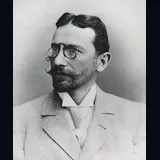
He was the best player who never wore the crown, and the teacher who mattered more than any crown could. Siegbert Tarrasch was a doctor of medicine who spent his life proving that chess obeyed laws — that beauty over the board was not luck or genius but the visible result of right principles, learnable and teachable by anyone willing to study. He took the hard, half-spoken discoveries of Wilhelm Steinitz and turned them into clear rules a club player could carry in his head, and in doing so he gave the game some of the most beloved sentences ever written about it. They called him Praeceptor Germaniae, the Teacher of Germany. He taught the world.
The doctor who played chess
Tarrasch was born in Breslau in 1862, in the Prussian east, and trained as a physician — a profession he never abandoned for the game that made him famous. He settled into a medical practice in Nuremberg, raised a large family, and pursued chess as the most serious of avocations. His medical practice also limited the time he could devote to a championship challenge.
His own account of choosing medicine is unexpectedly personal. In Three Hundred Chess Games he recalled abandoning an intended course in philology after seeing a doctor help the seriously ill young woman he loved. As a student in Berlin, chess then crowded out his studies. After a disappointing result at the 1881 congress, a physiology lecture by du Bois-Reymond awakened his interest in science. He described catching up three neglected semesters in one and passing his first medical examination. He had found a way to keep both medicine and chess.
When his prime came, it was overwhelming. His victories at Breslau in 1889 and Manchester in 1890 made him a leading challenger to Wilhelm Steinitz. After Manchester the Havana Chess Club offered him a match with the world champion, but he declined, citing his medical practice. The title went instead, in 1894, to a young mathematician named Emanuel Lasker.
The best player who never was champion
What he could not win in a title match he won everywhere else. Tarrasch took first prize at Breslau 1889, Manchester 1890, Dresden 1892, and Leipzig 1894 — an unbroken run of victories that established him as the dominant tournament player of his era. He won the great Vienna tournament of 1898 after a play-off with Harry Pillsbury, and as late as 1907, at Ostend, he finished ahead of Schlechter, Janowski, Marshall, Burn and Chigorin to claim one last grand first prize.
Nuremberg was his chess base as well as his home. As first chairman of the Schachclub Nürnberg he opened the club’s international tournament on 19 July 1896, held alongside the Bavarian state exhibition. In his opening address he said the club had wanted a tournament of real masters only, in which victory would be the highest honor for anyone and defeat a disgrace for no one. With the club’s second chairman, Christian Schröder, he edited Das internationale Schachturnier des Schachclubs Nürnberg (1897): Tarrasch annotated the games and Schröder wrote the account of the event. Tarrasch scored 12 from 18 and shared third and fourth prizes with Harry Pillsbury, behind Emanuel Lasker and Géza Maróczy. His eighteenth-round loss to Lasker decided first prize, and in his notes he called his own ninth move in that game a serious error. Schröder’s report of the last round tells how Pillsbury and Steinitz, who had to play each other, agreed that whichever of them won would pay Adolf Albin £10 if Albin beat Tarrasch, and half that for a draw. According to the report the committee disapproved, Albin played until eleven at night, and Tarrasch won.
In 1893 he travelled to St Petersburg to face Mikhail Chigorin in a match that has become legend for its ferocity: twenty-two games, no quarter given, ending dead level at +9 −9 =4. Two years later he beat Lasker himself at Hastings 1895. Against Frank Marshall in 1905 he was simply crushing, winning their match +8 −1 =8. For a decade and a half he was a fixture at or near the top of every elite field he entered — the eternal contender, garlanded everywhere but the one place he most wanted to stand.
“Chess, like love, like music, has the power to make men happy.”
“Before the endgame the gods have placed the middle game.”
“He who fears an isolated queen's pawn should give up chess.”
“The right standpoint is to play for pleasure—and do not think that pleasure is proportional to skill.”
“From Anderssen I learned the art of making combinations; from Tarrasch I learned how advantageously to avoid making them.”
“Tarrasch's play was razor-sharp, and in spite of his devotion to this supposedly scientific method of play, his game was often witty and bright.”
Praeceptor Germaniae
Tarrasch's deepest gift was not competition but instruction. Steinitz had discovered the principles of positional chess but expressed them obscurely, in dense and difficult prose; Tarrasch translated them into rules so clear that a beginner could learn and a master could not dismiss them. Control the centre. Develop with purpose. Give your pieces room — for a cramped position, he taught, carries within it the germ of defeat. His most famous maxim, the Tarrasch rule, still governs endgame play: rooks belong behind passed pawns, behind one's own to drive them forward, behind the enemy's to hold them back.
He poured these ideas into books that taught generations: Dreihundert Schachpartien (Three Hundred Chess Games), the monumental Die moderne Schachpartie, and at the last his most beloved manual, Das Schachspiel — translated as The Game of Chess. His openings entered the permanent canon: the Tarrasch Defence to the Queen's Gambit, which accepts an isolated pawn for free, active piece play, and the Tarrasch Variation of the French Defence. Of his own defence, attacked by the experts, he wrote with characteristic defiance: "The future will decide who has erred in estimating this defence—I or the chess world."
His textbook shows how much thought lay behind the teaching. In the preface to The Game of Chess, he begins with simple positions and teaches endings before openings, because a beginner can more easily handle a few pieces than all thirty-two. Rules supplied a starting point for judgment. Kasparov later described Tarrasch's celebrated dogmas as accessible, witty instructional material rather than eternal truths. His notes to the Nuremberg tournament book show the same edge. He mocked a long-accepted line of the Berlin Defense to the Spanish Game, in which a knight spends four of the first eight moves reaching b7. Adapting Mephistopheles in Goethe’s Faust, he added that bad moves are inherited like an eternal disease. The hypermodern generation delighted in testing those rules, but a club player who has never read Tarrasch still thinks in the language he helped build.
Lasker
The route to Lasker was interrupted as well as postponed. A match planned for autumn 1904 fell through after Tarrasch suffered a serious fracture while skating. In his own account of the 1908 negotiations, the decisive telephone call arrived on March 15 while he was having afternoon coffee with his family and debating whether to enter a tournament. Schenzel brought news of Munich's invitation to stage the championship match. Tarrasch accepted with delight.
He wanted the rivalry settled. During the negotiations he wrote that even an emphatic defeat would be preferable to uncertainty about who was stronger. The answer on the board was decisive: Lasker won by eight wins to three with five draws. Their rivalry could be bitter, but in 1914 Tarrasch praised Lasker's bold play against Marshall and defended the champion's substantial appearance fee: "Who else could play like this!"
Legend holds that at their introduction before the match, Tarrasch clicked his heels, bowed stiffly, and said: "To you, Dr. Lasker, I have only three words — check and mate." Whether or not the story is true, Lasker's victory settled the championship. They played another match in 1916, and again Lasker prevailed. Tarrasch would never hold the highest title, but two of his wins from the 1908 match survive in this archive. Game 10, linked below, ends with the sealed rook move 32.Rd6 and Lasker's resignation: even in defeat the teacher could still play.
The gathering dark
Tarrasch had been born Jewish and converted to Christianity in 1909; he was, in his own heart, a thoroughly patriotic German. He and his wife raised five children, and the First World War took one of his sons — a private grief beneath the public career.
Even in his fifties he could still beat the very best. At the great St. Petersburg tournament of 1914, won by Lasker ahead of Capablanca and Alekhine, Tarrasch finished fourth in a very strong field and beat the young José Raúl Capablanca, who would soon be world champion. In his tournament diary he blamed a recurrence of hepatic colic for four consecutive losses in the final stage. He kept teaching, writing and editing chess journals to the end. He died in Munich in 1934, just as the Nazi regime, which would have persecuted him for his Jewish birth, was taking hold of the Germany he loved.
The first English edition of The Game of Chess appeared in 1935, after his death. Its translators, G. E. Smith and T. G. Bone, recalled a letter written about a month before he died, announcing intended opening revisions after three years of analysis. A search of his papers found no written version of that new material. They therefore incorporated analysis he had already published in Tarraschs Schachzeitung and added five annotated games, bringing the English selection to twelve.
Legacy
Tarrasch died in Munich on February 17, 1934, a patriotic German who lived long enough to feel the antisemitism rising around him. The hypermodern generation, Nimzowitsch, Réti and Breyer, had already made a habit of rebelling against his rules and mocking how dogmatically he stated them, but everything they did started from what he had built. His openings are still played at the highest level: the Tarrasch Defense to the Queen's Gambit and the Tarrasch Variation of the French Defense carry his name into the 21st century. His Das Schachspiel, translated as The Game of Chess, stayed a popular primer for decades after his death. Above all he is remembered for taking the scattered principles of positional chess and turning them into something everyone could learn: the doctor who taught the world how to play.
Books
Books Siegbert Tarrasch wrote, co-wrote, edited, or contributed to. Translations and reprints are grouped under the same work.
-
Das Champion-Turnier zu Ostende im Jahre 1907
Author
-
Das internationale Schachturnier zu Nürnberg 1896
Coauthor — Chr. Schröder
-
Das Schachspiel / The Game of Chess
Author
-
Der Schachwettkampf Lasker–Tarrasch um die Weltmeisterschaft
Author
-
Der Schachwettkampf Marshall–Tarrasch im Herbst 1905
Author
-
Der Schachwettkampf Schlechter–Tarrasch
Author — with contributions by Dr. Deichmann
-
Der Schachwettkampf Tarrasch–Mieses im Herbst 1916
Author
-
Die moderne Schachpartie
Author
-
Dreihundert Schachpartien / Three Hundred Chess Games
Author
-
Защита ферзевого гамбита (The Queen’s Gambit Defence)
Author
-
Что каждый должен знать о мительшпиле (What Everyone Should Know About the Middlegame)
Author
-
Handbuch des Schachspiels, eighth edition
Contributor — opening theory
-
Das Grossmeisterturnier zu St. Petersburg im Jahre 1914
Author
-
The Hastings Chess Tournament, 1895
Contributor — game annotations