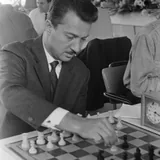
Svetozar Gligorić grew up in a poor Belgrade household and carved his first chess pieces from wine-bottle corks. After serving as a Partisan in the Second World War, he became one of the world's leading grandmasters in the 1950s and 1960s, winning eleven Yugoslav championships and reaching the Candidates stage three times. He combined competitive chess with journalism, contributed extensively to opening theory and explained his approach in the title of his games collection: I Play Against Pieces.
The boy at the tavern window
Gligorić was born in Belgrade in 1923 into a poor family. His father died when he was nine. He watched people playing chess through a neighborhood tavern window and learned the rules at about eleven from a boarder his mother had taken in. In I Play Against Pieces (p. 7), he recalled that neither parent knew anything about chess; his mother cared about his schoolwork and paid little attention to his early chess successes.
A broken arm at thirteen pulled him away from football, his first love, and pushed him deeper into chess. Too poor to buy a set, he carved his pieces from wine-bottle corks and drew a board with school ink. He studied newspaper chess columns with his homemade set. His autobiography distinguishes the Belgrade junior titles he won in 1937 and 1938 from the adult Belgrade Chess Club championship he won early in 1939. That summer he became a national master in Zagreb, aged sixteen. After his mother's death in November 1940, Dr. Niko Miljanić took him into his family (p. 7).
The partisan
Gligorić left Belgrade with the Miljanić family in 1941 and went to Montenegro. In 1943 he joined the Partisans. In I Play Against Pieces (pp. 7–8), he described commanding a small unit with a heavy mortar and a machine gun; he finished the war with two decorations and the rank of captain. He returned to Belgrade in 1945 after four years away and resumed competitive chess, finishing second in the Yugoslav Championship at Novi Sad.
At Warsaw in 1947 he scored seven wins and two draws, finishing two points ahead of Vasily Smyslov and Isaac Boleslavsky. The International Master title followed in 1950 and the Grandmaster title in 1951 — making Gligorić, after Boris Kostić, the second Serbian grandmaster. Chess shared his time with a continuing career in journalism. He worked for a daily newspaper from 1945, moved to the weekly NIN in 1954 and joined Radio Belgrade in 1960 to have more time for chess (I Play Against Pieces, pp. 8–9).
He nearly gave up chess after missing qualification for the next world championship cycle in the 1953 national championship. He turned to foreign-affairs journalism and thought the 1954 Belgrade international might be his last tournament. His final-round win over Petrosian brought the audience to its feet. He recalled turning his back to hide his emotion, and continued playing (I Play Against Pieces, p. 252, game 120).
“Out of some 3000 tournament games I have played so far, there are many I just can’t remember—not even when I see them published in books, magazines or bulletins.”
“The so-called ‘psychological’ approach to chess is uncharacteristic of me.”
“It was then that I decided that in the future I would rather play with a greater degree of risk than lose another game like that.”
“The beauty of logic and its attendant righteousness is the enchanting feature of chess.”
“Even when it's good, don't do it!”
“Gligorich’s play is marked by two qualities also revealed in his annotations to the games in this book: logic and thoroughness.”
“Gligoric is in the group of world grandmasters with the largest number of anthology games”
“He had character and was a very strong player.”
“We were always good friends, because Gligorić was one of my mentors.”
“he used to be a forthright attacking player, but gradually compromised until he evolved a style somewhere between Rubinstein and Capablanca that made him world famous”
The best of the West
During the 1950s and 1960s, Gligorić was one of the leading players outside the Soviet Union. He won the Yugoslav Championship a record eleven times between 1947 and 1966, and finished in the national top three an unmatched eighteen times. His tournament record reads like an atlas: Mar del Plata, Stockholm, Dallas, Belgrade, Manila, Lone Pine, and five victories at Hastings. Through him a small country became, for a time, the second power of the chess world.
On the big stage he was relentless. Across fifteen Chess Olympiads he won twelve team medals, a record, and at Munich in 1958 he took the individual gold medal on board one, finishing ahead of the reigning World Champion Mikhail Botvinnik and the former champion Max Euwe. He played in the Candidates Tournaments of 1953 and 1959 and the Candidates matches of 1968. In his autobiography he recalled that Bronstein rated him world number three in 1958, the year of his Munich gold and second place at the Portorož Interzonal (p. 9). In 1970, when Belgrade hosted the USSR versus the Rest of the World match, Gligorić played board five for the world team. Over his career he beat six men who held the world title, Euwe, Botvinnik, Smyslov, Tal, Petrosian and Fischer among them, twenty-four times.
At the 1967 Sousse Interzonal, his second Dragoljub Velimirović changed his routine. Gligorić had intended to rely on intuition, but Velimirović insisted on two or three hours of opening preparation each morning. He also walked barefoot along the beach for an hour before lunch. At forty-four, he finished as the tournament's only undefeated player and qualified for another Candidates cycle (I Play Against Pieces, pp. 10–11).
Tal’s account of their 1968 Candidates match, reproduced in My Great Predecessors, Part III, gives another measure of Gligorić’s sportsmanship. Although the Belgrade crowd supported the home player, Tal credited his opponent with keeping the atmosphere friendly and equally welcoming to both sides. Gligorić led 3–2 before Tal recovered to win the match 5½–3½.
At the Vidmar Memorial of 1975 in Portorož and Ljubljana, Anatoly Karpov's first tournament as world champion, Gligorić finished second with 10 of 15, a point behind Karpov; his only loss was to Lajos Portisch. He annotated six of his games for Vlastimil Hort's tournament book, Portoroz/Ljubljana Grandmaster Chess Tournament 1975 (1977). Against Marjan Karnar he met a move he had long feared: “I have been afraid of this move in the past because although I felt that it should be wrong I did not know how to refute it.” The same year, Jeremy James and William Hartston wrote in The Master Game, Book Two (1981), he received Yugoslavia's highest honor for contributions to culture and science and “promptly took a year's holiday from chess. It did him no harm.”
In the 1981 series of the BBC's The Master Game Gligorić was the oldest player; James and Hartston noted that he still played football at nearly sixty. He beat Vlastimil Hort but lost his first game to the teenage Nigel Short. Recording his thoughts on that game, he said: “I played against all the rules of chess. I decentralised my pieces and now he's coming in and I have no more good moves.”
I play against the pieces
The title I Play Against Pieces came from an interview with the editor of his original Russian games collection, published in 1981. In the English edition's foreword, Gligorić explained that the title expressed his view of chess as an art and a fair contest of ideas, free of personal hostility. His account of Budapest 1948 gives a practical example. As a Yugoslav chess organizer, he gave his tournament invitation to Tomović, a prewar national runner-up, to avoid being accused of using his position for his own benefit. The Hungarian organizers then invited a third Yugoslav player, allowing Gligorić to compete; he finished second behind László Szabó (pp. 117–118, game 58).
Gligorić's association with the King's Indian began with a change of mind. He had doubted the opening's soundness for years, but after losing a passive Queen's Gambit position to Ståhlberg at the 1952 Saltsjöbaden Interzonal, he decided to take more risks. A win with the King's Indian against Geller in his next game with Black encouraged him to keep it (I Play Against Pieces, p. 153, game 75). Bent Larsen, who thought the King's Indian incorrect but often liked playing it, wrote in How to Open a Chess Game (1974) that Gligorić “will not understand what his beloved King's Indian is doing there” among the incorrect defenses.
His work helped establish the Mar del Plata Variation. In Selected Chess Masterpieces, chapter 41, “So Many Years of Exploration,” he credited Aronin and Bronstein with earlier use of its initial move, while explaining his own contribution to Black's development scheme at Mar del Plata in 1953. The King's Indian also has a Gligorić Variation, although he acknowledged that Bronstein, Reshevsky and others had played it before him (I Play Against Pieces, p. 164). His name appears in the Nimzo-Indian and Ruy Lopez too. His contests with Fischer were close: in his own account of their 1962 Varna game, he admitted that his fourth and last win over Fischer came from a bad position (p. 59, game 24).
His ideas also reached the next generation. Kasparov recalls in My Great Predecessors, Part III that Botvinnik encouraged him to study Gligorić’s classic King’s Indian games. Kasparov later returned to Gligorić’s defensive ideas against a kingside pawn advance when developing his own treatment of the opening.
Journalist, author, composer
Fluent in several languages, Gligorić wrote columns for Chess Review and Chess Life and contributed for years to the Chess Informant. Selected Chess Masterpieces collected forty-five of his “Game of the Month” columns, examining other leading players as well as his own games. In the introduction, I. A. Horowitz praised the logic and thoroughness of both his play and his annotations. His 1972 book on the Fischer–Spassky match in Reykjavík became a bestseller; he reported 400,000 copies and translations from English into five other languages (I Play Against Pieces, p. 11). He was chief arbiter of the 1984–85 Karpov–Kasparov World Championship match, which was eventually stopped without a winner.
Fischer also suggested that he write about randomized chess. In the Author's Note to Shall We Play Fischerandom Chess? (2002), Gligorić recalled witnessing part of Fischer's work on the new game. He wrote the book in English over the years 1996–2002; Charles Crawford, the British ambassador to Yugoslavia, read the manuscript and advised him on English style.
His last passion was music. In his eighties he began taking lessons in harmony, and he composed in earnest, releasing a CD of his own work — jazz, blues, ballads, even a touch of rap — in 2011. He drew the parallel himself, between the two disciplines that had filled his life: “Each note is a move and from these elements you create your own architecture with known rules.”
Legacy
Gligorić died in Belgrade on August 14, 2012, aged 89, after a stroke, and was buried in the Alley of the Greats at the city's New Cemetery; the New York Times and newspapers across Europe ran obituaries of the most famous grandmaster the Balkans had produced. He holds the record for Yugoslav Championship titles and was one of the most decorated Olympiad players in history. Yugoslavia had named him its best athlete of 1958, and the honors continued after his death: in 2019 FIDE established the Fair Play Svetozar Gligorić Trophy, awarded each year for sportsmanship and ethics at the board, and in 2020 Serbia put him on a postage stamp in its Chess Giants series. He is remembered as a top-ten player, an outstanding opening theorist, a fine journalist and a real gentleman, the boy from a Belgrade attic who carved his pieces from corks and grew up to hold his own against the best Soviet players.
Books
Books Svetozar Gligorić wrote, co-wrote, edited, or contributed to. Translations and reprints are grouped under the same work.
-
Selected Chess Masterpieces
Author
-
Šahovska azbuka
Contributor — instructional contributions
-
Fischer vs. Spassky: The Chess Match of the Century
Author
-
How to Open a Chess Game
Coauthor — Larry Evans, Vlastimil Hort, Tigran Petrosian, Lajos Portisch, Paul Keres, Bent Larsen
-
The French Defence
Coauthor — Wolfgang Uhlmann
-
The Najdorf Variation of the Sicilian Defence
Coauthor — Efim Geller, Boris Spassky, Lubomir Kavalek
-
Play the Nimzo-Indian Defence
Author
-
Šahovski vodič, T.1: Suština šaha
Author
-
Peti meč Kasparov–Karpov za titulu svetskog prvaka
Author
-
Gligina varijanta
Author
-
Shall We Play Fischerandom Chess?
Author
-
I Play Against Pieces
Author
-
Interzonen-Turnier Portoroz1958
Coauthor — Aleksandar Matanovic
-
Kandidatenturnier für Schachweltmeisterschaft: Bled–Zagreb–Beograd1959
Coauthor — Viacheslav Ragozin
-
King's Indian Defence: Mar del Plata Variation
Author
-
Le Grand Tournoi International d'échecs: Terre des Hommes, Montréal1979
Author
-
The Sicilian Defence, Book One
Coauthor — Vladimir Sokolov
-
The World Chess Championship
Coauthor — Robert Wade
-
Yugoslav Chess Triumphs
Coauthor — Petar Trifunovic, Rudolf Maric, Dragoljub Janosevic
-
The Master Game, Book Two
Contributor — own game annotations
-
Portoroz/Ljubljana Grandmaster Chess Tournament 1975
Six game annotations, index p.191