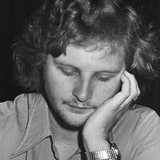
Tony Miles led the rise of English chess in the 1970s and 1980s. World Junior Champion in 1974, he became in 1976 the first English-born player to earn the grandmaster title over the board, and within a few years he was beating World Champions. He answered Anatoly Karpov's 1.e4 with 1...a6 and won, won Tilburg in 1984 by a point and a half, and reached ninth in the world in 1986. He was original in the opening, sharp-tongued away from the board, and tireless: he played an extraordinary number of tournaments, from super-tournaments to weekend opens, until the end of his life.
Birmingham
Miles was born in Edgbaston, Birmingham, on 23 April 1955, and his father taught him chess at five. He went to King Edward's School, won the British Under-14 Championship in 1968 and the Under-21 title in 1971, and went to Sheffield University to study mathematics.
In the collection Tony Miles: It's Only Me, he recalled playing with his father every night for a year, getting bored, and leaving chess alone for three years. A school chess craze brought him back at nine. At eleven he won the Birmingham Primary Schools Championship and joined Birmingham Chess Club, where Bernard Cafferty and Peter Gibbs encouraged him (p. 11).
In 1973 he took the silver medal at the World Junior Championship at Teesside and beat the winner, Alexander Beliavsky. The next year, at Manila, he won the title by a point and a half, which made him an International Master. He left university without a degree to play chess professionally, and in 1975 Sheffield gave him an honorary MA for his chess.
The first grandmaster
His opening experiments also helped establish the English Defence, beginning 1.d4 e6 2.c4 b6. Kasparov writes in My Great Predecessors, Part V that Miles took it up seriously in 1975 and that his example encouraged other English players, including Stean, Speelman, Short, and Adams. He was extending an older idea, giving it a place in modern grandmaster practice.
In February 1976, by sharing third place at Dubna, Miles completed the requirements for the grandmaster title, narrowly ahead of Raymond Keene. He was the first English-born player to earn it over the board, and he won the £5,000 prize that the financier Jim Slater had put up for the achievement.
The title depended on his last game at Dubna: he needed to beat the Polish player Kostro with Black, and did. Before leaving England, a friend, Eddy Penn, had asked him to send a telegram if he became a grandmaster. The reply was “A cable—Tony Miles.” He finished with 9/15 (Tony Miles: It's Only Me, pp. 14, 285).
He shared first place with Viktor Korchnoi at Amsterdam in 1976, won at Amsterdam and Biel in 1977, and finished second at Tilburg that year. In 1980, at the European Team Championship in Skara, he beat Karpov with Black after answering 1.e4 with 1...a6, the St George Defence. He beat Karpov again in the BBC Master Game at Bath in 1983, and won the British Championship at Torquay in 1982.
His own annotations explain the choice against Karpov: the World Champion was comfortable in familiar theoretical positions, so Miles wanted to avoid them. He had thought of an all-purpose defense a couple of years earlier and decided this was the occasion to test it. In Jeremy James and William Hartston's The Master Game, Book Two (1981), which calls the opening the Birmingham Defence, Miles says he decided on it only on the morning of the game, having always been ground down when he played orthodox defenses against Karpov. When he suggested it to Michael Stean, Stean replied that the only discomfort Karpov was likely to feel would be “from the tears trickling down his cheeks as he pushed all his pieces into the middle of the board and smashed Miles flat” (p. 112). By 2...b5, spectators were laughing. His win, alongside John Nunn's against Lev Polugaevsky, helped England draw the match with the Soviet Union 4–4 (Tony Miles: It's Only Me, pp. 128–129).
Miles played in five of the first six series of the BBC's The Master Game, in which the players' recorded thoughts were heard as the moves were shown. He lost the 1977–78 final to Karpov in a time scramble, finished third in 1979, and in 1981 won his group ahead of Bent Larsen before losing the final to the fifteen-year-old Nigel Short. In London in 1980 he had escaped with a draw against Short after being four pawns down: “It was quite safe for him to take three pawns, and any number of pieces, for that matter, but it was the fourth pawn that caused the trouble.” In the final, about to lose a piece, he thought aloud: “It's completely hopeless, but I could play for a few moves. Who knows, I swindled him once before” (The Master Game, Book Two, pp. 18, 108, 150).
“I thought I was playing a World Champion, not a monster with 22 eyes who sees everything”
“There are few things that motivate me more than a challenge, but there is one, and that is an impossible challenge.”
“I always like to underpromote. It appeals to my silly sense of humour.”
“I can't study something abstract that does not have any practical significance for me at the moment. There must be a challenge, an opponent and some excitement.”
“He broke the barrier of over-respect for Russians, and set a high achievement target for his friends and contemporaries.”
“Knowing him was an honour, a privilege—and a lot of laughs.”
“Brilliant though he is, Miles has always fiercely resisted being called a chess freak. Indeed, he played rugby well, still does play squash well, and once said he would happily give up chess for a good job in industry.”
“He particularly enjoyed endgames and other positions where our prospects looked hopeless and I was always amazed at some of the ideas that he found in situations that appeared almost resignable.”
Tilburg
His best years were the mid-1980s. In 1984 he won Tilburg alone, a point and a half clear of a strong field, and in Roetgen that May he played 22 opponents blindfold at once, a European record that stood until 2009. In 1985 he shared first place at Tilburg again, with Robert Hübner and Korchnoi, beating Korchnoi in both their games, despite severe recurring back trouble. He played several games lying face down on a table.
His Tilburg diary, “The Impossible Challenge,” describes arriving exhausted after four months without a tournament-free week. His back pain, which had troubled him intermittently since his teens, became severe during the event. The organizers replaced his chair with a massage table at board height, allowing him to play on his stomach. In a game against Lev Polugaevsky, he promoted to a rook: he enjoyed underpromotion, and fetching a queen would have meant climbing off the table. He eventually shared first place with 8½/14 (Tony Miles: It's Only Me, pp. 175–178, 182–183, 197).
In January 1986 he reached ninth in the world, and he played top board for England at the Olympiads of 1984 and 1986, when the team won silver both times. But he never got past an Interzonal into the Candidates, and against Garry Kasparov he had no success: in 1986 he lost a match to him in Basel, 5½–½.
The later years
In late 1987 Miles suffered a mental breakdown and spent two months in hospital. He transferred his chess allegiance to the United States and won the U.S. Masters in 1990. The collection clarifies that he continued to live mainly in West Germany rather than taking up residence in America (p. 20). He resumed representing England in the early 1990s. He shared first place at the Cappelle-la-Grande Open in 1994, 1995 and 1997, won the Capablanca Memorial in Cuba four times, and in 1995 knocked Vladimir Kramnik out of the PCA rapid Grand Prix in London.
His last tournament victory was the Canadian Open at Sackville in 2001. The line 1.d4 Nf6 2.c4 e6 3.Nf3 b6 4.Bf4 in the Queen's Indian Defence, which he used to beat Boris Spassky twice in 1978, is named the Miles Variation. Annotating the Montilla game, he had joked that after another game or two the line would probably bear his name (Tony Miles: It's Only Me, p. 102).
Mike Fox recalled in Tony Miles: It's Only Me how Miles phoned to offer help at Checkmate Junior Chess Club in Birmingham. Asked whether he had chess experience, he answered “A little.” Asked for a rating, he gave 2580. When tournaments allowed, he came on Saturdays, gave simultaneous displays, coached promising players, played ordinary juniors, and helped put the sets away. He never charged the club (pp. 264–265).
Legacy
Miles died of heart failure at his home in Harborne, Birmingham, on 12 November 2001, aged 46; he had suffered from diabetes, which contributed to his death. A moment of silence was held for him before the seventh round of the European Team Championship in León. He was the first of the English grandmasters of his generation; John Nunn, Nigel Short and Jon Speelman soon joined him, and the English team entered its strongest period.
Books
Books Tony Miles wrote, co-wrote, edited, or contributed to. Translations and reprints are grouped under the same work.
-
Tony Miles: It’s Only Me
Coauthor — Geoff Lawton, Mike Fox, Malcolm Hunt
-
The Master Game, Book Two
Contributor — own game annotations