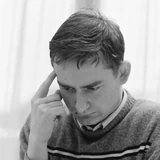
Valery Salov is a grandmaster from the Leningrad chess school who was ranked third in the world on the January 1995 FIDE list. He won the world cadet title in 1980 and the European Junior Championship in 1983/84, tied for first in the 1987 USSR Championship, and took first place on tiebreak at the Szirák Interzonal the same year. Between 1991 and 1997 he won or shared first place at Amsterdam, Wijk aan Zee (twice), Tilburg and Buenos Aires, where he beat Anatoly Karpov with both colors. He reached the Candidates matches in two cycles, and he has played no FIDE-rated event since 2000.
Leningrad and the junior titles
Salov was born in Wrocław, Poland, on 26 May 1964, and grew up in Leningrad. He told The Hindu in 2000 that he learned the game at seven at a local club there and became a Soviet national master at 14.
In 1980 he won the world cadet championship at Le Havre, a title chessgames.com lists as the under-16 championship. At the 1981 World Junior Championship in Mexico City he beat Nigel Short. In 1983 he was second at the World Junior Championship in Belfort, a point behind Kiril Georgiev, and that winter he won the European Junior Championship in Groningen. FIDE made him an International Master in 1984 and a grandmaster in 1986.
Soviet championships and Szirák
At the 54th USSR Championship, in Minsk in 1987, Salov tied for first with Alexander Beliavsky. Beliavsky won the four-game playoff with two wins and two draws. That summer Salov won the Interzonal at Szirák, Hungary, with 12½ points, ahead of Jóhann Hjartarson on tiebreak. In the first round of the Candidates matches, at Saint John in 1988, he lost to Jan Timman 2½–3½, with five draws and one loss.
Kasparov counted Salov, Beliavsky and Artur Yusupov among the other rivals at the 55th USSR Championship, in Moscow in 1988. Salov beat the former World Champion Vasily Smyslov in round four. Kasparov records that Salov and Beliavsky led with 5½ after eight rounds and that Salov beat Beliavsky in the ninth. Salov led with 7/10 but then lost to Leonid Yudasin and, in round 14, to Kasparov. He finished tied for third with Yusupov on 10/17, behind Kasparov and Karpov.
Salov was part of Karpov's team for the 1985 and 1986 world championship matches against Kasparov.
“I think it was Reuben Fine who wrote that in such positions a combination is as natural as a baby's smile.”
“Or even worse – simply as a present for the world champion, who that day celebrated his 26th birthday. Who after this game will believe that Kasparov was in poor form in Barcelona? What then can be said about me?”
“I am really impressed by the Indian youngsters. The game is definitely on the rise here.”
“Now I have a lot of time left to myself, and as a person I have developed more.”
“Well, what is unusual about the success of Salov and Short, who are undoubtedly among the strongest grandmasters in the world?”
“And for the 12th round 'white' game with my rival and contemporary Valery Salov I arrived in the most fighting mood possible, especially since it was played on the 13th April, my birthday.”
“Salov was quietly effective only losing to Piket.”
World Cup years and Amsterdam
Salov played in the Grandmasters Association's first World Cup, six classical tournaments held in 1988 and 1989. He was second at Brussels in 1988 with 10 points to Karpov's 11 and third at Barcelona in 1989. At Rotterdam in 1989 he beat Karpov, and Kasparov counts that game as the first of three successive defeats that cost Karpov first place there. Salov finished third in the overall standings with 68½ points, behind Kasparov and Karpov.
At Barcelona, on 13 April 1989, Kasparov celebrated his 26th birthday by beating Salov. Kasparov annotates it as Game 50 in the second volume of Garry Kasparov on Garry Kasparov, and he quotes Salov's own published comments on his defeat.
In 1989 Salov also played for the Soviet team that won the European Team Championship at Haifa, scoring 5/8. He was third at Linares in 1990. In May 1991 he and Short shared first place at the Euwe Memorial in Amsterdam with 6/9, half a point ahead of Karpov and Kasparov.
Spain and the 1994–95 Candidates
Kasparov writes that 1992 was the year Yusupov left Russia for Germany and Salov left for Spain. Salov settled near Madrid. He stayed with the Russian federation, and FIDE lists show him under Russia from July 1992. In January 1992 he had shared first place at Wijk aan Zee with Boris Gelfand on 8½/13, without a loss. In 1993 he scored 5/6 for Lyon-Oyonnax when the club won the European Club Cup final at Hilversum.
He qualified for the 1994–95 FIDE Candidates matches with 8½/13 at the Biel Interzonal in 1993. He beat Alexander Khalifman 5–1 at Wijk aan Zee in January 1994 and Timman 4½–3½ at Sanghi Nagar, India, that summer. The semifinal, at Sanghi Nagar in February 1995, went to Gata Kamsky 5½–1½.
In September 1994 Salov won the 120-player Interpolis knockout at Tilburg. On the way he beat Lajos Portisch and Vasyl Ivanchuk, and he beat Evgeny Bareev 1½–½ in the final. In October he won the Buenos Aires tournament held in honor of Lev Polugaevsky, which was played entirely in open Sicilians. He scored 9/14, half a point ahead of Viswanathan Anand, and beat Karpov in both of their games. On the January 1995 FIDE list he was rated 2715, third in the world.
Wijk aan Zee 1997 and after
Salov won the 1997 Hoogovens tournament at Wijk aan Zee outright with 8½/13, losing only to Jeroen Piket. In April he tied for third at Dos Hermanas behind Anand and Vladimir Kramnik, and at St Petersburg he shared first place with Viktor Korchnoi and Khalifman. He beat Karpov again at Wijk aan Zee in 1998. In the FIDE knockout world championships he lost to Vladislav Tkachiev in 1997 and to Gilberto Milos in the first round in 1999.
He has not played in a FIDE-rated event since 2000. In November 2000 The Hindu reported that he had coached the Indian team at the Istanbul Olympiad, was working as a FIDE commentator, and was president of the World Players Council. The paper said he had stopped playing professionally for political reasons and was living near Madrid.
In 2009 he gave talks at the Chigorin Chess Club in St Petersburg on computer-driven opening preparation, Fischer Random Chess and Russian politics. In a long interview with Chess-News in May 2015, he said a lack of invitations had forced him out of competitive chess and set out conspiracy theories about world championship matches. Chessgames.com describes him as an advocate of conspiracy theories. He has also published his views online, including an electronic journal called Chess Satiricon.
Legacy
Kasparov called Salov his rival and contemporary. Salov was third in the 1988–89 World Cup, reached the Candidates matches twice, and was third in the world in January 1995. From 1991 to 1997 he won or shared first at Amsterdam, Wijk aan Zee (twice), Tilburg and Buenos Aires, and he beat Karpov in classical games in 1989, 1994 and 1998. He has not played a FIDE-rated event since 2000.
Books
No authored or contributed books are documented in the available sources.