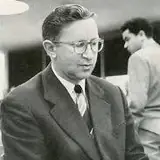
Boris Spassky called him Hand, because Smyslov's hand knew which square each piece belonged on without his head having to calculate it. Smyslov called the same gift a sense of harmony, a feeling for what each piece can and cannot do, and he traced it to the simple positions his father set him as a boy. Vasily Smyslov held the world title for barely a year, but he stayed near the top of the game for half a century: a trained baritone who sang in a competition at the Bolshoi, an endgame virtuoso who reached a Candidates final at sixty-two, and one of the most natural, unhurried talents the game has seen.
A father's gift
Smyslov was born in Moscow on 24 March 1921. His father, Vasily Osipovich Smyslov, born in Astrakhan in 1881, had studied at the St Petersburg Technological Institute and worked as an engineer-economist at the state securities printing works. According to P. A. Romanovsky's essay in My Best Games of Chess, 1935–1957, he attended Mikhail Chigorin's chess classes as a student and played on a top board for the Institute. In 1912 he beat the twenty-year-old Alexander Alekhine in a St Petersburg tournament, a game his son later printed with the father's own notes in Letopis shakhmatnogo tvorchestva (1993).
The father taught the boy the moves, and about six months later, at seven, Smyslov won a match against his uncle, Kirill Osipovich, who gave him rook odds. The prize, inscribed on 29 May 1928 to the future champion, was Alekhine's My Best Games; Smyslov still had it more than sixty years later. In the English preface to his best games he wrote that he "first became interested in chess as early as 1927 when still a child" and that the Alekhine book "became my constant reference." The first chess book he read through, he recalled, was Dufresne's self-tutor, with Emanuel Lasker's lectures Common Sense in Chess as an appendix.
The boy soon read everything in his father's library, Dufresne, magazines, the textbooks of Lasker and Capablanca, and tournament books, and he wrote that Chigorin's games "made an indelible impression on me." At the Moscow international tournaments of 1935 and 1936 he watched Lasker and Capablanca play. Smyslov later credited his father, whom Kasparov calls "his first and only chess mentor", with teaching him to love simple positions with only a few pieces, where he learned what each piece could and could not do.
In 1938, the year he left school, he won the All-Union Schoolboys' Championship. That autumn, aged seventeen and a first-year student at the Moscow Aviation Institute, he shared first place in the Moscow Championship, ahead of grandmaster Andor Lilienthal, and earned the master title. In his first Soviet Championship, in 1940, he led unbeaten after fourteen rounds, lost only to Makogonov, and finished third on 13/19, half a point behind Bondarevsky and Lilienthal and ahead of Keres and Mikhail Botvinnik. Third place in the 1941 Absolute Championship, behind Botvinnik and Paul Keres, brought him the Soviet grandmaster title at twenty. His father died in 1943, having seen his son become a grandmaster. When FIDE drew up its first list of grandmasters in 1950, Smyslov's name was on it.
In September 1945 he played second board for the USSR against Samuel Reshevsky in the radio match with the United States and won both games. His first international tournament, Groningen 1946, brought third place behind Botvinnik and Max Euwe and a place in the 1948 match-tournament for the world title.
The long duel with Botvinnik
Smyslov's road to the title ran through Mikhail Botvinnik. In the 1948 match-tournament that made Botvinnik champion, Smyslov finished second with 11/20; he lost his mini-matches to Botvinnik and Keres 2–3 but beat Reshevsky 3–2 and Euwe 4–1. At the 1952 Helsinki Olympiad grandmaster Ossip Bernstein was heard to say, on seeing him, "There goes the best player in the tournament." He won the Zürich Candidates tournament of 1953 by two clear points, losing one game in twenty-eight, and three times he faced Botvinnik for the world championship.
The first match, in 1954, began badly: Smyslov trailed ½–3½. He later recalled a saying of his singing teacher, Konstantin Zlobin, to do what is right and let come what may, and he answered with three wins. He led only once, at 6–5. In the fourteenth game Botvinnik tried 9.Be3, a move he had played only in training games; by Botvinnik's own account in his book on the match, Smyslov spent no more than two or three minutes on the next six moves of a sharp line and went on to win. Botvinnik suspected that Smyslov had found a way to guess variations his opponent had not yet played; Smyslov answered that "the methods of opening preparation are well known and do not contain any secrets." The match ended 12–12 (+7 −7 =10), after Smyslov offered a draw in the last game, and under the rules the champion kept his crown. One move he had prepared for the match, he noted later, he could use only a quarter of a century afterwards, in a 1980 win at Linz.
Smyslov won the Amsterdam Candidates tournament of 1956 and in 1957 won the rematch 12½–9½ (+6 −3 =13), becoming the seventh world champion. In the seventeenth game Botvinnik's second sent a draw offer after the adjournment; Smyslov played on and won the bishop-against-knight ending through a deeply hidden zugzwang. Kasparov notes that under the FIDE rules in force before 1956 he would have kept the title for at least three years.
His reign lasted a single year. Botvinnik exercised his new right to a return match in 1958, opened with three wins, and took the title back 12½–10½ (+7 −5 =11). Smyslov wrote that "during the match I went down with the flu, and I finished the event with ... pneumonia"; Kasparov accepts that he was ill but adds that he had not been able to prepare normally. Botvinnik's book on the return match records that Smyslov fell ill after the second game and lost the third through an unexpected oversight, and that after winning the nineteenth he missed two games and asked in vain for a further postponement. Botvinnik, who used all his own sick days too, called it a record match for illness, and he asked whether Smyslov's endgame play had not been the main reason for his defeat. "I have the feeling that all my life I have been playing only against Botvinnik," Smyslov said when it was over. Across the three matches he won eighteen games to Botvinnik's seventeen, with thirty-four draws. He shared first place in the Soviet Championship with David Bronstein in 1949, and in 1955 he finished level with Efim Geller, ahead of Botvinnik, but lost the play-off for the title.
“I will make 40 good moves and if you are able to do the same, the game will end in a draw.”
“Such a “mutual understanding” with the pieces enables a player to see that which often remains concealed to purely logical analysis. It is then that the innate ability of a player, which I call a sense of harmony, manifests itself.”
“I have the feeling that all my life I have been playing only against Botvinnik.”
“For me chess aesthetics signify, most of all, the correctness of an idea, its truth, revealed in clear logic of thought. Beauty manifests itself not only in combinative play with spectacular sacrifices, but also in a seemingly simple position, when the richness of its content is suddenly discovered.”
“Smyslov is a chess player with a fantastic intuition. I call him 'Hand' because his hand knows exactly on which square to put which piece.”
“In the period 1953-58 Smyslov was undoubtedly the strongest tournament fighter. ... And this is to say nothing about the endgame – here he was in his element.”
“Smyslov is a modern Capablanca. We have all learned from his brilliant technique of playing endings.”
“The play of the youthful Smyslov is of unusual profundity, originality and versatility.”
A sense of harmony
Smyslov is remembered above all for positional clarity and a command of the endgame that bordered on the uncanny. His credo, as Kasparov gives it in My Great Predecessors, sounded modest: he would make forty good moves, and if his opponent could do the same, the game would end in a draw. "But it was precisely this 'doing the same' that was the most difficult," Kasparov adds: "Smyslov's technique was ahead of his time." Smyslov explained the gift through his father's simple positions. Learning what the pieces "like" and what they "don't like" gave a player a mutual understanding with them, and with it the innate ability he called a sense of harmony.
He composed endgame studies from his teens: his first appeared in print in 1937, one took fourth prize in a Shakhmaty v SSSR contest in 1938, and he wrote that composing them developed both his aesthetic sense and his endgame play. In his preface to the 1986 edition of Teoriya ladeinykh okonchanii, the rook-endings book he wrote with Grigory Levenfish, he said the endgame had drawn him from his first steps, when most young players want attacks, because what mattered to him was never victory in itself but the triumph of logic.
He wrote of the game as an art. In the preface to his best games he described chess as "an interesting sphere of creative ideas built up on the opposing thoughts of two chessplayers, who in the process of a tense struggle are striving to create an artistic composition." Kasparov quotes his rule for that art: "I am a staunch supporter of classical clarity of thought. The content of a game should be a search for truth, and victory a demonstration of its rightness." He also distrusted fixed rules. In a note to his 1948 win over Euwe, against the faith in the two bishops, he wrote that "in the art of chess there are no unalterable laws governing the struggle, which are appropriate to every position, otherwise chess would lose its attractiveness and eternal character."
It would be a mistake to call him merely safe. Kasparov writes that "if 'life compelled it' he would boldly launch into a maelstrom of combinations," and Romanovsky noted in 1952 that he had "no special love for draws". His name is also stamped across opening theory. The Smyslov Variation of the Grünfeld Defence (7...Bg4 and 8...Nfd7 against White's 5.Qb3), newly devised when he beat Euwe with it in the 1948 match-tournament, was tried against him by Botvinnik in their 1957 and 1958 matches and lost both times. "I had to find a way of countering my own theoretical weapon," Smyslov wrote. The Closed Ruy Lopez line with 9...h6 also carries his name, and Kasparov judged his "contribution to theory is no less significant than that of Botvinnik".
The singer
Chess shared his life with music. His father had a fine baritone, took regular lessons, and by family tradition once sang for Fyodor Chaliapin and was praised. The son had the same voice. From 1948 Smyslov studied singing with Professor Konstantin Zlobin, whom he had met in Leningrad during the 1947 Soviet Championship, and he sang in a singers' competition at the Bolshoi Theatre. Singing stayed a private passion, as it had been for his father; his favourite singer was Enrico Caruso. He wrote that a player with no interests beyond chess finds defeats hard to bear, and that his love of music helped him take the turns of fortune more calmly. He still gave recitals during tournaments, sometimes accompanied at the piano by his fellow grandmaster Mark Taimanov, himself a concert pianist, and once recorded an EP of songs.
Kasparov, introducing the champions in the first volume of My Great Predecessors, saw him as a symbol of the thaw after Stalin: "a mild, intelligent man with a fine baritone voice, who had dreamed of a singing career. He was not a communist, and his deep religiousness as though anticipated the approaching rebirth of the Orthodox Church." His style, Kasparov wrote, was "much lighter and more airy compared with Botvinnik's tank-like onslaught."
The long evening
What sets Smyslov apart even among champions is how long he stayed at the top. He represented the Soviet Union at nine Olympiads between 1952 and 1972 and won a record number of medals. He shared first place in the 1964 Amsterdam Interzonal; against Gligorić there he chose an early queen move, which his notes in Letopis trace to memories of Chigorin's games and a wish to leave well-studied lines for an almost forgotten past. In 1965 he won the Capablanca Memorial in Havana ahead of Bobby Fischer, who played his games by telephone from New York. When Boris Spassky lost his first title match to Petrosian in 1966, Smyslov helped him; Spassky later said Smyslov "fed me all the time at his place, and by the end of the match I had actually put on six kilograms!"
At the 1970 USSR versus Rest of the World match his last-round game against Friðrik Ólafsson was adjourned, and when it resumed every other board had finished, with the match level at 19½–19½. "If I won – we would win the match. If not, then I would be the only culprit," he recalled; he won. Asked in 1972 whether Fischer or Spassky would win at Reykjavik, he replied that it was their affair: "I have already played three matches for the world championship, and that's enough for me."
He went on anyway. In 1983, at sixty-two, he drew his Candidates quarter-final with Robert Hübner 6–6 and 1–1 and went through on a drawing of lots in a casino, then beat Zoltán Ribli 6½–4½. In the final, at Vilnius in 1984, both players had birthdays during the match: Smyslov turned sixty-three and Garry Kasparov twenty-one. Kasparov won 8½–4½. Smyslov had beaten him once already, in a grandmaster clock simultaneous in 1975 when Kasparov was twelve.
In 1991, at seventy, he was invited to the first World Senior Championship at Bad Wörishofen and, he recalled, had to ask himself whether it was worth risking his reputation as a former world champion. In a Swiss field of 110 in which every rival was younger, he went unbeaten with six wins and five draws and took the title on tie-break from Geller, a result he called symbolic. That June, Kasparov watched him play a rapid match against the eighty-year-old Reshevsky that ended 2–2 "without any draws!" He remained on FIDE's top-100 list until he was seventy, played the Biel Interzonal in 1993 at seventy-two, and despite serious problems with his eyesight he kept playing for about ten more years and went on composing endgame studies. His opponents ranged from Fedor Duz-Khotimirsky, born in 1881, to Étienne Bacrot, born in 1983.
Legacy
Smyslov died in Moscow on 27 March 2010 of congestive heart failure, three days after his eighty-ninth birthday. Of the lost return match he had written: "Even so, I have no reason to complain of my fate: I fulfilled my dream and became world champion." He left a body of endgame play still studied today, a place in the Olympiad record books, and a name that even reached the cinema: Stanley Kubrick named a character after him in 2001: A Space Odyssey. In My Great Predecessors, Part V Kasparov wrote that Smyslov's long career "was helped by his innate sense of harmony and incredible intuition."
Books
Books Vasily Smyslov wrote, co-wrote, edited, or contributed to. Translations and reprints are grouped under the same work.
-
Избранные партии
Author
-
Международный шахматный турнир в Швейцарии (Впечатления участника)
Author
-
My Best Games of Chess 1935–1957 / Smyslov’s Best Games, Volume 1
Author
-
Избранные партии гроссмейстеров и мастеров РСФСР
Editor — compiler and contributor to the collected annotated games
-
В поисках гармонии
Author
-
125 Selected Games
Author
-
Rook Endings: Algebraic Edition
Coauthor — Grigory Levenfish, Vasily Smyslov
-
Летопись шахматного творчества
Author
-
Endgame Virtuoso / Искусство эндшпиля
Author
-
Мои этюды / My Studies
Author
-
Smyslov's Best Games, Volume 2: 1958–1995
Author
-
Тайны ладейного эндшпиля
Author
-
Наука побеждать
Author