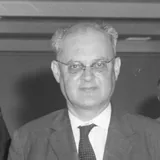
Vasja Pirc
His name sits in every opening manual on earth and is mispronounced in most of them. Vasja Pirc was a schoolmaster's son from the mercury town of Idrija who became the first Slovene to make chess his living — five times champion of Yugoslavia, and for a few years around 1938 one of the ten strongest players alive. The defence that carries his name is the small, permanent monument. The larger one is harder to see: a lifetime spent teaching the game to a country that had only just begun to play it.
◈A schoolmaster's son from Idrija
Idrija in 1907 was a mercury town in the Duchy of Carniola, at the far edge of Austria-Hungary. Pirc was born there on 19 December to two teachers: his father Matija, a professor of history who would go on to run the men's teacher-training college, and his mother Antonija Okoren. The family moved to Maribor while he was still a boy, and he went through the classical gymnasium there at the head of his class. He learned the moves at home, from his parents, and by sixteen or seventeen he was the champion of the city.
He enrolled at the University of Ljubljana in 1925 to read history and geography, and spent time studying in Vienna — a city then still saturated with the chess of the great Viennese school, which he worked through in earnest. He finished the geography degree. Then he did the thing nobody in Slovenia had done before: he gave himself to chess.
The results came quickly. In 1927 he took the Ljubljana club championship and won the national master title at the fifth Yugoslav amateur tournament in Karlovac. In 1929, at the international tournament in Rogaška Slatina, he shared third place with Géza Maróczy and came away an international master. In December 1930 a rapid tournament was got up in Ljubljana with the reigning World Champion as guest of honour and Milan Vidmar as arbiter; Alexander Alekhine and the twenty-two-year-old Pirc finished level at the top, and Pirc beat him in their game. He would lose far more games to Alekhine than he won. He never lost that one.
◈1938
Through the thirties he was Yugoslavia's man. He shared the national title with Boris Kostić at Belgrade in 1935, then won it outright at Novi Sad in 1936 and at Rogaška Slatina in 1937. At Prague in 1931 — his first Olympiad — he made 12½ from 17 on fourth board, 73.5 per cent, the best score of his six Olympiads. That summer at Bled, in the great tournament Alekhine won without losing a game, he beat Aron Nimzowitsch. He also learned where the ceiling was: at Moscow in 1935, in a field with Botvinnik, Flohr, Lasker, Capablanca and Spielmann, he finished eighteenth of twenty, salvaging wins over Romanovsky and Chekhover.
Then came 1938, the year everything landed at once. At Łódź he won the tournament with 11½ from 15, a point and a half clear of Tartakower, with Petrovs, Ståhlberg and Eliskases sharing third. He won at Bad Harzburg. At Noordwijk, where Eliskases finished first and the young Keres second, he beat Spielmann, Bogoljubow and Tartakower in the space of four days. He was named first reserve for AVRO, the strongest tournament of the decade, and by the common reckoning of the time he stood among the ten best players in the world.
He was thirty. There would be no more tournaments like that for seven years.
◈A thousand games in the Café Evropa
From 1934 to 1941 Pirc ran the chess column in the Ljubljana daily Jutro, and between 1939 and 1941 he worked as a stenographer taking down foreign radio broadcasts. Then Ljubljana was occupied — by the Italians from 1941, by the Germans from 1943 — and he went quiet, withdrawing from public life along with most of Slovene culture.
What he did instead was play. Every Tuesday through those four years he met Milan Vidmar, Slovenia's other great player and an electrical engineer of international standing, at the Café Evropa in Ljubljana. Pirc reckoned afterwards that they got through something like a thousand casual games, and that the score between them came out about level. Not one of them was written down. It is the longest match either man ever played and the only one nobody can look at.
◈The grandmaster years
He came back. At Novi Sad in 1945 he played the first championship of the new Yugoslavia; in 1948 at Saltsjöbaden he played the first Interzonal, tying for eleventh with Book and Gligorić and beating Najdorf and Lilienthal along the way. Over the winter of 1948–49 in Belgrade he shared his fourth national title with the rising Svetozar Gligorić. In June 1949 at Bled he played ten games against Max Euwe, the former World Champion, and drew the match 5–5.
In 1950 FIDE's first title list made him an International Master, and that autumn at Dubrovnik he played second board in the first Olympiad since the war — the last before the Soviet Union entered. He scored 9½ from 14 for an individual silver medal, and Yugoslavia took the gold. Helsinki in 1952 and Amsterdam in 1954 each brought team bronze behind the Soviets; at Amsterdam, aged forty-six, he was on board one.
In 1953 FIDE made him a Grandmaster; Slovenian accounts record the award as recognition of the Łódź victory fifteen years earlier. That December in Zagreb, at forty-five, he won the Yugoslav championship for the fifth and last time, beating Gligorić on the way. Across forty years of play — 1927 to 1967 — he entered fifty-six international tournaments and got through something like thirteen hundred serious games.
◈The defence that carries his name
1.e4 d6 2.d4 Nf6 3.Nc3 g6. Black declines to contest the centre, lets White build the broad pawn wall he has always wanted, and then goes to work on it from the flank with the fianchettoed bishop and a timely break. It is hypermodernism in its purest and most patient form. Nineteenth-century players had stumbled into the position now and again, but it was filed under irregular and left there; only after the Second World War did it become respectable, and it did so under Pirc's name because he was the one who analysed it, argued for it and put it in print. In Russia and the former Soviet republics it is the Ufimtsev Defence, after Anatoly Ufimtsev, or the Pirc–Ufimtsev; elsewhere it has been called the Yugoslav Defence.
Its arrival at the summit came in 1972, when Bobby Fischer answered Spassky's 1.e4 with 1...d6 in the seventeenth game at Reykjavík — the opening's first appearance in a World Championship match. It was drawn. Pirc was sixty-four and alive to watch it. There is a wry footnote, supplied by Vlastimil Hort, who went looking through the games and found exactly one in which Pirc himself used the thing: his own preference at the board was the Caro-Kann.
One correction the man himself would probably have appreciated: the name is peerts. The Slovene c is a ts, not a k.
◈The schoolroom and the desk
After the war Pirc did what his father had done and taught, holding posts in Ljubljana gymnasiums and eventually directing one of them; among the boys who passed through his hands was Bruno Parma, who became World Junior Champion in 1961. From 1955 to 1960 he travelled the republic as the chess federation's instructor. He served as its vice-president and sat as a referee on the committee for physical culture, and in 1973 FIDE made him an International Arbiter.
He wrote steadily. There was a book on the 1951 Staunton Memorial at Birmingham, a tournament he had played in himself, and one on the 1950 Amsterdam world tournament; a series on modern opening theory whose first volume, in 1959, treated the King's Indian Defence; and an account of the 23rd Yugoslav championship at Čatež in 1968, another event he played. Hort thought the Staunton Memorial book a wonderful one, and important for the development of chess right across the Balkans.
He had married Jožica Juvanec in 1935, and they raised four children — a physicist among them, and two daughters who made their careers in Romance languages. In 1967 Slovenia gave him the Bloudek Award, its highest state honour in sport. Hort, who met him at Mariánské Lázně in 1965, remembered a man taking the waters in the mornings, playing in the afternoons, and settling in with a glass of wine at night.
“Pirc from Maribor is the strongest among all domestic participants. He is very resistant and solid, lacking only tournament experience.”
“To my disappointment, I found only one game in which he used the defence himself. Instead, Pirc preferred the Caro-Kann rather than his own invention.”
“He and his colleague Gideon Stahlberg walked diligently in the morning, received a massage here and enjoyed the blessings of the healing springs there. In the afternoon chess was played and in the evening — presumably against any medical order — wine (Pirc), beer and schnapps (Stahlberg) was consumed.”
◈From the archive
◈Legacy
Pirc died in Ljubljana in June 1980, aged seventy-two, and was buried there. In 2007 the Slovenian post office issued a stamp for his centenary, an honour paid to very few chess players anywhere; his old club in Maribor still runs a Pirc Memorial. He was never a World Championship contender and never claimed to be — a strong grandmaster who reached the world's top ten for a season or two, then spent the rest of his life building the game in a small country that had almost none of it. But his name outlasted his results in the way only an opening name can. Every day, somewhere on earth, White pushes the king's pawn and Black answers 1...d6, and a schoolmaster from Idrija is named again.