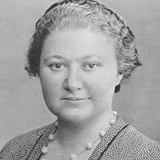
Vera Menchik was the first Women's World Champion, and she held the title from 1927 until her death, the longest reign in the history of the women's championship. She won it eight times, and across nine years of world championship tournaments she won at least 59 games in a row. In an age when women played almost only against women, she was the one woman playing master tournaments against the best men in the world. When Albert Becker joked at Karlsbad in 1929 that anyone she beat would join a "Vera Menchik Club", he became its first member, and the club came to include a future World Champion, Max Euwe, whom she beat twice.
Moscow to Hastings
Vera Menchik was born in Moscow on 16 February 1906, to a Czech father, František Menčík, and an English mother, Olga Illingworth. Her father taught her chess at nine. At fourteen she played her first tournament, in her school's new chess club, against students and teachers, and she said that it gave birth to her sporting spirit.
In 1921, after the Revolution and her parents' separation, she moved with her mother and sister to Hastings, on the south coast of England. She spoke only Russian, and chess needed no English. She joined the Hastings Chess Club in March 1923, trained with the club champion James Drewitt, and took private lessons from Géza Maróczy, whom she credited with inspiring her to aim higher.
The first Women's World Champion
In 1925 she beat Edith Price, the British women's champion, in two matches, and became the best woman player in the country. In July 1927 FIDE held a women's tournament alongside the first Chess Olympiad in London and declared its winner the first Women's World Champion. Menchik, twenty-one, won it with 10½ out of 11.
She defended the title at Hamburg in 1930, Prague in 1931, Folkestone in 1933, Warsaw in 1935, Stockholm in 1937 and Buenos Aires in 1939. From 1931 she won four championships in a row with a perfect score, 45 games without a draw. In 1937 she also played a match with Sonja Graf, the next strongest woman of the time, at Semmering, recognised by FIDE as for the world title; Menchik won 11½–4½.
“She is without a doubt a phenomenon, and her victory over Yates in the first round will be historical.”
“One. Her name is Vera Menchik ... She played against me and she is very strong.”
“Vera Menchik was relaxed in both her wins and losses. When an opponent won a good game, she was the first to congratulate him.”
The Vera Menchik Club
Menchik played her first master tournament at Scarborough in 1928 and beat Fred Yates in the first round. Alekhine, then World Champion, called her a phenomenon. At Ramsgate in 1929 she scored an unbeaten 5 out of 7 and shared second place with Akiba Rubinstein, half a point behind Capablanca, and invitations to the great international tournaments followed.
At Karlsbad in 1929 Albert Becker proposed, as ridicule, that any master who lost to her should be counted a member of the "Vera Menchik Club". In the third round he became its first member. She finished near the bottom at Karlsbad, but she also beat Friedrich Sämisch there, and Edgard Colle at Paris the same year. Four of the first grandmasters named by FIDE in 1950 would be members: Euwe, Mieses, Reshevsky and Sämisch.
Euwe, Hastings and Yarmouth
At the Hastings Christmas Congress of 1930/31 she beat Max Euwe, who won the tournament and became World Champion in 1935, and the result was reported around the world. A year later she beat him again, and Mir Sultan Khan too, for her best Hastings result. In 1931 she won the Major Open at the British Championship, unbeaten on 9 out of 11.
In 1934 she finished third at Maribor behind Vasja Pirc and Lajos Steiner. At Yarmouth in 1935 she beat Samuel Reshevsky, who lost on time to her and won every other game. Menchik was a positional player who liked 1.d4 with White and the French Defence with Black, and she sat through her games, it was said, with her hands in front of her and without moving a muscle in her face.
War
In October 1937 she married Rufus Henry Streatfield Stevenson, the honorary secretary of the Southern Counties Chess Association and later of the British Chess Federation, and became a British citizen. In 1939 she won her last world championship at Buenos Aires with 18 out of 19, while the Second World War began. In London she ran the British National Chess Centre until it was destroyed in the Blitz, edited and wrote for chess magazines and gave lessons.
In 1942 she played a match with Jacques Mieses, then 77 and once among the best players in the world, and won it +4 −1 =5. Her husband died in February 1943. She was still playing in 1944: her team had reached the semi-finals of the Southern Counties Chess Union Championship when she was killed.
Legacy
Vera Menchik was killed on 26 June 1944, with her mother and her sister Olga, when one of the first V-1 flying bombs destroyed their home in Gauden Road, south London. She was thirty-eight and still Women's World Champion. Her reign of nearly seventeen years remains the longest in the women's championship. The trophy of the Women's Chess Olympiad is the Vera Menchik Cup, and Elisaveta Bykova, a later Women's World Champion who said Menchik's visit to Moscow in 1935 had inspired her, wrote the first biography of her.
Books
No authored or contributed books are documented in the available sources.