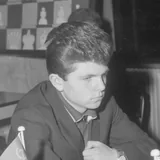
Viktor Kupreichik
Mikhail Tal, who was his idol, gave him the name that stuck: the d'Artagnan of chess. Viktor Kupreichik came out of Minsk in the 1960s with a sword in his hand and never once put it down — a player who treated a draw as a kind of surrender, who sacrificed on instinct and calculated on nerve, and whose games were followed by packed halls in a republic that had never had a chess star of its own. He was the first grandmaster Belarus ever produced. He beat Tal, he beat Korchnoi, he beat Smyslov; he won Reykjavík and he won Hastings outright; and when the great Soviet machine handed out its honours he was rarely near the top of the list, because the way he played had never been designed to accumulate half-points. It had been designed to be worth watching.
◈The boy who wanted to be a footballer
Viktor Davydovich Kupreichik was born in Minsk on 3 July 1949, and for a long time chess was not the plan at all: as a child he dreamed of being a footballer. The board won in the end, and it won quickly. He was a Master of Sport of the USSR at sixteen, in 1965, and by then he had already found the player he would spend the rest of his life trying to be worthy of — Mikhail Tal, the magician of Riga, whose willingness to set fire to a position Kupreichik took as a personal instruction.
In 1963, at the USSR Junior Championship, he was put in a hotel room with a twelve-year-old from the Urals named Anatoly Karpov. “I was then 12 years old, he was 14,” Karpov remembered, “and the difference of two years was still appreciable.” They became firm friends three years later, when the Soviet federation's secretary muddled up an invitation and sent two youngsters to an adult international in Czechoslovakia — “a 17-year-old first year student at Minsk University and a 15-year-old schoolboy.” A blizzard closed Sheremetyevo for three days; when the pair finally reached Třinec the organisers were appalled to find two children on the entry list, and late ones at that. Karpov won the tournament with 11 out of 13, ahead of his friend Viktor. It was the beginning of a friendship that would one day give Minsk its Chess Palace.
◈The student who ambushed the champions
At nineteen he was brought into the Soviet student team, and there he became a serial champion of the world. He won the World Student Team Championship with the USSR three times — in 1968, 1969 and 1974 — and at the fifteenth of those events, at Ybbs in 1968, he took the individual gold medal on his board. Twice, in 1970 and again in 1974, he won the All-Union tournament of young masters. In December 1968, at a Soviet team event in Riga, he sat down for the first time against a fifteen-year-old called Alexander Beliavsky and won a long Ruy Lopez; Beliavsky, who would go on playing him for the next twenty-seven years, titled his memoir of that day “A Memorable First Meeting.”
The ambush that made his name came in October 1970, at Sochi, where the Soviet federation set its grandmasters against its young masters. On the 26th Kupreichik faced Tal himself with the white pieces, and in a sharp Sicilian he did the one thing nobody does to Mikhail Tal: he sacrificed first. Sixteen moves in the knight went to d5 — 16.Nd5 — and the centre opened like a trapdoor; Tal resigned on move 31. Genna Sosonko, recalling that Tal's own favourite squares were d5 and f5, wrote that Kupreichik “repeatedly placed his pieces en prise too on these very squares. And his most brilliant firework display began with a knight sacrifice on d5 in a game with Tal himself.” The following day, 27 October, he beat Viktor Korchnoi — and beat him a second time in the same event. He was twenty-one years old.
◈Eight championships of the Soviet Union
Between 1969 and 1987 he played eight finals of the Soviet Championship, the hardest tournament on earth, and in every one of them he was the man nobody wanted to draw as an opponent. His best came at the 47th, at the end of 1979 — and it was held, of all places, in Minsk. “The very one,” Karpov wrote, “where Kupreichik established a record by winning five games in a row.” He finished in a tie for fifth to seventh. He was sixth to ninth in the 1980/81 championship and eighth to eleventh in 1987.
The pattern was maddening and completely his own. He is remembered as a player of real fighting chess who would frequently lead a great event early, then run out of stamina and lose heavily in the closing rounds — the arithmetic of a man who never learned to bank a point. He was champion of Belarus in 1972, and would be champion of Belarus again in 2003, thirty-one years later.
The profession knew exactly what he was worth even when the crosstables did not. He worked as an assistant to Viktor Korchnoi in the early 1970s, and in the 1980s he helped Vassily Smyslov prepare for his Candidates matches — two of the most demanding analytical clients in the world, both of whom wanted the Belarusian in the room.
◈The grandmaster year
In 1977 he won the Masters group at Wijk aan Zee and was made an International Master. In 1978 he shared first at Kirovakan. And then came 1980, the year everything landed at once: first at Reykjavík, first at Plovdiv, first at Medina del Campo, and the grandmaster title — the first ever awarded to a player from Belarus. In January 1981 he stood twenty-second in the world; that July his rating peaked at 2580. At the turn of 1981/82 he went to the Hastings International Chess Congress and won it outright, his name added alone to a winners' list that runs back to the nineteenth century. Zenica 1985, Winnipeg 1986 and Malmö 1987/88 followed.
He left something in the books, too. The Kupreichik Variation of the Sicilian Defence — 1.e4 c5 2.Nf3 d6 3.d4 cxd4 4.Nxd4 Nf6 5.Nc3 Bd7 — carries his name, a quiet developing move chosen for exactly the reason everything else in his chess was chosen: it steers the game off the memorised roads and into a position that has to be played.
◈Tasty chess
Grandmaster Alexey Suetin put the style on the record as plainly as it can be put: “He is a chess player of an attacking, combinative style that is distinguished by a rich imagination, a lack of generic moves and a readiness to take risks.” Sosonko, writing the foreword to the English edition of his biography, went further — “A master of attack, he demonstrated play that you rarely see nowadays,” he wrote, and reached for a phrase of Tal's to describe the sensation of replaying him: tasty chess. Professionals, Sosonko added, “knew that one always had to be wary of him, because when he was on form no one could withstand the pressure of his imaginative ideas.” Alex Yermolinsky, who faced him across the Soviet leagues and was one of his fans long before that, said it for everyone who came after: “Kupreichik's chess is a breath of fresh air we all could use after feeling burned-out by the modern game.” Away from the board he was the opposite of forbidding — “Viktor was always very friendly and eager to spend time looking at crazy stuff on the chessboard,” Yermolinsky remembered of their post-mortems.
In Belarus he was not merely a grandmaster; he was a public event. “In the distant 1980s the name of Kupreichik resounded throughout the country,” his niece Anastasia Sorokina wrote. “He was recognised in the street, fans would queue up to watch him play, and largely thanks to him a chess boom began in the Republic.” The republic's players still had nowhere to play, though, and it was Karpov who fixed that. Visiting Minsk around the 1979 championship, he told Pyotr Masherov, First Secretary of the Belarusian party, that the interest in chess was enormous but the city's players had no club of their own. “I promise that there will be a club!” Masherov answered — and when it was objected at the Politburo that the fine new building in the centre had been put up for the writers, he replied: “Writers want to improve their conditions, but chess players have nothing.” The building was handed to the chess players. Minsk has had its Chess Palace ever since.
A very modest man, Sorokina wrote, he never prepared a serious autobiography; for his fifty-fifth birthday a brochure appeared in which the games were given only with variations, without a single word of prose. He would probably have said that the games were the words.
“It was a good game!”
“The d'Artagnan of chess.”
“He is a chess player of an attacking, combinative style that is distinguished by a rich imagination, a lack of generic moves and a readiness to take risks.”
“A master of attack, he demonstrated play that you rarely see nowadays. Even today when playing over many games by Minsk's favourite, an expression of Tal's comes to mind — “tasty chess”.”
◈From the archive
◈Legacy
Kupreichik died in Minsk on 22 May 2017, aged 67, in the city where he had been born and which he never left for long. He had gone on playing to the very end: for independent Belarus at the Chess Olympiads, whose games in this archive run from Moscow 1994 to Bled 2002; at the Belarusian Championship of 2003, which he won at fifty-three, thirty-one years after his first national title; at the European Seniors' Rapid Championship of 2010, which he also won; and at the European and World Senior Championships of 2015 and 2016, where he was still beating grandmasters. His last winning games here come from the Suetin Memorial in Tula in January 2017, four months before his death. He was elected to the FIDE Hall of Fame, the Chess Academy in Minsk bears his name, and tournaments in his memory are played in the city. In 2019 his niece Anastasia Sorokina — International Master, president of the Belarus Chess Federation and a FIDE vice-president — gathered the memories of Karpov, Kasparov, Sosonko, Gelfand, Beliavsky, Tukmakov, Sveshnikov and his own family into a book, published in English in 2021 as Kupreichik: The Maestro from Minsk. Asked to sum up a life given to the board, he needed only five words: “It was a good game!”