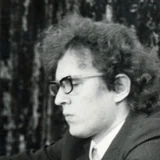
Vitaly Tseshkovsky was a grandmaster from Omsk who won the USSR Championship twice. In 1978 at Tbilisi he shared first place with Mikhail Tal after a last-round win, and in 1986 at Kiev he finished a point clear of the field. He placed fourth at the Manila Interzonal of 1976, one place short of the Candidates, and beat Tal, Boris Spassky, Vasily Smyslov and the fifteen-year-old Garry Kasparov. From Krasnodar he coached the young Vladimir Kramnik, and in his sixties he won the European Senior Championship twice before dying at the board in December 2011.
Omsk
Tseshkovsky was born in Omsk on 25 September 1944 into a family of Polish descent. His father, Valery Stanislavovich, a fitter at an Omsk power station, was an amateur player and his first opponent, and named him after an uncle killed at the front. A 2012 profile in the Omsk weekly Vecherny Omsk–Nedelya records that he was thirteen before his elder sister took him to Konstantin Isakov's group at the Pioneers' House, a late start by the standards of the time.
In 1962 he was among the individual prize-winners when the Omsk team won the Chigorin Cup. At twenty-one, added at the last minute to a USSR Championship semifinal held in Omsk, he missed the final by half a point and made the master norm. In his first round-robin USSR final, at Alma-Ata in 1968/69, he shared fourth place with 11/19, and in 1969 he played third board for the Soviet team that won the World Student Team Championship at Dresden, scoring 7/10.
He won the championship of the Russian Federation (RSFSR) in 1972 and shared first place in 1973 with Yakov Rusakov and Valery Korensky. The Omsk profile says that officials long sent him to minor international events such as Varna and Bucharest, and that even after he had made a name abroad he lived with his sister in a one-room flat on the edge of Omsk.
Grandmaster and Interzonal player
Tseshkovsky became an International Master in 1973 and a grandmaster in 1975. He beat the former World Champion Tal at Sochi in 1970, in a match-tournament between grandmasters and young masters. At the 1974 USSR Team Cup in Moscow he played first board for Trud, scored 6/9 and beat two more former World Champions, Spassky and Smyslov. He took first place at Bucharest in 1974, Leipzig in 1975 and Dubna in 1976.
He shared first to fourth places in the 1975 Soviet zonal at Vilnius and again in the play-off at Sochi, which sent him to the Manila Interzonal of 1976. He scored 12/19 there and finished fourth, behind Henrique Mecking, Lev Polugaevsky and Vlastimil Hort, the three who went on to the Candidates. According to the Omsk profile, he declined a draw offer from Mecking and lost, then pressed in a level position against Sergio Mariotti and lost a piece in time trouble. His own verdict, as the profile reports it, was that among the leaders he had beaten only Hort and Oscar Panno.
In 1977 he scored 4½/5 on eighth board for the Soviet team that won the European Team Championship in Moscow. He qualified for a second Interzonal through the 1978 Soviet zonal at Lvov and a play-off at Tallinn in January 1979, and finished 8th–10th at Riga in 1979 with 9/17.
“A difficult puzzle, but how interesting!”
“I'm not capable of behaving so that I beg for these tournaments”
“An important theoretical novelty, backed by energetic play, brought Kasparov another win. The world champion's unconditional success in this tournament gives a conclusive reply to the question who is who.”
“When he was on fire he would rip everyone apart, and no-one understood what was happening on the board!”
“It seems to me that Vitaly Tseshkovsky didn't achieve all he could because he loved chess too much”
“Tseshkovsky's last-round victory over Dorfman was a real sporting achievement, winning as Black.”
“You were a wonderful fighter who departed this world during battle.”
Champion of the USSR
At the 46th USSR Championship in Tbilisi in 1978, Tseshkovsky scored 11/17 and tied for first with Tal. Bernard Cafferty and Mark Taimanov describe him there as "the Siberian tactician" and call his last-round win as Black over Josif Dorfman, joint champion the year before, "a real sporting achievement". In the previous round he had beaten Kasparov in a Caro-Kann. In My Great Predecessors, Part II (chapter on Tal, note to Game 143), Kasparov writes that he failed to equalize in that game, and that after his games with Tseshkovsky and Efim Geller he gave up the Caro-Kann for the Sicilian.
Immediately after the title he moved from Omsk to Krasnodar, which had offered him a large flat on Krasnaya Street and good financial terms so that the region would have a player of his strength. On the January 1980 rating list he stood joint 15th in the world with 2595. In 1981 he won at Banja Luka with 10/11 and without a loss, at the Capablanca Memorial in Cienfuegos with 9½/13 and at the Chigorin Memorial in Sochi with 10½/15; he also won at Yerevan in 1980 and Minsk in 1982. In My Great Predecessors, Part V (p. 367) Igor Zaitsev names him among the players who joined Anatoly Karpov's preparation for the 1981 world championship match in Merano.
He reached the 1986 final in Kiev as what Cafferty and Taimanov call "a marginal qualifier" from the First League, and won it outright with 11/17, a point ahead of six players. The same authors wrote that the "semi-veteran" Tseshkovsky "played some splendid games", and printed his attack against Semen Dvoirys. Later that year he was second reserve for the Soviet team that won the Dubai Olympiad, scoring 2½/5.
Trainer in Krasnodar
Tseshkovsky was the strongest player in the Krasnodar region, and from about 1988–89 to 1994 he trained the young Vladimir Kramnik, who lived in Tuapse on the Black Sea coast. Kramnik later recalled that they worked mostly at tournaments and training camps, sometimes sharing a hotel room at junior events. He remembered Tseshkovsky analyzing for hours on a magnetic set from Riga that he carried everywhere, and the two of them playing blitz for three days in a row at a camp in Novogorsk before a World Junior Championship.
Kramnik wrote that Tseshkovsky showed him that chess was more many-sided and less categorical than the strict criteria he had taken from the books of Nimzowitsch and Tarrasch. Their work ended around 1994, when computers changed top-level preparation and Tseshkovsky, who analyzed deeply but slowly, found it hard to adapt. Kramnik also believed that his teacher's refusal to seek favors from officials was the reason he was rarely allowed to play abroad.
The Russian Chess Federation lists Bartłomiej Macieja and young grandmasters from southern Russia among his later pupils, and Chess.com adds Boris Savchenko. Kasparov credits him with an opening idea, 11.Nd5, that Kasparov played against Viswanathan Anand at Las Palmas in 1996 (Garry Kasparov on Garry Kasparov, Part III, p. 158, Game 33).
Senior years
Tseshkovsky kept playing in strong events into his sixties. At the 2004 Russian Championship Superfinal in Moscow, at sixty, he was the oldest player in the field; he scored 2½/10, beat Alexander Morozevich, and lost to Kasparov after holding the advantage. His highest FIDE rating, 2600, came on the October 2005 list, when he was 61. He tied for first in the Agzamov Memorial at Tashkent in 2008 and won it outright in 2009 with 7½/9.
He won the European Senior Championship at Rogaška Slatina in 2009 and again at Thessaloniki in 2010, where FIDE reported that a last-round win over Stanislav Zhelesny decided the title. The Russian Chess Federation also records him as Russian senior champion and a European team champion.
On 24 December 2011, in the first round of the Krasnodar Krai rapid cup, Tseshkovsky fell ill at the board and died without regaining consciousness. He had already suffered two heart attacks. He was buried on the Alley of Glory at the Slavyanskoye Cemetery in Krasnodar.
Legacy
Tseshkovsky won the USSR Championship eight years apart, from Omsk in 1978 and from Krasnodar in 1986, and finished one place short of the Candidates at Manila. Kramnik, the future World Champion he trained for about six years, said their work together was very useful to him. Tseshkovsky was still winning international senior titles in his mid-sixties, and he died during a tournament game at the age of 67.
Books
No authored or contributed books are documented in the available sources.