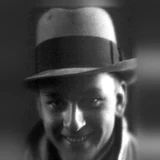
Vladas Mikėnas was born in Tallinn, won the championship of Estonia at twenty, moved to Lithuania the next year and played first board for it at every Olympiad from 1931 to 1939. He beat Alexander Alekhine at Kemeri in 1937, and after the war, as a Soviet player, he beat Mikhail Botvinnik, Vasily Smyslov, Tigran Petrosian and, twice, Mikhail Tal. He played in ten finals of the USSR Championship and was still winning the championship of Lithuania at sixty-seven. His name is on a sharp line of the Modern Benoni and on a variation of the English Opening, and in his seventies he was an arbiter at Garry Kasparov's matches on the way to and for the world title.
A boy in Tallinn
Mikėnas was born in Reval, now Tallinn, on 17 April 1910, to a Lithuanian father and a Polish mother. At home the family spoke Polish and Russian. His father, Jonas, died when Vladas was ten, and the boy worked after school to help support the family. He studied chess late at night by an oil lamp, hiding it from his mother and sisters, who disapproved.
At fifteen he entered the jubilee tournament of the Tallinn chess club, lost his first three games, won all the rest and took first place. He won the Tallinn championship in 1928 and 1929 and a national schools championship with fourteen wins from fourteen games, and in 1929 he entered the Tallinn University of Technology. In September 1930 he beat Johannes Türn in a match, +5 −2 =1, to become champion of Estonia. That December he won a tournament in Tallinn by beating Efim Bogoljubov in the deciding game.
Lithuania
In May 1931 he played in the first Baltic championship at Klaipėda, his first visit to Lithuania. He had a Lithuanian passport but did not speak Lithuanian. The seven-time Lithuanian champion Aleksandras Machtas persuaded him to move, and in June 1931 he settled there. Their first title match, in 1932, went to Machtas. In the return in 1933 Mikėnas won the last five games and the match, +6 −3 =1, and became champion of Lithuania. He defended the title in matches through the rest of the decade.
From 1931 to 1939 he was captain and first board of the Lithuanian team at five Olympiads and at the unofficial Olympiad in Munich in 1936, facing the top board of every other team. At Folkestone in 1933 he beat Salo Flohr in twenty moves; at Munich he beat Paul Keres; at Buenos Aires in 1939, Lithuania's last Olympiad before the Soviet annexation, he scored +10 −5 =4.
“Never mind. I will win it over again.”
“Young man, you could have mated in three!”
"Young man, you could have mated in three"
At Kemeri in 1937 Mikėnas finished only tenth, but he beat Alexander Alekhine, who at the end of that year took the world title back from Max Euwe. During the game he missed a quick mate. Alekhine pointed it out afterwards: "Young man, you could have mated in three!" Mikėnas answered, "Never mind. I will win it over again."
Ten Soviet finals
Lithuania was annexed by the Soviet Union in 1940, and that autumn Mikėnas played in his first USSR Championship final in Moscow. He finished in a tie for 13th to 16th place and beat the reigning champion, Mikhail Botvinnik. In the 1944 final he tied for fifth and sixth with 9/16; in 1945 he won the Baltic championship in Riga. Over the next two decades he played in ten USSR finals in all, and in those events and others his victims included Smyslov, Petrosian, Bronstein, Keres, Korchnoi and Tal.
At Riga in December 1959 he scored 11 out of 13 and finished half a point behind Boris Spassky, ahead of Alexander Tolush and of Tal, whom he beat; a few months later Tal was World Champion. He won the championship of Soviet Lithuania many times, in 1947, 1948, 1961 and 1964 among others, and again in 1977, at sixty-seven. He played first board for the Lithuanian team that won the correspondence Europe Cup of 1963–1972, and became an International Master of correspondence chess in 1971.
Openings, pupils and arbitration
Two openings carry his name. The Mikėnas Variation of the Modern Benoni, 1.d4 Nf6 2.c4 c5 3.d5 e6 4.Nc3 exd5 5.cxd5 d6 6.e4 g6 7.f4 Bg7 8.e5, is a sharp attacking line against it, and the Flohr–Mikėnas Variation of the English Opening begins 1.c4 Nf6 2.Nc3 e6 3.e4. In 2020 a Mikėnas variation was mentioned in the fifth episode of the Netflix series The Queen's Gambit.
He worked with Paul Keres as a trainer from 1955 to 1962, and he wrote a series of books in Lithuanian, from a chess textbook in 1932 to 35 metai prie šachmatų lentos ("35 years at the chessboard") in 1961. He became an International Arbiter in 1968, and from 1983 to 1985 he was an arbiter at Kasparov's matches with Alexander Beliavsky and Smyslov and at the 1985 World Championship match between Anatoly Karpov and Kasparov. FIDE made him an honorary grandmaster in 1987.
The tension of that work appears in Yuri Averbakh’s recollection of the 1959 Candidates, quoted in Garry Kasparov’s My Great Predecessors, Part II (2003), Game 126. As Tal played Fischer in the penultimate round, Keres had won his own game and temporarily drawn level with Tal. Averbakh recalled Mikėnas, Keres’s second, and Koblents, Tal’s trainer, watching anxiously even after Tal had reached a won position. Tal’s victory restored his one-point lead.
Legacy
Mikėnas died in Vilnius on 3 November 1992, after Lithuania had regained its independence. He had arrived in the country in 1931 unable to speak its language and was one of its leading players for four decades, first as the top board of an independent Lithuania and then as a Lithuanian player inside the Soviet system, and he left behind books on the game in Lithuanian. In 2010, for the hundredth anniversary of his birth, Lithuania Post issued a stamp in his honour.
Books
Books Vladas Mikėnas wrote, co-wrote, edited, or contributed to. Translations and reprints are grouped under the same work.
-
Šachmatų vadovėlis
Author
-
Šachmatų žaidimo pagrindai
Author
-
Šachmatų pirmenybės
Author
-
35 metai prie šachmatų lentos
Author
-
Šachmatai: teorija ir praktika
Author