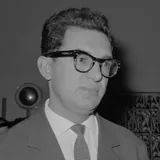
Vladimir Bagirov
He is remembered for two things that rarely belong to the same man — the games he played, and the champions he made. Vladimir Bagirov came out of the Baku Palace of Pioneers to win the championship of Azerbaijan thirteen times, and in his first Soviet Championship final, at Leningrad in 1960, the twenty-three-year-old finished fourth and beat Korchnoi, Spassky and Bronstein on the way. The grandmaster title would not arrive for another eighteen years. He spent them doing something quieter and more durable: rebuilding the Alekhine Defence from its foundations, writing the monograph that gave the opening a second life, and training the young Garry Kasparov, then Mikhail Tal, Lev Polugaevsky and Alexei Shirov. At sixty-two he finally won a world championship of his own. Two years later he was leading a tournament in Finland when his heart gave out at the board.
◈The Palace of Pioneers, Baku
Vladimir Konstantinovich Bagirov was born in Baku on 16 August 1936, into a family of Armenian and Ukrainian parentage, on the Caspian shore of Soviet Azerbaijan. He came to the game late by the standards of the Soviet machine — he was ten when he found his way to the chess circle at the Baku Palace of Pioneers, where Suren Abramian first taught him — and he came to it as an amateur, training as an engineer in the oil industry that gave the city its name and its smell.
The master who shaped him was Vladimir Makogonov, the great Azerbaijani player of the previous generation. Bagirov studied the games of Akiba Rubinstein and idolised Vasily Smyslov, and the influence held for the rest of his life: an unhurried, classical, deeply-read style with no interest in theatre. In 1958 he beat Yakov Estrin in a qualification match to earn the Soviet master title. Over the decades that followed he would win the championship of his republic thirteen times, a run of local dominance stretching across the whole of his Azerbaijani career.
◈Leningrad, 1960
He announced himself in the hardest tournament in the world. At twenty-three, in his first final of the USSR Championship — the 27th, at Leningrad in 1960 — Bagirov finished fourth, behind only Viktor Korchnoi, Tigran Petrosian and Efim Geller. The archive keeps the receipts: across those weeks he beat Boris Spassky, Viktor Korchnoi, David Bronstein, Eduard Gufeld and Vladimir Simagin, and Korchnoi went on to take the title. Later that year he won the international tournament at Jakarta outright, and in 1961 he wore Soviet colours at the European Team Championship in Oberhausen, won by the USSR, and at the World Student Team Championship in Helsinki.
The International Master title followed in 1963. The grandmaster title did not. Bagirov made his first grandmaster norm in 1960 and then waited seventeen years for the second, receiving the title at last in 1978, at the age of forty-two. He played ten USSR Championships across two decades, finished first or joint-first at Baku in 1964, Batumi in 1966, Moscow in 1968 and Tbilisi in 1971, and took the European Club Cup with Burevestnik in 1976 and again in 1979. Genna Sosonko, who knew the field, put the quality plainly: “in ‘his’ positions Bagirov was a danger to anyone.”
◈The second life of the Alekhine Defence
What carried his name beyond the Soviet Union was not a tournament but an opening. Alekhine's Defence — 1.e4 Nf6, the knight offered as bait to be chased across the board — had been a curiosity since its inventor's day, admired more often than trusted. Bagirov made it his own, played it for forty years at the highest level, and in 1971 published Zaschita Alekhina in Moscow, the monograph that set out its modern theory. An expanded second edition followed in 1987. The Russian Chess Federation's verdict is blunt and fair: the Alekhine Defence owes its second resurrection to him.
He was never a one-opening man. He contributed to the theory of the Caro-Kann, the Slav and the Semi-Slav, wrote constantly for the Soviet journal Shakhmaty v SSSR and for the Latvian chess magazine, and in his last years turned to the English Opening, producing two volumes for Cadogan — English Opening: Classical and Indian (1994) and English Opening: Symmetrical (1995). His final work, a CD-ROM on the Exchange Variation of the Queen's Gambit Declined, was published by New In Chess in 2000, the year he died. He was still writing theory at sixty-three.
The archive holds the proof that he practised what he catalogued. At the 31st Soviet Championship final in 1963, against David Bronstein — a former World Championship challenger and one of the most inventive attacking minds alive — Bagirov answered 1.e4 with the knight, and won.
◈The maker of champions
In 1975, as national coach of Azerbaijan, Bagirov became for a short time the sole trainer of a boy from Baku named Garry Kasparov. It was a brief appointment and a permanent line in the history of the game: the future thirteenth World Champion, at the outset, had one coach, and this was the man. He also worked with Lev Polugaevsky for nine years, and in the early 1980s served as second to Mikhail Tal — the eighth World Champion, and by then his close friend.
The teaching did not stop when he crossed to the Baltic. In Riga he took on the teenage Alexei Shirov and worked with him from 1986 to 1989, and he trained Alexander Shabalov and Normunds Miezis, all of whom became grandmasters. Shirov's assessment of his old trainer was short and total: “a brilliant analyst with a remarkable understanding of the game.” Two World Champions and a generation of grandmasters passed through his hands — a stranger and rarer distinction than any tournament result.
◈Riga, and a crown at sixty-two
Following a dispute with chess officials, Bagirov left Azerbaijan in the late 1970s and moved to Latvia, heeding the advice of Tal, his friend of many years. He became a Latvian player, and when the Soviet Union dissolved he represented the newly independent republic on the international stage: fourth board at the 1992 Manila Olympiad, third board at Yerevan in 1996, second board for Latvia at the 1992 European Team Championship in Debrecen, and fourth board at the 1993 World Team Championship in Lucerne, where he came through the event without a loss.
And then, at an age when most players are archived rather than crowned, he won a world title of his own. At the World Senior Championship in Grieskirchen, Austria, in 1998, Bagirov scored 8½ out of 11 and finished first. He was sixty-two years old. Thirty-eight years after his first grandmaster norm, twenty years after the title itself finally came, the theoretician who had spent his life making other people into champions became one himself.
“Bagirov was a player with an academic, positional style. He possessed an excellent endgame technique, was highly erudite in the opening, and incredibly tenacious in defence… in ‘his’ positions Bagirov was a danger to anyone.”
“A brilliant analyst with a remarkable understanding of the game.”
“The Alekhine Defence owes its second resurrection to him.”
◈From the archive
◈Legacy
In July 2000 Bagirov travelled to Jyväskylä for the Heart of Finland Open, an event he had played the year before. He opened with three straight wins and took the lead. In round four, against Teemu Laasanen, he came out of a time scramble a pawn ahead — and suffered a heart attack at the board. He died the following day, 21 July 2000, aged sixty-three. The last of those three wins, played on 20 July, is the final game in this archive: a Nimzo-Larsen Attack, forty moves, methodical to the end. He was a working grandmaster to his last hour, and the record shows a man who was still winning. In 2011 the Riga Chess Federation, the Riga Armenian Society and Alexei Shirov — who put up the prize fund himself — founded a memorial tournament in his name in the city he had made his home; Evgeny Sveshnikov came, and Normunds Miezis, and Shirov played. It is a fitting monument for a man who never contested a World Championship match, never courted attention, and left behind two World Champions, a shelf of theory, and an opening that would not have survived the century without him.