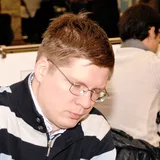
Vladimir Malakhov grew up in a family of physicists in Dubna, won the World Under-14 Championship in 1993 ahead of Peter Leko, became a grandmaster in 1998 and graduated in physics from Moscow State University. He played in the 2007 Candidates matches and finished second at the European Championship in 2003 and 2009, and in 2009 he reached the semifinal of the World Cup and won the European Rapid Championship. In January 2010 he won team gold and a board gold medal with Russia at the World Team Championship, and that July his rating reached 2732, 17th in the world. Boris Gelfand described him as a technical player able to "create something out of nothing".
A family of physicists
Malakhov was born in Ivanovo on 27 November 1980 into a family of physicists. A few years later the family moved to Dubna, a town two hours by train from Moscow known for its nuclear physics institute, where his mother lectured on physics at the university and his father worked as a researcher; his father later went to work at CERN in Geneva. "My dad taught me to play chess when I was 5," Malakhov said in 2010, "but I first took part in a tournament when I was 7." The Russian Chess Federation names his first trainers as Popelyshev and Bodisko and writes that even as a child he stood out for thorough play, fine positional understanding and virtuoso endgame technique.
He became Russian Under-12 champion, finished second at the World Under-12 Championship at 11, and a year later, at Bratislava in 1993, won the World Under-14 Championship ahead of Peter Leko. At school he won the first stage of the all-Russian Mathematics Olympiad but missed the final, which clashed with a chess tournament.
Malakhov became an International Master in 1995 and a grandmaster in 1998. With two physicists for parents, he said, it was obvious that he would study physics, and he graduated from the physics faculty of Moscow State University. He decided to become a professional player only after graduating at 22, when his rating first passed 2700, and he still took a job at the institute in Dubna. By 2010 he described himself as "an amateur physicist, as it's a long time since I last worked in the Institute"; the Russian Chess Federation lists him as a junior researcher at the Joint Institute for Nuclear Research.
European medals and the Candidates
His first major results came early in the 2000s. He won the European Club Cup with Norilsk Nickel in 2001. At the 2002 FIDE World Cup in Hyderabad he won his qualifying group, which included Vassily Ivanchuk, before losing the quarterfinal to Viswanathan Anand, ½–1½. In 2003 he finished second at the European Championship in Istanbul with 9/13, behind Zurab Azmaiparashvili, and took the bronze medal at the Russian Championship in Krasnoyarsk.
At the 2005 World Cup in Khanty-Mansiysk he knocked out Ivan Sokolov in the third round and went on to finish 11th. Because Étienne Bacrot had already qualified on rating, 11th place gave Malakhov a place in the 2007 Candidates matches. He prepared with Alexei Dreev and took up the Berlin Defense for the match, but lost to Alexander Grischuk in Elista, 1½–3½.
He won the European Club Cup again with Ural in 2008, scoring 7/7 on fifth board, and the Russian Team Championship with Ural in 2006 and 2008. At the 2008 team championship in Dagomys he beat Evgeny Bareev from an ending that Boris Gelfand, Bareev's teammate, called "close to what we would call dead drawn". Gelfand wrote: "at some point I was sure that the game would end in a draw. But Malakhov played on and eventually won."
“I love to have the initiative and I play that type of position very strongly, while in turn I play much more weakly when my opponent has the initiative in a complex position, or has developed an attack on my king.”
“Only rapid, as it allows you to develop the ability to take decisions quickly. … While blitz is simply a waste of time.”
“I don't just play for money, but mainly because chess is a magical sport.”
“When you play speed chess, it is, in essence, pure action.”
“Malakhov is to some extent the inventor of the style we now associate with Magnus Carlsen.”
“However, Malakhov is able to cook soup on a stone, and exploit the miniscule advantages that can be spotted only with a microscope.”
“But generally he holds such endgames very confidently, and we were hoping that he wouldn't lose. You have to put in a lot of effort to beat him!”
“The reality, that Malakhov is a part-time nuclear physicist and a professional chess player, is hardly less impressive.”
The 2009 World Cup
In 2009 Malakhov again finished second at the European Championship, at Budva with 8/11. At the World Cup in Khanty-Mansiysk that November and December he beat Bassem Amin 2–0, Ilya Smirin 3½–1½, Pavel Eljanov, the 16-year-old Wesley So and Peter Svidler, 1½–½, to reach the semifinal. Vladimir Tukmakov, later So's coach, wrote that "It was only Vladimir Malakhov who managed to knock the teenager out of the World Cup when he outplayed him in the tiebreak games." In the semifinal Malakhov drew both classical games with the former FIDE World Champion Ruslan Ponomariov and lost the rapid tiebreak, 2–4 overall.
Two weeks later he won the European Rapid Championship in Warsaw with 11½/13, holding off Vassily Ivanchuk by beating Alexei Shirov with Black in the last round. In January 2010, at the World Team Championship in Bursa, he played as Russia's reserve and scored 5/7, winning the board gold medal as Russia took the title.
His rating reached 2732 in July 2010, 17th in the world, and that autumn he played as reserve for Russia's first team at the Khanty-Mansiysk Olympiad, scoring 3/6. In the eighth-round match against Ukraine, which Tukmakov, Ukraine's captain, called the crucial match of the Olympiad, Malakhov lost a long ending to Zahar Efimenko; the match was drawn, Ukraine won the gold medals and Russia took silver. In December he beat Sergey Karjakin in the last round of the Russian Championship Superfinal, Karjakin's only loss of the event.
Technique
Malakhov said in 2010 that he played best when he had the initiative and that he had no problems in the endgame, which for him was a matter of intuition more than theory: "all the 'R + B v R' endgames that I've had in my life I've won as the stronger side, and drawn as the weaker side." He worked alone with a computer, he said, because he put his family life first, and he had no plans to write about chess, "as the effort required doesn't convert into profits".
Gelfand, who had played him only once at a classical time control, wrote in 2015 that Malakhov "plays very strong technical chess and is able to outplay his opponents in flat positions". Many players, Gelfand added, can play well with a slight advantage, "but to be able to create something out of nothing is really a supernatural skill."
Later career
Malakhov took third place at the 2012 European Championship in Plovdiv. With Ugra he won silver at the 2010 European Club Cup, scoring 5½/7 for the gold medal on second board, and he won another silver with Malakhit in 2013 and the Russian Team Championship with Malakhit in 2014. In the Chinese Team Championship he beat Ding Liren in 2013 and Lu Shanglei in 2014, and at the 2013 World Cup he reached the third round, where he lost to Fabiano Caruana. He returned to the Russian Championship Superfinal in 2017, when he beat Daniil Dubov, and in 2025.
Married with two daughters, he lives in Dubna. "I love Dubna, I love Russia and I really don't intend to move," he said in 2010. Since May 2022 he has played under the FIDE flag, and in 2023 FIDE made him a Senior Trainer.
Legacy
Malakhov combined a place among the world's top 20 players with a physics degree and a home in Dubna. He won the World Under-14 title in 1993, played in the 2007 Candidates, reached the World Cup semifinal in 2009 and won world team gold with Russia in 2010, and Gelfand saw in his technical play an early form of the style later associated with Magnus Carlsen.
Books
No authored or contributed books are documented in the available sources.