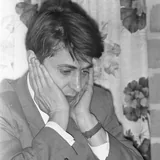
In the autumn of 1971 the Soviet Union gathered twenty-two of the strongest players alive in Leningrad to decide its championship, including Smyslov, Tal, Karpov, Stein, Polugaevsky, Geller and Bronstein. Five weeks later the title belonged to a quiet international master from Kharkiv who hadn't touched a chess piece until he was thirteen. Vladimir Savon went through the whole tournament without losing a game, scored 15 out of 21, and finished a point and a half clear of two former world champions. The standard history of the Soviet championships calls it the least likely result in decades. He never reached that level again; a head injury at thirty-nine ended his career at the top. But he spent the second half of his life coaching the young players of Kharkiv, and they remember him as clearly as the record remembers Leningrad.
A boy who came late to the board
Vladimir Andreyevich Savon was born on 26 September 1940 in Chernihiv, in the north of Soviet Ukraine, and he came to chess the way almost no Soviet champion did — late, and from nowhere. He learned the moves at thirteen, an age by which the boys of the Moscow and Leningrad palaces of pioneers had already been drilled for half a decade. Vladimir Tukmakov, who knew him for forty years, put the whole of his origin into a single sentence: “Born and raised in a small provincial town in Ukraine, a simple and kind man, he seemed to be completely content with his chess status.”
Being content didn't stop him improving. He earned the Soviet title of Master of Sport in 1960, while still in his teens, and began qualifying for the finals of the Ukrainian championship. He studied at the Economics Faculty of the University of Kharkov, the city that would be his home for the rest of his life, and through the 1960s he traveled with Soviet student teams to the World Student Team Championships. FIDE awarded him the International Master title in 1967. He was twenty-seven, respectable and unremarkable, one of the several hundred very strong Soviet players who never expected the elite to make room for them.
The dormant ambition
What changed, in Tukmakov's reading, was that the men around him began to win. “I think it was the success of his younger friends, Kuzmin, Podgaets and Tukmakov, that awakened his dormant ambition,” he wrote of the late 1960s — and Savon's whole bearing altered with it. His attitude towards the game changed; he even began to look more stern and resolute. In 1969 he shared the Ukrainian championship with Gennady Kuzmin, and in the 37th Soviet Championship that autumn he beat Mikhail Tal outright.
The following year the ascent became unmistakable. He reached the semi-final of the USSR Cup, knocking the former world champion Tal out in the quarter-finals; he finished fifth-to-seventh in the 38th Soviet Championship at Riga; and abroad he shared first place at Debrecen with István Bilek. In the spring of 1971 he took second-to-third at Mar del Plata. He was still, on paper, only an international master. The Soviet championship at Leningrad was five months away.
“Born and raised in a small provincial town in Ukraine, a simple and kind man, he seemed to be completely content with his chess status.”
“A versatile chess-player, he was especially good in dynamic positions with the initiative. But he was lacking something required to conquer the chess heights — maybe, sporting brazenness.”
“The coach was the famous GM Vladimir Savon. He taught me a lot of things — unfortunately he is not with us anymore…”
Leningrad, 1971
The 39th USSR Championship ran from 15 September to 18 October 1971 — twenty-two players, an all-play-all containing very nearly the entire Soviet elite. Savon never lost a game. He finished on 15 points out of 21. Vasily Smyslov and Mikhail Tal, both former world champions, shared second on 13½; Anatoly Karpov, three years from the crown himself, was fourth on 13; Leonid Stein, three times a Soviet champion, shared fifth–sixth with Yuri Balashov on 12. The margin was a point and a half, and the man who held it did not even carry the grandmaster title. Kasparov records these standings in Garry Kasparov on My Great Predecessors, Part II, in the introduction to Game 117.
Mark Taimanov and Bernard Cafferty, in their standard history of the Soviet championships, called Savon's win “the least plausible result for decades” — and the chess world reached at once for an explanation. One theory recorded in the literature is that the Soviet leaders were distracted: Bobby Fischer had just annihilated Taimanov and Bent Larsen by 6–0 in the Candidates matches, and Tigran Petrosian's own match against Fischer was to finish only days after the Leningrad tournament ended. It was claimed that those 6–0 scores had hypnotised the top Soviets.
The theory is worth recording, but not worth accepting whole. Going twenty-one rounds without a loss in a field that strong doesn't happen because your rivals were reading the newspapers. Savon simply played the best chess of his life for five weeks and kept it up to the end. The championship of the Soviet Union, then the hardest tournament in the world, went home to Kharkiv.
The years at the top
For the next few seasons he belonged where the title had put him. At the 1972 Olympiad in Skopje he was the sixth man of a Soviet team otherwise composed of Petrosian, Korchnoi, Smyslov, Tal and Karpov — five grandmasters and one international master — and the USSR took the gold medal for the eleventh consecutive time. In July 1972 his rating peaked at 2590 and he stood fifteenth in the world. At Sukhumi that year he finished second behind Tal, and at the 40th Soviet Championship in Baku he tied for third to fifth and qualified for the Interzonal.
FIDE made him a grandmaster in 1973. That year he finished eighth of eighteen at the Petropolis Interzonal, and at the 41st Soviet Championship in Moscow, where he managed only 8/17 and a share of ninth to twelfth, he still beat Boris Spassky, the tournament winner. Good results kept coming: shared first at the Vilnius zonal in 1975, where he narrowly missed qualifying for the world championship cycle; second equal with Vlastimil Hort behind Larsen at Portorož in 1977; second equal at Kyiv in 1978. But he never reached his 1971 level again, and Tukmakov's explanation is as gentle as it is precise: “A versatile chess-player, he was especially good in dynamic positions with the initiative. But he was lacking something required to conquer the chess heights — maybe, sporting brazenness.”
Kharkiv
In 1980, at a tournament in Dnepropetrovsk — a qualifying event for the 48th Soviet Championship — Savon suffered a serious head injury. It ended the competitive part of his life. His playing strength declined significantly and never recovered, and with it, in Tukmakov's account, went his motivation. He was thirty-nine years old.
He did not disappear. He kept entering the Soviet championship — eleven of them in all, from his debut in 1961 at the age of twenty-one to the very last one held, in 1991 — and he went on competing in the open tournaments of independent Ukraine into his sixties. Above all, he became a trainer. The National Law Academy of Ukraine in Kharkiv ran a strong chess club, and its coach was Savon; among the students who arrived there at seventeen was Alexander Moiseenko. “The coach was the famous GM Vladimir Savon,” Moiseenko said afterwards. “He taught me a lot of things — unfortunately he is not with us anymore…”
Legacy
Savon died in Kharkiv on 1 June 2005, aged 64. In 2020 his student Alexander Moiseenko published Grandmaster Savon. Champion and Mentor, a biography built from archive material, more than a hundred largely newly annotated games, and the recollections of the people who had studied and worked alongside him — a book whose title says exactly how Kharkiv chose to remember him. From the second half of the 1960s to the end of the 1970s he was one of the strongest players in the Soviet Union; for five weeks in the autumn of 1971 he was the strongest of them all. That month has never needed defending: twenty-one rounds, not one defeat, 15 points, and a field of world champions left a point and a half behind.
Books
No authored or contributed books are documented in the available sources.