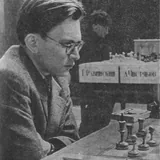
Vladimir Simagin
Vladimir Simagin played chess the way a good writer writes — for the idea, not for the score. Three times champion of Moscow, a grandmaster only in his forties, he had a tournament record that understates him badly. His contemporaries treated him as one of the most original minds in Soviet chess: a man who went looking for the move nobody else would consider, and who kept finding that it worked. Whole variations in the King's Indian, the Nimzo-Indian and the Sicilian still carry his name. He died at forty-nine, in the middle of a tournament in the Caucasus.
◈A Moscow boy who went looking for odd moves
Simagin was born in Moscow on 21 June 1919 and learned his chess in the city's Pioneers' clubs, the nursery that fed Soviet chess for half a century. He was twenty when he first sat down in the adult Moscow championship in 1939, and he announced himself there by beating the veteran Boris Verlinsky — a result the Moscow chess world remembered long afterwards, because the boy had won it with ideas nobody recognised.
Then the war closed the Soviet chess calendar down. Competition largely stopped, and by the time it resumed Simagin was in his mid-twenties, a late starter by the standards of a country that produced champions at eighteen. He was awarded the title of Master of Sport of the USSR in 1944, and from that point he was never out of Moscow's front rank.
◈The long apprenticeship
In the 1946 Moscow championship he finished second on 11/15, behind David Bronstein. A year later he took the title himself: joint first on 9/14 with Bronstein and Grigory Ravinsky, then a play-off match-tournament which he won. In the same season he tied for first with Semyon Furman in the Spartak club championship on 15/19 and won that play-off too. He was, for a season, the hardest man in Moscow to beat twice.
Being city champion earned him a board in the home-and-home match between Moscow and Budapest in 1949, and it produced the single most emphatic result of his career: 12/16, worth a performance of 2732 by Chessmetrics' later reckoning, with wins over László Szabó and a young Pál Benkő among them. FIDE made him an International Master in 1950, the year the title was created.
The Soviet championship itself was another matter. For years the semi-finals stopped him — Leningrad 1945 with 5½/15, Leningrad 1946 with 9½/18, Vilnius 1949 with 9/17, Tula 1950 with 8/15 — good chess, never quite the qualifying score. Nothing in his career came easily or early.
◈Champion of Moscow
In 1956 he shared first place in the Moscow championship with Tigran Petrosian on 10/15; the play-off match went to Petrosian by three wins to one with a draw, though the city's records credit both men as champions of that year. In 1959 there was no ambiguity at all: 12/15 and the title outright. The grandmaster title followed in 1962, when he was already in his forties.
He reached seven USSR Championship finals and never placed high in one. His best was the 1961 final in Moscow — 10/19 and a share of ninth and tenth — but the bare number hides what the fortnight actually contained, because in that single event he beat Leonid Stein, Boris Spassky, Lev Polugaevsky and Yuri Averbakh. That was the shape of his career in miniature: capable of taking down anyone, incapable of grinding out the safe half-points in between.
Abroad the results arrived late and then came steadily: joint second at Sarajevo in 1963, joint first at Zinnowitz in 1965, first at Varna in 1966 with 8/11, and a share of first at the Chigorin Memorial in Sochi in 1967. He was forty-eight, and playing the best chess of his life.
◈The variations that carry his name
Simagin's real monument is in the opening books. The Accelerated Dragon in the Sicilian owes much of its early development to him. The Simagin Variation of the Nimzo-Indian is 1.d4 Nf6 2.c4 e6 3.Nc3 Bb4 4.e3 0-0 5.Nge2 d5 6.a3 Bd6; Simagin's Defence is 1.e4 d6 2.d4 c6 3.Nf3 Bg4. In the fianchetto King's Indian, 7...Bg4 is the Simagin Variation, and he experimented so persistently around it that 7...Bf5 became known as the Lesser Simagin and the rarer 7...Bd7 as the Least Simagin. Russian sources credit him with the opening move 1.b3, later associated with Bent Larsen, and with systems in the Slav, the Dutch and the Grünfeld. Friends asked him why he insisted on lines nobody else played; the answer, over twenty years, was that a good many of them became lines everybody played.
The one position of his that everyone knows is a fragment. In a game against Bronstein at Moscow in 1947 he reached an ending and played Bg5 — a move so strange that it has been reprinted in tactics books ever since. Only the conclusion was ever published; the score of the complete game has never been found, and Edward Winter lists it among chess's permanently incomplete games.
He was a working theoretician as well as a practising one. He edited the Bulletin of the Central Chess Club, and in 1966 it was Simagin who pushed through — against internal resistance — the preview article from Mikhail Botvinnik's Algorithm of Chess, the first public airing of Botvinnik's computer-chess research. As a trainer he worked with Alexander Kotov around 1950, and through the 1950s, alongside Vladimir Makogonov, he was one of the two men who prepared Vasily Smyslov for the world title Smyslov won in 1957.
◈Chess by post
Correspondence chess suited him exactly, because it rewarded the thing he was best at: sitting with a position for as long as it took. He won the 6th USSR Correspondence Championship of 1963–64 with 13/17, and finished runner-up in the 7th with 13½/19. The ICCF made him an International Master of correspondence chess in 1965.
He believed the postal games had helped carry him to the over-the-board grandmaster title, and Soviet writers of the time expected him to become only the fifth player in history to stand as a grandmaster in both forms of the game, after Vyacheslav Ragozin, Igor Bondarevsky, Alberic O'Kelly and Lothar Schmid. He did not live to complete the double.
◈The man, and the end
Away from the board he was reserved to the point that strangers mistook it for coldness; those who knew him described a shy, courteous, unusually well-read man who carried good books to tournaments. Bronstein called him a chess philosopher. He rarely bothered with the crosstable. What he wanted from a game was that it should be full of original ideas and consistent from the first move to the last, and he would accept a worse result for a better idea more or less indefinitely.
He smoked heavily, and from the late 1950s his heart was not sound. He kept playing anyway, and 1968 was a busy year: third to fifth at Polanica-Zdrój, then the international tournament at Kislovodsk in September. On 25 September 1968, the day after losing his game there, Vladimir Simagin died of a heart attack. He was forty-nine. His ashes were placed in the columbarium at Novodevichy Cemetery in Moscow.
“A game conducted logically and finished off with a beautiful combination — that is my chess ideal.”
“In chess, as in life, all the time you have to overcome obstacles. When you play a game, your opponent with each move sets up barriers before you.”
“His character was resolute, and his chess talent was extraordinary and original.”
“A player with a highly original, unique and imaginative style of play; he was a chess philosopher and a very educated personality, with a great love for literature.”
“Simagin was one such artist, and I recommend that you study his selected games. For some time it was a standard reference work for me.”
◈From the archive
◈Legacy
Moscow held its inter-departmental team championships in his memory from 1968 to 1973, and the literature about him has outlived most of the players who beat him: Sergey Voronkov's Vladimir Simagin appeared in Moscow in 1981, Aidan Woodger's English monograph in 2000, and his own 1963 collection Best Games went through four editions in Spanish translation as El Estilo Posicional. Mark Dvoretsky kept it on his shelf as a working reference. Douglas Griffin calls him one of the most original chess thinkers of the twentieth century, which is the fairest summary available: Simagin never won a great tournament that history remembers by name, and he changed how a dozen openings are played.