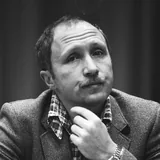
Vladimir Tukmakov became a USSR master at sixteen and a grandmaster at twenty-six. He finished second in the USSR Championship three times, behind Viktor Korchnoi, Mikhail Tal and Anatoly Karpov, and second to Bobby Fischer at Buenos Aires in 1970. He won tournaments across Europe for two decades, played on the Soviet team that won the 1984 Olympiad, and then became one of the most successful coaches in the game: Ukraine won the Olympiad under him in 2004 and 2010, and he later worked with Anish Giri and Wesley So. He has also written several books on chess, among them an autobiography, Profession: Chessplayer.
Odesa
Tukmakov was born in Odesa on 5 March 1946; most reference books give the date as 15 March, but he has confirmed the 5th. He trained in Odesa under Samuil Kotlerman and became a USSR master in 1962, at sixteen.
He studied at the Odesa Technological Institute and for a time intended a career in science rather than chess. In 1965 he shared second place at the World Junior Championship in Barcelona, half a point behind Bojan Kurajica, and from 1966 to 1972 he played in the Soviet teams that won the World Student Team Championship year after year, collecting nine gold medals. In Coaching the Chess Stars (2019) he recalled starting in that team as second reserve and eventually reaching first board.
In Profession: Chessplayer, he recalled almost leaving chess behind while studying. An invitation to the Soviet qualifier for the World Junior Championship took him to Moscow, despite a warning from his dean. Playing without great expectations, he won the tournament two points clear of the runner-up. Reports in Pravda and Izvestia softened the dean's response: Tukmakov was allowed to sit his missed examinations later. He eventually transferred to the economics department.
Buenos Aires and the Soviet Championships
In 1970 he finished second at Buenos Aires behind Bobby Fischer, and in the same year he won the Ukrainian championship and finished second in the USSR Championship at Riga, behind Viktor Korchnoi, whom he beat there. He became a grandmaster in 1972, the year he was again runner-up in the USSR Championship, this time behind Mikhail Tal. That championship was played in Baku, which he later called his luckiest city: second place there brought him his first qualification for an Interzonal.
His meeting with Fischer in Buenos Aires had its own difficulties. In the recollection quoted by Garry Kasparov in My Great Predecessors, Part IV, Tukmakov was due to face him in the first round, but Fischer arrived late and their game was postponed to an extra adjournment day. It then started another half-hour late while the lighting was adjusted at Fischer's request. Tukmakov admitted that the atmosphere of special treatment for Fischer had affected him.
His autobiography returns to his Buenos Aires win over Oscar Panno. Tukmakov played 21.e6 at once; Panno spent more than an hour on his reply and resigned. Tukmakov credited the win with lifting his spirits before three further victories. The move remained a source of pride for years, until he discovered another way to win and then submitted the game to a computer: “Wretched Fritz 8 found the move of my life in seconds.”
He played in fourteen USSR Championships between 1967 and 1989. His third second place came in Moscow in 1983, behind Anatoly Karpov. He also finished second behind Karpov at Madrid in 1973.
“Analyzing one’s failures, both in life and in sports, is much more productive for growth than basking in success.”
“Wretched Fritz 8 found the move of my life in seconds.”
“I felt myself a captain long before it became my work.”
“But even with these potential drawbacks, I wish I could turn the clock back and leave the decision to Shakhriyar.”
“The main requirement for being a captain is to remain an honest person in any circumstances. It is not so easy to be a captain!”
The tournament circuit
Tukmakov shared first place at the IBM tournament in Amsterdam in 1974 with Vlastimil Jansa and Borislav Ivkov, won at Děčín in 1977, shared first at Las Palmas in 1978 with Gyula Sax, and won at Vilnius in 1978, ahead of Tigran Petrosian, and at Malta in 1980. He played in two Interzonals: Leningrad 1973, and Las Palmas 1982, where he beat Petrosian in the first round, also beat Vasily Smyslov, led the field early on and finished fourth.
A defeat could change his methods. In Modern Chess Formula, he traced a gradual change in his opening repertoire to his loss against Igor Novikov at Lviv in 1984. He became less committed to the Grünfeld Defense and broadened his repertoire, avoiding long forcing variations.
Later wins included the Lugano Open in 1985, the 30th Reggio Emilia tournament in 1987/88 and the Canadian Open in 1989 and 1994, and he shared first place with Judit Polgár at the OHRA open in Amsterdam in 1990.
Playing for the team
Tukmakov played at one Olympiad, Thessaloniki 1984, and won team gold with the Soviet Union. At the European Team Championships of 1973, 1983 and 1989 he won five gold medals, three for the team and two individual. In Coaching the Chess Stars, he recalled playing Black in all five games for the Soviet team at the 1973 championship in England.
At the USSR v Rest of the World match in London in 1984 he started as a reserve. He twice replaced Smyslov on board four and once Lev Polugaevsky on board three, and scored a win and a draw against Ljubomir Ljubojević and a draw against Korchnoi. He later described the Soviet team meeting before the last round, when Polugaevsky looked for any pretext not to play Black against Korchnoi and the reserves were reluctant to take his place. Polugaevsky's final argument was to yell, “All of you, you want me dead!”, and Tukmakov gave in.
Not every team event went his way. At his first Soviet Army Championship in 1971, his Odesa Military District team was leading when it fell 0–3 behind against the Transcaucasian Military District. The Odesa players turned down three offers of draws on the remaining boards and lost 0–7, a result Tukmakov called “to a large extent, a mutual achievement.” In 1988 he was board one and captain of CSKA, the Red Army team, at the European Club Cup final in Rotterdam. With a two-point lead before the last round, he left for a tournament in Biel; the army officials who were to submit the team list had begun celebrating the night before, and the match started with a forfeit for his absence from board one. CSKA lost the match by the minimum score but kept first place.
Coach and author
His coaching began long before he stopped playing. In 1971, just out of university and at the start of his military service, he was assigned to help Efim Geller, a fellow Odesa native, in his Candidates quarter-final against Viktor Korchnoi, which Geller lost. In 1976 he was Vitaly Tseshkovsky's second at the Manila Interzonal, where Tseshkovsky finished fourth, half a point short of a Candidates place, and in 1978 he helped Mark Dvoretsky's pupils Artur Yusupov and Sergey Dolmatov at the World Junior Championship in Graz, which Dolmatov won by half a point from Yusupov. He never had a personal coach himself; before Manila, he wrote, “Tukmakov the coach worked with Tukmakov the player, which was not too inspiring.”
His work with Korchnoi began by chance at Wijk aan Zee in 1991. Tukmakov was playing in a side tournament when Korchnoi's second, Dmitry Gurevich, had to leave during the Candidates match against Gyula Sax and asked him to help prepare the next game. Tukmakov had a plus score against Korchnoi and “didn’t feel any particular reverence for him”, but he was struck by the veteran's energy. Korchnoi beat Sax and asked him to stay for the rest of the cycle. Before the next match, against Jan Timman in Brussels, Tukmakov persuaded a tired Korchnoi to withdraw from the Biel tournament; Korchnoi lost to Timman, and Tukmakov later wrote that he no longer had “the absolute conviction” behind that advice. In Modern Chess Formula, he recalled buying his first laptop afterward: watching the sixty-year-old Korchnoi retrieve material with one finger convinced him to change his own methods of gathering chess information.
In early 1998 he joined Anatoly Karpov's team for the FIDE World Championship match against Viswanathan Anand in Lausanne, where his eldest daughter lived. When Anand won the last regular game and forced a rapid tiebreak, Tukmakov proposed a new routine: choose the sharpest line with White the evening before and drink “alcohol instead of water during dinner”. Karpov rejected the plan angrily, though an hour later the whole team was in a restaurant. Karpov won the tiebreak and kept his title. Tukmakov went on playing for some years and wrote that he crossed the line from player to coach only when he became Ukraine's head coach in 2004.
His first formal appointment as Ukraine's captain came at the Bled Olympiad in 2002. As he explained in Coaching the Chess Stars, it was a temporary role: he inherited a selected team and met the players together only on arrival. The disappointing performance persuaded him that coaching required sustained work. He declined another temporary appointment for the 2003 European Team Championship and preferred the prospect of becoming a permanent head coach.
In 2004 Tukmakov became a FIDE Senior Trainer and captain of the Ukrainian team, which won the Olympiad that year at Calvià with Vassily Ivanchuk as its leader and the fourteen-year-old Sergey Karjakin in the squad. In the last round the French captain, Joël Lautier, offered draws on all four boards; Tukmakov checked the pursuers' matches, played on, and Ukraine won 3–1. Success there, he wrote, meant that his life in chess was not over: “That was how a professional player who was ready to start collecting his pension transformed into a young coach.” In 2009, when the sports ministry could provide only part of the money for the European Team Championship in Novi Sad, the players voted unanimously to share the financial risk, and the team took bronze, a result he counted among the highest achievements of his captaincy. Ukraine won the Olympiad again at Khanty-Mansiysk in 2010, and FIDE named him its Trainer of the Year. Tired of “endless bureaucratic and political games”, he resigned in 2011, ending seven years as head coach.
From 2010 he also captained SOCAR, a new Azerbaijani club whose first team, formed during the 2010 Olympiad, joined Teimour Radjabov and Shakhriyar Mamedyarov with Alexander Grischuk, Maxime Vachier-Lagrave and Alexei Shirov. It won the European Club Cup at Eilat in 2012, when Tukmakov, believing the title lost, had already gone back to his room until Eltaj Safarli phoned to ask, “Do you know that we won?”, and again at Bilbao in 2014. The club lasted six years. From May 2011 he was also head coach and captain of Azerbaijan, which took silver at the 2011 European Team Championship; the 2012 Istanbul Olympiad was his last event with the team. He then captained the Netherlands at the 2014 and 2016 Olympiads and the 2015 European Team Championship.
He coached Anish Giri from 1 January 2014 until the 2016 Candidates Tournament in Moscow, where Giri drew all his games; a few days later Giri wrote to him that their work was finished. From May 2016 he coached Wesley So, who had never had a personal coach, mainly by Skype. In that period So won the 2016 Grand Chess Tour and, in 2017, Wijk aan Zee and the US Championship; they stopped working together before the 2018 Candidates. In 2024 FIDE gave Tukmakov its Best Trainer award as part of its centenary celebrations.
He also wrote about a captain's mistakes. In Risk & Bluff in Chess, he recalled Shakhriyar Mamedyarov asking whether to accept Borki Predojevic's draw offer in a 2011 team match. Tukmakov, captaining SOCAR, saw a continuation that he believed favored Black and told Mamedyarov to play on. Short of time, his player missed it and lost; the team lost the match. Tukmakov wished he had left the decision to Mamedyarov.
His books include Profession: Chessplayer (2009; English edition 2012), an autobiography with more than forty of his annotated games, Modern Chess Preparation (2012), Risk & Bluff in Chess (2015), Coaching the Chess Stars (2019) and Modern Chess Formula (2020).
Legacy
Tukmakov never reached the Candidates, but over more than twenty years he was one of the strongest Soviet grandmasters, three times runner-up for the national title and the winner of tournaments from Amsterdam to Reggio Emilia. As a coach he took Ukraine to two Olympiad titles and worked with players at the top of the world rankings, and in his books he has written about his own career and about how grandmasters prepare.
Books
Books Vladimir Tukmakov wrote, co-wrote, edited, or contributed to. Translations and reprints are grouped under the same work.
-
Profession: Chessplayer — Grandmaster at Work
Author
-
Modern Chess Preparation: Getting Ready for Your Opponent in the Information Age
Author
-
Risk & Bluff in Chess: The Art of Taking Calculated Risks
Author
-
Coaching the Chess Stars
Author
-
A Feast of Chess in Time of Plague: Candidates Tournament 2020, Part 1 — Yekaterinburg
Author
-
Modern Chess Formula: The Powerful Impact of Engines
Author
-
Victor Kupreichik: The Maestro from Minsk
Contributor — written tribute
-
From Ukraine with Love for Chess
Contributor — recollections and game annotations