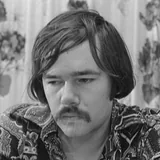
Walter Browne was born in Sydney, grew up in Brooklyn and left school at sixteen to play chess for a living. He won the Australian championship at twenty, qualified for the grandmaster title the same year at San Juan, and played first board for Australia at two Olympiads before he switched to the United States in 1974, the year he won the first of six U.S. Championships; only Bobby Fischer and Samuel Reshevsky won more. He also won the National Open eleven times, and he was known as "Six-time" and "King of the Swiss." He often spent much of his clock in the opening and then made twenty or so moves with a minute or two left, and he was one of the best blitz players in the world. For five decades he earned his living from chess and poker, and he was still playing both in the week he died.
Sydney and Brooklyn
Walter Shawn Browne was born in Sydney on 10 January 1949, the oldest of four boys. His father, Walter Francis Browne, was American and his mother, Hilda, was Australian. The family moved to New York when he was a small child, and his father taught him chess when he was eight. He joined the Manhattan Chess Club at thirteen.
Like Bobby Fischer, he went to Erasmus Hall High School in Brooklyn, and like Fischer he dropped out at sixteen to play chess full time. In 1966 he won the first U.S. Junior Closed Championship.
Australia's grandmaster
Browne held both Australian and American citizenship, and for a few years he played for Australia. He won the Australian championship in 1969 and tied for first with Renato Naranja at the Asian Zonal in Singapore the same year. The result made him an International Master, but Naranja took the Interzonal place on tiebreak.
The zonal brought him an invitation to a grandmaster tournament in San Juan, Puerto Rico, in late 1969, where he tied for second to fourth with Bruno Parma and Arthur Bisguier, behind the World Champion Boris Spassky. The result earned him the grandmaster title, which FIDE awarded in 1970. He played first board for Australia at the Siegen Olympiad of 1970, scoring 14/19, and at Skopje in 1972, where his 17½/22 won the board bronze medal. In 1974 he began to represent the United States.
Fischer also considered working with him. In My Great Predecessors, Part IV, Chapter Two, “Hara-Kiri,” Kasparov records a January 1971 letter inviting Browne to become Fischer's manager or second. Fischer argued that they could earn more together than separately.
“If Bobby Fischer is the god of chess, I am the devil.”
“I have struggled with my artistic and competitive desires.”
“I firmly believe that by competing you are a winner, no matter the result.”
“It was silly of me not to use more time. I was thinking too much of the clock instead of the position.”
“None of my later rivals did I find as frightening as Walter.”
“It is a vast understatement to call him a hard worker at the board. He never stops.”
“One of the great characters of the game and a legend of US Chess.”
“He is not a man who suffers fools gladly, and if the fool is himself, he punishes himself.”
Six-time
Browne won the U.S. Championship at Chicago in 1974 with 9½/13, at Oberlin in 1975 with 8½/13 and at Mentor in 1977 with 9/13. He shared the title at Greenville in 1980 with Larry Evans and Larry Christiansen, at South Bend in 1981 with Yasser Seirawan, and in 1983 with Christiansen and Roman Dzindzichashvili. Only Fischer and Reshevsky, with eight titles each, won more.
He played in 24 U.S. Championships between 1973 and 2007 and scored 85 wins, 68 losses and 114 draws. He was the highest-rated American on the FIDE lists of January 1976, January 1984 and July 1984, and in January 1976 he was ranked fourteenth in the world. After 1983 he never again reached that level in the championship.
In March 1976 the Soviet Sports Committee named Browne among ten leading foreign grandmasters whose games and opening repertoires were to be studied for the next world championship cycle. Kasparov reproduces the preparation instructions in My Great Predecessors, Part V, p. 303.
Tournaments abroad
From the early 1970s to the mid-1980s Browne won tournaments around the world: Venice 1971, Wijk aan Zee 1974, the Pan American Championship at Winnipeg in 1974, Lone Pine 1974, Mannheim 1975, Reykjavík 1978, Wijk aan Zee again in 1980, Chile 1981, a 26-player round robin in Indonesia in 1982 that he shared with Ron Henley, the 1983 New York Open, Gjøvik 1983 and Naestved 1985. His wins over former World Champions include Vasily Smyslov at Hastings 1972/73 and Mikhail Tal at Milan in 1975.
The world championship cycle went less well. He qualified for three Interzonals and was never near a Candidates place: 8½/19 and fifteenth place at Manila in 1976, last of fourteen with 3/13 at Las Palmas in 1982, and 6½/15 at Taxco in 1985. At the Olympiads he did better. In six appearances, two for Australia and four for the United States, he scored 55½/86 and won five bronze medals: the board medal at Skopje and team medals with the United States in 1974, 1978, 1982 and 1984.
Clock, blitz and poker
In the preface to The Stress of Chess ... and its Infinite Finesse (p. 19), Browne described the tension between creativity and winning. He preferred unfamiliar, sharp positions, prepared new opening ideas and always carried a rook-ending book to study.
Browne's habit at the board was to use a large part of his time in the opening and early middlegame and then, at risk of losing on time, make twenty or so moves with a minute or two left. In time trouble he rocked forward and back over the board while he worked through the variations. His peers admired how hard he calculated, and in American opens he was hard to stop: besides his eleven National Opens he won the American Open seven times, the World Open three times, the U.S. Open in 1971 and 1972, and the Canadian Open in 1991. The U.S. Chess Federation credited him with more Swiss tournament wins than any other player.
He played two series of the BBC's The Master Game, in which the players' recorded thoughts were heard as the moves were shown. Jeremy James and William Hartston's The Master Game, Book Two (1981) follows both. In 1979, against Hein Donner, he reproached himself early on for not using more time, then blundered a piece in extreme time pressure and lost. In 1980 he arrived with one leg in plaster, won his group, and lost the final to Lothar Schmid on time after Schmid had made a new queen. The book says he spent much of both series away from the board looking for “a good poker or backgammon school,” and that after the final he at once challenged Schmid to a five-minute game for the first-prize money. Schmid declined (pp. 17, 35, 37, 67, 105).
Seirawan's foreword to the memoir (pp. 9–10) describes Browne's earlier publishing work. In the late 1970s he paid contacts abroad to mail complete tournament bulletins, then mimeographed and sold them to cover the expense, sometimes adding his own annotation marks.
For decades he was among the best blitz players in the world. In 1988 he founded the World Blitz Chess Association and the magazine Blitz Chess, and he ran the association until it closed in the early 2000s. He had played poker professionally since the early 1970s and often paid for his chess that way; from the mid-1980s poker gradually became his main game. In 2007 he finished second in the $2,500 H.O.R.S.E. event at the World Series of Poker and won $131,445.
In his last years he came back to chess. In 2012 New In Chess published The Stress of Chess ... and its Infinite Finesse: My Life, Career and 101 Best Games, with a foreword by Seirawan. At his death he was the reigning U.S. Senior Champion, and in December 2014 he won the Pan-American Senior Championship for players over 65 in São Paulo.
Legacy
Browne died in his sleep on 24 June 2015, at sixty-six, at the Las Vegas home of his friend Ron Gross. In the days before, he had tied for ninth place in the 50th National Open, a tournament he had won eleven times, and had given lectures and a 25-board simultaneous exhibition. He was inducted into the U.S. Chess Hall of Fame in 2003. His autobiography, The Stress of Chess ... and its Infinite Finesse, collects 101 of his best games, and the Browne System in the Najdorf Sicilian, marked by an early ...h6, is named after him.
Books
Books Walter Browne wrote, co-wrote, edited, or contributed to. Translations and reprints are grouped under the same work.
-
The Stress of Chess: My Life, Career and 101 Best Games
Author
-
The Master Game, Book Two
Contributor — own game annotations