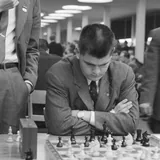
William Lombardy won the 1957 World Junior Championship with eleven wins from eleven games. Three years later he led the United States to the World Student Team title, beating Boris Spassky on first board. He entered a Jesuit novitiate that same year, was ordained in 1967, and continued to compete while serving as a priest. In 1972 he became Bobby Fischer's second in Reykjavík. His memoir, Understanding Chess: My System, My Games, My Life, tells the story from his own side of the board: the boy learning from newspaper clippings, the grandmaster preparing for opponents, and the teacher still passing on what he had learned.
A boy from the Bronx
Lombardy was born in New York City in December 1937, the son of an Italian-American father and a Polish-American mother, and grew up in a crowded Bronx apartment. In Understanding Chess (2011, pp. 13–15), he recalled learning the moves from his neighbor Eddie Galernter, who was a year older and wanted someone he could beat. Eddie initially taught him the knight's move incorrectly; Lombardy remembered that in their games the knight was almost as strong as a queen.
At about ten he began playing the adults at Lion's Square Den Park. An elderly player gave him a notebook containing some two thousand newspaper chess clippings. Lombardy went to the public library to learn descriptive notation, then began playing through the games on his little board. He estimated that he had covered a fifth of the notebook within a month. Decades later he could still picture the donor's face, though he had never learned his name.
As a teenager he became a regular visitor to Jack Collins's Brooklyn home, a gathering place for young American players. In the memoir (p. 28), Lombardy described Collins as his “friend and mentor but not my teacher,” disputing the familiar account of formal instruction. He also recalled hours spent studying master games with the younger Bobby Fischer (p. 23). Their friendship would later take them to the world championship match in Iceland. Lombardy pursued his education alongside chess: three years at City College, followed by philosophy and ethics at the seminary.
The perfect score
In 1957, in Toronto, Lombardy played the World Junior Chess Championship and won it with eleven wins and no draws or losses — a clean 11–0. No player has matched that perfect score in the event's history before or since. He was the first American to win the World Junior, and the first U.S. citizen since Wilhelm Steinitz to capture an individual world chess title. The result brought him the International Master title automatically.
Against Vladimir Selimanov in Toronto, he used his own idea in the Chigorin Ruy Lopez — advancing the c-pawn a single square rather than two. Its first outing had come a month earlier, against Fridrik Olafsson at the World Student Team Championship in Reykjavík. In Understanding Chess (p. 67), Lombardy said the idea came “quite by accident,” from asking whether Black needed to advance the pawn two squares at all. He acknowledged working on the strategy with Nicolas Rossolimo.
His eighteen-move win over Mathias Gerusel, the eventual runner-up, was backed by extensive preparation. In the notes to that game (p. 74), Lombardy recalled spending more than five hours that morning reviewing the Ragozin system. The willingness to take risks, he explained, came from knowing the positions. He wanted the reader to see the work behind the celebrated attack.
“I have never forgotten the “old man” who kindly gave me that awesome gift.”
“Brilliancies are not born purely of intuition, inspiration or imagination!”
“The flawless execution of inaccurate ideas makes chess fun.”
“I have immensely enjoyed chess. It is the reason I still teach.”
“Lombardy might have been the greatest of his generation if Bobby hadn’t come along.”
Leningrad, 1960
Lombardy represented the United States seven times at the World Student Team Championship — an American record — but one campaign stands above the rest. At Leningrad in 1960 he played first board and scored twelve points from thirteen games, a 92 per cent run that took individual gold and helped carry the U.S. team to the title with the highest winning percentage in the competition's history.
Among those he beat that year was Boris Spassky, on Soviet soil, nine years before Spassky became world champion. The Grandmaster title came to Lombardy the same year. At the U.S. Championship he had already defeated Samuel Reshevsky, and in the 1960–61 championship he finished second behind Fischer.
The collar and the board
His account in Understanding Chess (p. 64) dates his entry into a Jesuit novitiate to September 1960, just after Leningrad. He left before completing the thirty-day retreat, allowing him to play at the Leipzig Olympiad. In 1961 he began training at Saint Joseph's Seminary at Dunwoodie. He took degrees in philosophy and ethics and was ordained a Catholic priest in 1967.
He continued to compete. He shared the U.S. Open title with Robert Byrne in 1963 and with Pal Benko in 1975. At Monte Carlo in 1969, he tied for third with Vlastimil Hort behind Smyslov and Portisch. His memoir records that placing and his three wins from eleven games (pp. 197, 204–205). In 1979 he beat Viktor Korchnoi at Lone Pine.
That last win had a personal background. In the notes to the Korchnoi game (p. 260), Lombardy recalled spending ten days helping him analyze openings in England in 1977. They could not agree on a fee for Lombardy to serve as his second against Karpov at Baguio. At Lone Pine two years later, Lombardy set out to stay ahead on the clock and put Korchnoi under time pressure. He credited his eventual win to a seventy-five-minute time advantage, and remembered Korchnoi responding graciously: they spent more than two hours analyzing the game together afterward.
He eventually left the priesthood, but never the calling to teach. He ran what was among the first residential chess camps in the United States, lectured everywhere from clubs to West Point, and wrote a shelf of instructional books — Modern Chess Opening Traps, Chess Panorama, Guide to Tournament Chess — culminating in his 2011 memoir, Understanding Chess: My System, My Games, My Life. In its account of learning (p. 25), he treated chess as a language acquired through repeated study and practice. Later in the book (p. 187), he explained his continued teaching simply: “I have immensely enjoyed chess. It is the reason I still teach.”
Fischer's man in Reykjavík
When Fischer finally reached his world-title match against Spassky in Reykjavík in 1972, he wanted Lombardy beside him. As Fischer's second, the priest from the Bronx managed the man as well as the chess, and when Fischer, furious after a forfeited game, was ready to abandon the match and fly home, Lombardy helped persuade him to stay.
In Understanding Chess (pp. 219–220), Lombardy resisted accounts that reduced his contribution to administrative help. He recalled working with Fischer on fourteen adjourned games and described his main purpose as helping his friend complete the match and fulfill his ambition to become world champion. He also made clear that the work was paid: by his reckoning, his long hours amounted to earnings of about five or six dollars an hour. His account combines pride in the chess work with a conviction that it had been undervalued.
Legacy
Lombardy's last years were hard: evicted in 2016 from the New York apartment he had held for decades, he faced homelessness before the Archdiocese of New York and old friends came to his aid, and he died in October 2017 at a friend's home in Martinez, California. He was portrayed by Peter Sarsgaard in the 2015 film Pawn Sacrifice, and his name endures in opening theory and in the affection of the American chess world. His record includes a perfect World Junior Championship, first-board leadership of the 1960 student team, and decades of teaching. His memoir preserves his own account of those achievements and of the people with whom he shared the game.
Books
Books William Lombardy wrote, co-wrote, edited, or contributed to. Translations and reprints are grouped under the same work.
-
Modern Chess Opening Traps
Author
-
Snatched Opportunities on the Chessboard
Author
-
Chess Panorama
Coauthor — David Daniels
-
Guide to Tournament Chess
Coauthor — David Daniels
-
Understanding Chess: My System, My Games, My Life
Author
-
Chess for Children, Step by Step: A New, Easy Way to Learn the Game
Author
-
U.S. Championship Chess: With the Games of the 1973 Tournament
Coauthor — David Daniels