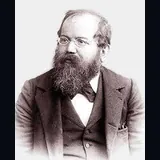
Wilhelm Steinitz, born in the Jewish quarter of Prague, became the first official world chess champion in 1886 and helped establish the positional approach to chess. His writings explained how pawn structure, piece placement, and small advantages could determine whether an attack would succeed. He also credited earlier masters, especially Louis Paulsen, with developing ideas that he brought into a systematic account of the game. He died in poverty on Wards Island in New York in 1900, after losing his title and suffering a mental breakdown.
Out of the Prague ghetto
Wilhelm Steinitz was born in 1836 in the Jewish quarter of Prague, one of the youngest in a large and poor family, and raised to study the Talmud. He learned the moves of chess at twelve. In 1857 he left for Vienna to study mathematics at the Polytechnic, and there the game took him over: he climbed from third in the Vienna city championship to first by 1861, winning thirty of thirty-one games and earning the nickname that announced his ambition — the Austrian Morphy.
He was never an imposing figure. Barely five feet tall and lame from birth, he carried a temper that made him as many enemies as admirers, and he would spend his whole life a poor manager of money. J. G. Cunningham's biographical sketch in The Games in the Steinitz–Lasker Championship Match (1894) adds that he had been “somewhat ailing from his youth upwards.” In its account, an attack of sunstroke in 1867 “greatly impaired his memory,” and insomnia at the start of important matches may explain the poor start he made in most of them. But across a chessboard the small man was without equal, and he knew it.
The conqueror of Anderssen
The 1862 London International was his first big international event. He finished sixth but won the tournament's brilliancy prize for a spectacular win over Augustus Mongredien, and he stayed in London, turned professional, and began beating the strongest players in Britain, among them the young Joseph Blackburne, who had been playing for barely two years.
Then, in 1866, he challenged Adolf Anderssen, who had been the world's best player since Morphy's retirement and the leading figure of the romantic attacking school. Over fourteen games in London, with no draws, Steinitz won eight and lost six. The match was played for £100 a side, and Cunningham's sketch records that Austrian newspapers called it “Sadowa revenged,” after Prussia's victory over Austria at Sadowa earlier that year. The result made him widely regarded as the best player alive. Ironically, the man who would later bring an end to romantic chess won that match playing exactly that way, all attack and combinations. His change of style came later.
Ten years later he beat Blackburne 7–0 at London's West End Chess Club, in a match played from February 17 to March 2, 1876. In Chess Match Between Messrs. Steinitz & Blackburne, his annotated account published that year, he warned against treating the score as a complete measure of strength: “It is a delusion to estimate the merits of two players by the score only.” Health, temperament, and physical strength mattered too. His account of the third game also showed his practical approach to competition. With Blackburne short of time, he deliberately made the position difficult, “even at the expense of correctness, and at some risk.” He equalized, and a later mistake by Blackburne gave him the win.
“It is a delusion to estimate the merits of two players by the score only.”
“Correctness of judgment and calculation ought to be chiefly cultivated in the exercise of our pastime, and it merely shows primitive taste to prefer brilliancy to soundness.”
“Among first-class masters the capture of the adverse King is the ultimate but not the first object of the game and by best play on both sides a draw ought to be the legitimate result.”
“If the editorial merits of this book should disappoint the anticipations of the Chess world, I can only plead in extenuation that they do not satisfy my own.”
“In the beginning of the game ignore the search for combinations, abstain from violent moves, aim for small advantages, accumulate them, and only after having attained these ends search for the combination — and then with all the power of will and intellect.”
“I who vanquished him must see to it that his great achievement, his theories, should find justice, and I must avenge the wrongs he suffered.”
“Steinitz was the first to realise that chess, despite being a complicated game, obeys some common principles. He pointed out that chess obeys laws that should be considered.”
“To a great extent Steinitz's theories—as apart from Steinitz's fads—have been abundantly justified in the process of the various games, and he may be said to have forged some of the keenest of the weapons that defeated him.”
The crown made official
For two decades Steinitz reigned by reputation, unbeaten in match after match. But there was no formal title — only the understanding that he was the strongest. In 1886 that changed. He met Johannes Zukertort, his great rival and the other claimant to supremacy, in a match played across New York, St. Louis and New Orleans and explicitly designated for the Championship of the World.
Zukertort raced to a 4–1 lead in the New York games. Then Steinitz's method took over. Steinitz won game after game while his opponent, exhausted and in failing health, managed only one more win in the last fifteen. The final score was 12½–7½. On March 29, 1886 Wilhelm Steinitz became the first official World Chess Champion. He defended the title against Mikhail Chigorin in Havana in 1889, against Isidor Gunsberg in New York in 1890–91, and against Chigorin again in 1892, a very close fight he won 12½–10½ when a single blunder by the Russian handed him the last game.
The revolution of small advantages
His change of style became clear at Vienna in 1873. In The Modern Chess Instructor (1889), he explained the modern school's emphasis on steady development, the balance of forces, and the accumulation of small advantages. He believed that correct play by both sides should lead to a draw, and that brilliant sacrifices usually became possible because someone had made a serious error. He also acknowledged predecessors. Discussing the strength of the two bishops, he credited Louis Paulsen with demonstrating it systematically in practice and called him “one of the chief pioneers of the modern school.”
It was heresy, and it was fought bitterly. Critics called the new method cowardly, dull, a betrayal of the game's spirit, and Steinitz waged the so-called Ink War through the chess press against Zukertort and Leopold Hoffer for years. He had the platforms for it: he had been chess correspondent of The Field in London, and in New York he founded and edited the International Chess Magazine. In 1889 he laid out his system in The Modern Chess Instructor. He held idiosyncratic convictions to the end — that the king was a strong piece that could fend for itself in the middlegame, that the defender's resources were deeper than anyone believed — and he proved them at the board. By the early 1890s the chess world had stopped laughing. It had started imitating him.
After his 7–0 victory over Blackburne in 1876, Steinitz spent six years away from serious competition. Kasparov describes this period in My Great Predecessors, Part I: Steinitz supported himself with simultaneous exhibitions, including blindfold displays, and his analysis for The Field.
His work also included organizing tournaments and preserving their games. The Book of the Sixth American Chess Congress (1891) lists him as secretary of the congress that held the New York tournament in 1889. Its committee report records that, when the book faced a financial deficit, he gave up his original entitlement to copies; the committee arranged compensation of $500 and ten copies instead. In his preface he explained that printing costs had forced him to shorten the annotations and reduce the number of diagrams. He opened with a candid assessment: “If the editorial merits of this book should disappoint the anticipations of the Chess world, I can only plead in extenuation that they do not satisfy my own.”
The long defeat
In 1894 a 25-year-old named Emanuel Lasker challenged the 58-year-old champion — the widest age gap in the history of the title. Steinitz, confident and inclined as ever to test experimental ideas, defended the Ruy Lopez with his own system and, in the New York games, lost three of the four in which he used it and drew the other. Leopold Hoffer, his old opponent in the chess press, found it strange that he should persist in a defence that compelled him “to repudiate fundamental principles that he has been professing for years.” Cunningham's book calls the three Philadelphia games, all lost, a display of “Steinitz at his very worst.” Lasker won the match 12–7, the first serious match defeat of Steinitz's life. A rematch in Moscow in 1896–97 was worse, a 12½–4½ rout, and shortly after it Steinitz suffered a breakdown and was confined for forty days in a Moscow sanatorium.
His last years were a slow ruin. His daughter Flora had died at twenty-one; his first wife followed; money, never his friend, abandoned him entirely. He spent his final months in institutions in New York, and on 12 August 1900 he died of a heart attack on Wards Island, penniless. His widow kept the family afloat by running a small shop. The first champion of the world had given chess its modern mind and had almost nothing left for himself.
Legacy
Steinitz was buried in the Cemetery of the Evergreens in Brooklyn, survived by his second wife and two young children. He is remembered, with Paul Morphy, as the founder of modern chess: the man who replaced inspiration with method and showed that the game obeys laws. Emanuel Lasker, the man who took his crown, made it his life's debt to defend the old champion's ideas — and chess kept that promise for him. Every player who speaks of pawn structure, weak squares, the two bishops, or the right to attack is speaking Steinitz's language, more than a century after the small man from the Prague ghetto first wrote it down.
Books
Books William Steinitz wrote, co-wrote, edited, or contributed to. Translations and reprints are grouped under the same work.
-
The Chess Match Between Messrs. Steinitz and Blackburne
Author — game annotations
-
The Book of the Sixth American Chess Congress
Editor and annotator
-
The Lasker–Steinitz Match for the Chess Championship of the World
Contributor — game annotations
-
The Hastings Chess Tournament, 1895
Contributor — game annotations
-
The Modern Chess Instructor, Part I
Author
-
The Modern Chess Instructor, Part II
Author