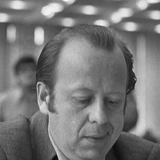
Wolfgang Uhlmann was East Germany's most successful chess player from the mid-1950s to the late 1980s. A baker's son from Dresden, he learned chess from his father and studied it without rest through a year and a half in a tuberculosis sanatorium as a teenager. He won the East German Championship eleven times, played eleven Olympiads, took the gold medal on top board at Tel Aviv in 1964 and reached the Candidates in 1971. Above all he was the great authority on the French Defence, which he played against 1.e4 almost without exception for his whole career, and with which he beat Bobby Fischer.
Dresden
Uhlmann was born in Dresden on 29 March 1935, the son of a baker, Alfred, who taught him the game. At sixteen he contracted tuberculosis and spent a year and a half in a sanatorium, where he studied chess relentlessly.
In Winning with the French he recalled his first major chess success: winning the East German Junior Championship at Leipzig in 1951, aged sixteen, by a margin of 1½ points. The French was already his favorite reply to 1.e4. He still called his victory over Wolfram Bialas there "a little gem in my collection" (game 1, p. 12).
He trained as a letterpress printer, but chess never left him time to practise the trade. He won the East German Championship in 1954, 1955 and 1958, became an International Master in 1956 and a grandmaster in 1959, and lived in Dresden all his life.
East Germany's first board
Between 1956 and 1990 Uhlmann played eleven Olympiads for East Germany, mostly on top board. At Tel Aviv in 1964 he scored 15 out of 18 and won the individual gold medal on first board, and at Havana in 1966 he took the bronze with 13 out of 18.
In 1964 he shared first place with Lev Polugaevsky at Sarajevo and with the former World Champion Vasily Smyslov at the Capablanca Memorial in Havana. He shared first with Borislav Ivkov at Zagreb in 1965, ahead of the World Champion Tigran Petrosian, with Boris Spassky at Hastings 1965/66, and with David Bronstein at Szombathely in 1966 and at the Lasker Memorial in Berlin in 1968.
“When played correctly, the French Defence is a real joy, it is always interesting and leads to extremely hard-fought contests.”
“Since as a rule many players like to follow the lead of others, one always needs to have an improvement at the ready, albeit only a subtle one.”
“During all this time his faith in this move has been unshakeable, and his successes entirely justify his choice.”
The Candidates
In 1969 he won the zonal tournament at Raach by two points, ahead of a field that included Lajos Portisch. At the Palma de Mallorca Interzonal of 1970 he finished sixth, which took him into the Candidates matches of 1971. There he lost his quarter-final to Bent Larsen, 5½–3½. It was the closest he came to the World Championship.
He went on winning into the 1970s and 1980s. He shared first place with Bronstein and Vlastimil Hort at Hastings 1975/76, finished second to Anatoly Karpov at Skopje in 1976, and won Halle in 1981 by a full point.
The French Defence
Uhlmann was one of the world's leading experts on the French Defence, and particularly on the Winawer Variation, many of whose lines he refined. He was one of very few grandmasters to answer 1.e4 with the French almost exclusively, and he set out his lifetime's experience of it in Ein Leben lang Französisch (1991), published in English as Winning with the French (1995). The English edition, translated by Malcolm Gesthuysen and updated by Andrew Harley, contains sixty annotated games. In the preface Uhlmann explained that his annotations concentrated on the plans and an accurate assessment of each position (p. 8).
He also included defeats and draws. At Madrid in 1973, the twenty-two-year-old Anatoly Karpov beat him in a game that received the brilliancy prize. Uhlmann then returned to the opening: "After my defeat against Karpov I did a great deal of analysis." Against Lothar Vogt at Potsdam in 1974 he brought his rook to e8 earlier, gained a tempo and won. He presented the two games together in Winning with the French, showing how he revised his play after a loss (games 19–20, pp. 51–55).
He kept playing into old age. In 2012, at 77, he was one of the "Old Hands", with Oleg Romanishin, Hort and Friðrik Ólafsson, in a match against a team of young women masters, and ChessBase called his win against Alina Kashlinskaya the most beautiful game of the event, played in the style of the young Mikhail Tal.
Legacy
Uhlmann died in Dresden, the city where he had lived his whole life, on 24 August 2020, at the age of 85, after a fall; he had lived with the after-effects of his childhood tuberculosis for most of his life. He was survived by his wife, Christine, two children and two grandchildren. His book on the French Defence, and the Winawer lines he refined, remain his lasting contribution to the opening.
Books
Books Wolfgang Uhlmann wrote, co-wrote, edited, or contributed to. Translations and reprints are grouped under the same work.
-
The French Defence
Coauthor — Svetozar Gligoric
-
Offene Linien: Strategie für die Schachpraxis
Coauthor — Gerhard Schmidt
-
Bauernschwächen
Coauthor — Gerhard Schmidt
-
Gute Läufer – schlechte Läufer
Coauthor — Lothar Vogt
-
Winning with the French
Author
-
Meine besten Partien
Author