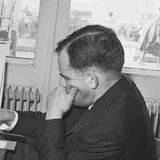
After the Second World War, and until about 1970, Wolfgang Unzicker was the strongest chess player in Germany, and he never played for a living. He studied law, became a judge and took his holidays to play tournaments. In those years he won the German championship seven times, played first board for West Germany at ten Olympiads and beat four World Champions: Bobby Fischer, Mikhail Botvinnik, Vasily Smyslov and Mikhail Tal. Anatoly Karpov called him the "world champion of amateurs". He played 386 times for the national team, a German record, and at eighty he was still playing first board for a Munich club.
Pirmasens and Munich
Unzicker was born on 26 June 1925 in Pirmasens, in the Palatinate. In 1931 the family moved to Munich, where his father, Eugen, had taken a post as a secondary-school teacher, and Wolfgang later went to school at the Theresien-Gymnasium, where his father taught.
He learned the game in the summer holidays of 1935, when he was ten. Two boys from Pirmasens came to visit and played with his father and his older brother Gerhard, and Wolfgang was the only one who could not play, so his father taught him the rules. That December the brothers played a thirty-game match in imitation of the Alekhine–Euwe world championship match of the same year. Wolfgang led after 28 games, lost the last two, and Gerhard won 15½–14½.
In 1939, at fourteen, he was invited to a training course for young talents run by Willi Schlage, where the other pupils included Klaus Junge. Schlage wrote that the boy's aggressive, imaginative play gave good grounds for hope, and that he knew a surprising amount of opening theory for his age. Gerhard Unzicker was killed on the Eastern Front in January 1945.
After the war
In 1946 Unzicker won a master tournament at Regensburg ahead of Paul Tröger, and in September he won at Augsburg with 14 points from 16 games. In 1948 he won the German championship at Essen, and he and Friedrich Sämisch became the first German players invited to a tournament abroad after the war, at Lucerne. Unzicker won it.
West Germany was readmitted to FIDE in 1950. At the Dubrovnik Olympiad that year Unzicker played first board, scored 11 points from 14 games (+9 −1 =4) and shared the prize for the best result on that board with Miguel Najdorf. He became an International Master in 1950 and a Grandmaster in 1954. He qualified for two Interzonal tournaments, Saltsjöbaden 1952 and Gothenburg 1955, but did not reach the Candidates, and in 1953 he won the only all-German championship, held in Leipzig with players from East and West.
In 1956 he lost a friendly match in Hamburg to Paul Keres, with four losses and four draws. All eight games were Ruy Lopezes.
“Fischer also lost this game because of his fairness, and I have never derived pleasure from this win.”
“world champion of amateurs”
“Wolfgang had a phenomenal memory. I suppose that was one reason for his strength.”
“I am certain that Wolfgang would have been a World Championship candidate had he been a chess professional.”
Four World Champions
At Buenos Aires in 1960 he beat the seventeen-year-old Bobby Fischer. On move 12 Fischer touched his h-pawn, intending ...h6, then saw that White could answer Bxh6. Under the touch-move rule he had to play ...h5, which weakened his kingside, and he resigned ten moves later. Unzicker said afterwards that he would not have protested if Fischer had moved another piece, and that the win had never given him any pleasure.
At the European Team Championship in Oberhausen in 1961 he had the second-best result on first board, behind Mikhail Botvinnik, who had just won back the world title from Mikhail Tal. Unzicker beat Botvinnik with White in a Winawer French. ChessBase has described it as the first time after the Second World War that a German player had beaten the reigning World Champion in a tournament game.
At the Tel Aviv Olympiad in 1964 he scored 13 points from 18 games on first board and beat the former World Champion Vasily Smyslov in West Germany's 3–1 win over the Soviet Union. West Germany took the bronze medals. In 1975 at Milan he beat Mikhail Tal, a game Vlastimil Hort later called very impressive, and he beat Tal again in the Bundesliga in 1989.
A judge who played chess
Unzicker began studying law at the University of Munich in 1948. He worked as a civil servant in the government of Upper Bavaria and from 1971 as a judge at the Administrative Court in Munich, where he was a presiding judge until 1990. In 2005 he told ChessBase that a professional chess career had seemed too insecure in the West and that he had not wanted to give his whole life to chess. After the Varna Olympiad of 1962 his work left him less time for individual tournaments.
Even so, he tied for first place with Boris Spassky at the Chigorin Memorial in Sochi in 1965, won at Maribor in 1967 ahead of Samuel Reshevsky, and won at Krems. At the second Piatigorsky Cup in Santa Monica in 1966 he shared fourth place with Lajos Portisch, behind only Spassky, Fischer and Bent Larsen and ahead of the World Champion Tigran Petrosian. He was second to Portisch at Hastings 1969–70, and in South Africa in 1979 he finished second to Viktor Korchnoi, with a performance rating of 2724.
He was usually described as a classical player in the tradition of Siegbert Tarrasch, but he considered himself more of a tactical fighter than a strategist. As a boy he had watched Kurt Richter's combinations at the 1936 Olympiad in Munich, and Richter's book on combinations became an early inspiration. Hort, who became a friend, wrote that Unzicker could recall some 200 model games with their variations and analysis, and that as a judge he wanted water-tight proofs and had no use for assumptions and half-truths.
Karpov recalled a less restrained moment after their game at the Nice Olympiad in 1974. In Kasparov's Garry Kasparov on My Great Predecessors, Part V, he describes Unzicker suddenly cursing his position in Russian and complaining that his black knight could not escape its cage. Hearing the complaint in Russian surprised Karpov (p. 285, after Game 66).
The national team and later years
Between 1950 and 1982 Unzicker played at thirteen Olympiads, ten of them on first board, and made 386 appearances for the national team, a German record. He played for the Münchener SC 1836, with which he won the German team championship eight times, and he was still playing in the Bundesliga in his seventies.
From 1991 to 2003 he was legal adviser to the German Chess Federation, and in 1994 he wrote a legal opinion for it concluding that players hold no copyright in the games they play. In 1958 he became an International Judge of chess composition for endgame studies. He wrote Vierzig eigene Partien (1962), a collection of his own games, a Geschichte des Schachspiels with Jacob Silbermann (1975) and the instructional book Knaurs Neues Schachbuch (1975). He married the watercolor painter Freia in 1963, and they had three sons.
Legacy
Unzicker died of heart failure on 20 April 2006, during a holiday in Albufeira, Portugal, at eighty. The year before, the Chess Classic in Mainz had held an Unzicker Gala for his eightieth birthday, at which he played Anatoly Karpov, Viktor Korchnoi and Boris Spassky. He received the Silver Laurel Leaf in 1954 and the Federal Cross of Merit in 1995, and the German Chess Federation made him an honorary member in 2003. ChessBase has described him as the best German player after Emanuel Lasker until Robert Hübner reached the world's top.
Books
Books Wolfgang Unzicker wrote, co-wrote, edited, or contributed to. Translations and reprints are grouped under the same work.
-
Vierzig eigene Partien
Author
-
Second Piatigorsky Cup International Grandmaster Chess Tournament
Contributor — own game annotations
-
Geschichte des Schachs
Coauthor — Jacob Silbermann
-
Knaurs neues Schachbuch: Für Anfänger und Fortgeschrittene
Author
-
Schach für Kenner
Author
-
Bobby Fischer: From Chess Genius to Legend
Coauthor — Eduard Gufeld, Mike Morris, Carlos Almarza-Mato