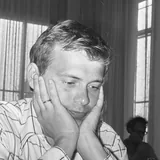
Yuri Razuvaev was a Moscow grandmaster who studied in Mikhail Botvinnik's group as a teenager, graduated in history from Moscow State University, and played in Soviet championships from 1973 to 1985. He beat the fifteen-year-old Garry Kasparov at Tbilisi in 1978 and took first place at London in 1983 and shared first at Dortmund in 1985. His deepest mark was as a trainer: he worked with Anatoly Karpov for seven years, coached Soviet and Italian national teams, and helped Alexandra Kosteniuk, who became Women's World Champion in 2008.
Moscow and the Botvinnik School
Razuvaev was born in Moscow on 10 October 1945. In the early 1960s he studied in Mikhail Botvinnik's group, where his logical, positional style took shape and where, at the first sessions in 1963, he met Anatoly Karpov. Yuri Balashov and Gennady Timoshchenko were in the group as well.
He graduated from the history faculty of Moscow State University and captained the university chess team, playing on its top board. Boris Gulko, who met him at the Central Chess Club and later played beside him for the university, lost a long run of games to him and recalled that the young players of the time spoke of him with awe.
Grandmaster
Razuvaev became an International Master in 1973 and a grandmaster in 1976, and he played in a series of Soviet championship finals between 1973 and 1985. In the 1978 final at Tbilisi he beat the fifteen-year-old Kasparov in a Najdorf Sicilian.
He took first place at Polanica-Zdrój in 1979 and London in 1983, and shared first at Dubna in 1979, Zalaegerszeg in 1981, Dortmund in 1985 and Jūrmala in 1987. His highest rating was 2625, in July 1983. Gulko wrote that he lacked a killer instinct and sometimes agreed to draws in positions where he stood much better, including games against Vasily Smyslov and Mikhail Tal, whom he greatly respected.
His notes in Devoted to Chess (pp. 76–78) describe how he prepared for Wolfgang Uhlmann at Amsterdam in 1975. After a dispiriting loss to Svend Hamann, he spent the evening looking for an improvement against the Grünfeld Defense. The preparation led to a win over Uhlmann with a kingside attack; his annotations also admit where he could have played more precisely.
“Such a combination cannot be calculated to the end, and this is the main difficulty in taking a decision in similar situations.”
“My hand falters, with flag hanging.”
“It was essential for him constantly to feel resistance – then he would be turned on and find the “guiding thread”.”
“He was not just the strongest of all, he also had a unique style, won extraordinary games against opponents of all kinds.”
“I am sure that studying the creative heritage of Yuri Razuvaev will bring you great benefits.”
London 1984
At the second USSR versus Rest of the World match, in London in 1984, Razuvaev took the place of Tigran Petrosian, who was ill, on the eighth board. His opponent was the much higher-rated Robert Hübner, and all four of their games were drawn.
The trainer
Razuvaev was a second to Karpov from 1971 until 1978, stepping down before the world championship match with Viktor Korchnoi. He was named an Honored Coach of the RSFSR and was trainer of the Soviet team at the European Team Championships of 1977 and 1980 and the 1980 Olympiad, and later of the Russian team. Gulko recalled that, as trainer of the Soviet team, Razuvaev fought for the young Vladimir Kramnik to be included. In 1994 he helped Gulko prepare for his Candidates match against Nigel Short.
In Part V of My Great Predecessors (p. 221), Kasparov traces the Karpov collaboration to the Student Olympiad in Puerto Rico in 1971. After that event, Karpov asked his teammates Razuvaev and Balashov to help him and Semyon Furman in the next world championship cycle. Razuvaev's memoirs in the same volume describe Karpov practicing positions from both sides, changing colors roughly once an hour. At a training session outside Leningrad, Tal and Karpov played blitz from a set position while Razuvaev recorded Tal's ideas in a thick notebook (pp. 293–294).
He continued to contribute after leaving Karpov's regular team. During the 1981 match with Korchnoi in Merano, the USSR Sports Committee's deputy head, Ivonin, summoned Razuvaev and Efim Geller to his office to find a Ruy Lopez novelty. Razuvaev recalled a chessboard, paper, mineral water and caviar sandwiches waiting for them; Ivonin then locked the door and left them to analyze for the day. Their idea, 13.Ne4, reached Karpov through Igor Zaitsev and was used in his win in game fourteen. Razuvaev recounts the episode in My Great Predecessors, Part V, p. 373.
Kramnik's foreword to Devoted to Chess (pp. 11–12) supplies his own account of joining the Russian team. At the closing reception in Dortmund in 1992, Razuvaev told the sixteen-year-old that he and Kasparov wanted to take him to the Olympiad. They overcame opposition in Moscow by accepting responsibility for the choice. Razuvaev shared a room with Kramnik at the Manila Olympiad, beginning a friendship that lasted for years.
From 1999 to 2009 he trained the Italian men's team. His pupils included Alexandra Kosteniuk, who won the Women's World Championship in 2008, and Evgeny Tomashevsky, and the players he worked with also included Kramnik, Boris Gelfand, Joël Lautier, Laurent Fressinet, Valery Salov and Veselin Topalov. FIDE made him a Senior Trainer in 2005, and for many years he headed the FIDE Trainers' Committee.
Writer and historian
ChessBase described Razuvaev as a historian by profession who also made his name as a chess journalist. With Valery Murakhveri he wrote Akiba Rubinstein (1980), and with Gennady Nesis a short book on the transition to the endgame (1981). In his last years he led the Chess Hopes of Russia project for school chess.
Kasparov's My Great Predecessors quotes his analysis of Rubinstein's games, including the bishop sacrifice against Teichmann at Vienna in 1908: Razuvaev stressed the difficulty of committing to a combination that could not be calculated to its end. Part IV also credits him with developing the 13.h4 gambit in a Queen's Gambit line, illustrated by his attacking win over Ivan Farago at Dubna in 1979 (Game 32, note to 13 Qc2).
Razuvaev died in Moscow on 21 March 2012 after a long illness and was buried at the Pyatnitskoye Cemetery. In 2019 New in Chess published Devoted to Chess, compiled by Boris Postovsky with a foreword by Kramnik, which collects his best games, his articles and the recollections of the players he taught.
Legacy
Razuvaev's own results placed him among the leading Soviet grandmasters of the 1970s and 1980s, and his work as a trainer reached further. He prepared Karpov in the years before Karpov became World Champion, backed Kramnik for the Soviet team, coached the Italian team for a decade, and worked with Kosteniuk before her world title. Carlsen and Caruana also had sessions with him.
Books
Books Yuri Razuvaev wrote, co-wrote, edited, or contributed to. Translations and reprints are grouped under the same work.
-
Akiba Rubinstein
Coauthor — Valery Murakhveri
-
Die Kunst der Vereinfachung, Band 1
Coauthor — Gennady Nesis
-
The Anti-Sicilian: 3 Bb5(+)
Coauthor — Aleksander Matsukevitch
-
Key Concepts of Gambit Play
Author — later edition updated by Jacob Aagaard
-
Devoted to Chess: The Creative Heritage of Yuri Razuvaev
Contributor — collected writings and game annotations; compiled by Boris Postovsky