EVENTS ·
Historical tournaments and their surviving scores
Tournament archives add original standings and explain the limits of their surviving scores.
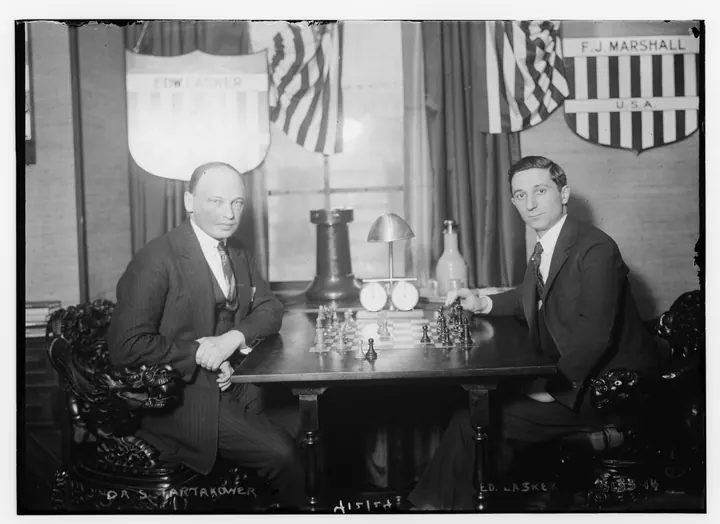
Bradley Beach’s 1928 National Chess Federation championship adds all twenty-eight pairings. Abraham Kupchik won with 5/7, ahead of Israel Horowitz and Edward Lasker on 4½. The page gives the original standings, distinguishes the Federation title from the U.S. championship, and explains differences in published score versions. Chester’s 1934 British Championship adds all sixty-six games. Sir George Thomas won unbeaten with 8½/11, a point ahead of William Fairhurst and Reginald Michell. The full table preserves the shared places, and four existing Harry Golombek games keep their archive identities and study links. Viña del Mar 1947 adds twenty-one records, including an ending. Ståhlberg’s 8/10 and the full standings are sourced; the whole played-game total remains unknown. Lucerne’s 1951–52 Christmas tournament adds all twenty-eight played scores. Original reports confirm Unzicker’s unbeaten 6/7, every final total and the closing rounds at Hotel Rebstock. Sweden 1952 adds four scores, including the third title-playoff game. Original reports establish thirteen main entrants and Stoltz’s 3½–½ playoff win; the whole played total remains unknown.
Prague’s 1931 pre-Olympiad tournament adds five surviving scores. Gösta Stoltz won with 8/11, ahead of Vasja Pirc and Salo Flohr. The page gives all twelve historical totals, identifies at least seventeen published scores missing from the approved archives, and explains why the incomplete record cannot support a computed cross-table. Prague’s 1933 city championship adds eleven surviving records and the contemporary final totals. Karel Opočenský won with 11 points, ahead of Dr. Jäger and Pelikán. The page explains Runza’s unresolved connection to the final field and leaves the physically played total unknown. Prague’s 1943 congress championship adds sixty-five main-event scores and all six games of the required title playoff. Zíta won the playoff on 3/4 after sharing the main-event lead with Foltys and Opočenský on 7/11. The page keeps their separate standings and explains the unrecorded Thelen–Hromádka result, its unverified played/default status and the conflicting publication counts. Bariloche 1953 adds all forty-five scores; its page explains why the preserved results disagree with the original report naming Eliskases the winner on 6½/9.
Two separate Moscow qualifying groups from the 1931 Soviet championship add twenty-six surviving scores. Kasparian won Group 4; Sozin and Lisitsin shared first in Group 8. The original tournament book supplies both final tables and proves a corrected Khodzhaev attribution and the placement of Kaspersky–Sozin in Group 8. Eliskases–Souza Mendes in Rio de Janeiro adds seven of the ten match scores. The published result ledger gives Eliskases a 7–3 victory and identifies the three missing scores: two draws and an Eliskases win. The seven held games yield 5–2. The reported 4 April–8 June 1944 span is explained alongside the preserved April-only source dates. Santiago de Chile 1946 adds fifteen recorded pairings from Stahlberg’s unbeaten 4½/5 victory. All six original final totals agree. The Flores–Schroeder one-move stub is preserved with a visible warning that its opening differs from the longer newspaper score; no outside moves replace the approved record. Riga’s 1951 Soviet quarterfinal adds eight scores and all sixteen original yearbook totals. Chaplinsky won on 10/15; the whole played-game total remains unknown.
Linz 1934 adds five surviving scores and the original fourteen-player final table. Albert Becker and Erich Eliskases shared first on 11/13, ahead of Hans Müller. The contemporary ordinary-result matrix supports 91 played games; eighty-six scores remain unavailable in the approved archives. Luhačovice’s 1935 Olympic selection trial adds all twenty-eight scores, each matched to the original eight-player table. Karel Opočenský won with 5/7. The contemporary report names Opočenský, Rejfíř and Pelikán as qualifiers for the separate Warsaw Olympiad; it does not explain the selection rule among the tied runners-up. Arbon 1946 adds twenty-four recorded pairings from the triple first place of Opočenský, Pachman and Yanofsky. Nine short openings and one ending remain intact. The original eight final totals are given; four other published pairings lack scores, and the whole played-game total remains unknown. Utrecht 1950 adds all twenty Netherlands–Yugoslavia scores. Original reports establish the ten-board, two-round match and Yugoslavia’s 14½–5½ win. Stuttgart 1954 adds ten scores from Pilnik’s 9½/11 victory. The later full table records sixty-six games; fifty-six scores are missing.
Two separate Zürich tournaments add twelve preserved scores. Eliskases won all ten games at Neumünster in 1935; four survive, while contemporary reports leave the whole-event played total unknown. His 1936 Easter victory is represented by eight of fifteen played games and the complete original final table. Both pages explain the surviving record and its gaps. Birmingham’s 1937 international adds thirteen preserved scores and all eleven official final totals. Eliskases and Prins shared first on 8½. The contemporary round report identifies one default, leaving 54 played games. Three scores begin from recorded positions; the page explains a player-name conflict and leaves the computed table hidden. Leeuwarden’s 1947 Philidor centenary adds five Group A scores, including a source-guarded correction placing Kramer on White against O’Kelly. The two international groups’ full totals are given separately; fifty-one of their fifty-six played scores remain missing. Budapest 1954 adds all forty-eight Triennial Cup board scores. Hungary won the official competition on eleven points; its reserve team’s results are shown separately.
Örebro’s 1938 Nordic Congress premier class adds seven preserved scores. Gideon Ståhlberg won with 9/11. The original table supports 66 played games by inference, leaving 59 scores missing. Its Larsson–Lundin result conflicts with the complete printed score; the page preserves that disagreement and distinguishes the class victory from the Nordic title rule adopted for the following year. Choceň 1942 adds all sixty-six scores in the original final table, won by Katětov on 8½/11, and three separately identified companion scores. Those companions remain available alongside an explanation of their uncertain circumstances and stay outside the official table. Keller–Opočenský keeps its recorded unknown result. The page uses the original book’s dates, 26 July–6 August, while preserving the game headers. Austria–Hungary in Vienna 1947 adds twelve of twenty played scores. Original reports establish Hungary’s 13½–6½ win, both ten-player rosters and all twenty results. Eight scores are missing; the native Florian–Keller May date remains alongside the documented April chronology. Manhattan’s 1956–57 championship now has 79 scores; Bisguier won with 8½/11 including semifinal carryover.
Vienna’s 1939 Wertungsturnier adds all twenty-eight scores, matching the original final totals: Eliskases won unbeaten on 5½/7. The 1941 Georgian championship adds fifteen scores from 190 ordinary pairings; Ebralidze won on 15/19. Its page identifies historical Tbilisi alongside the preserved Kutaisi headers, includes the three off-contest guests and explains Kasparian–Mikenas’s unrecorded continuation. Stoltz–Karlin in Stockholm adds all eight match scores, with Stoltz winning 6–2 without a loss. The contemporary report dates the Wasa anniversary match from 28 December 1941 to 6 January 1942; all preserved February 1942 game dates remain unchanged and are explained. Every recorded move agrees with the eight original printed scores. Stoltz–Sundberg adds one score from two six-game sets in Stockholm in 1942. The original report gives Stoltz 4–2 in each set, or 8–4 overall; the second set used Alekhine’s Defence throughout. Eleven scores remain missing, and the held game’s original match position is unknown. Aalborg 1947 adds all 45 scores, with Poulsen and van Scheltinga sharing 6½/9. All 90 original result cells agree; source dates and moves are preserved.
Two Washington Divan collections add nine scores. The 1944 special rapid tournament preserves four Fine wins; its full field and final outcome remain unverified. The separate 25 April 1945 blindfold rapid exhibition preserves five of ten games, including the Cantwell draw. Fine scored 8½–1½ while playing two games at a time at ten seconds per move. Five exhibition scores remain missing. Harrogate’s 1947 British Championship adds thirty-four main-event records and all six London playoff games. Golombek and Broadbent tied on 8/11 before Golombek won the title match 4–2. Eight endings and four opening prefixes remain intact; thirty-two main scores are missing, with the 66-game main total explicitly identified as an inference from the compiled table. São Paulo 1948 adds eight scores and all fourteen published totals, led by O’Kelly on 11½. The later source explicitly lists ninety-one games played; its eighty-three-score gap and the missing contemporary default census are disclosed. Kyiv 1954 adds thirty-four scores and all nineteen original totals. Khavin won with 13/18; the complete ordinary-result table supports 171 games, with 137 scores missing.